
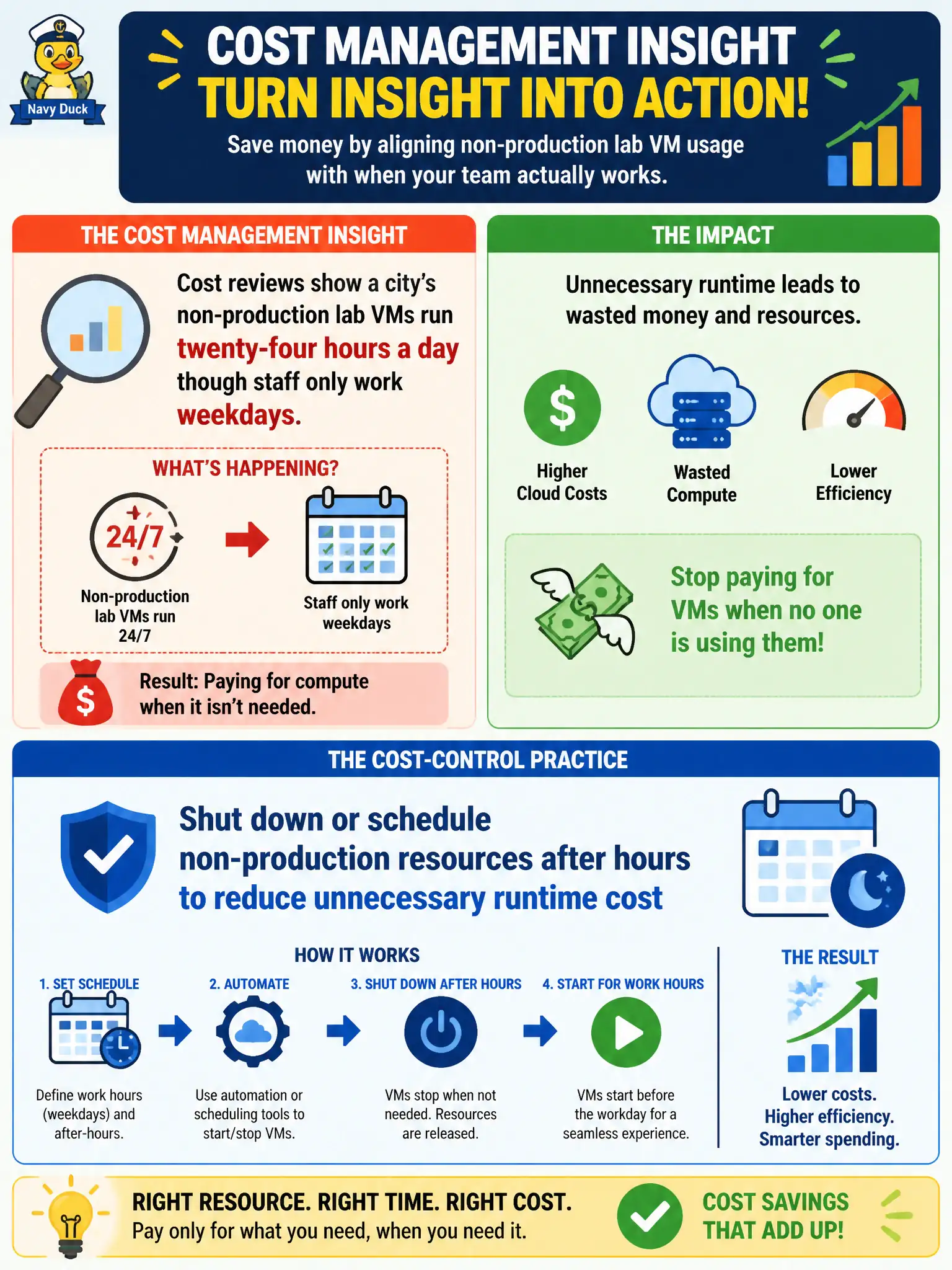
Cost reviews show a city's non-production lab VMs run twenty-four hours a day though staff only work weekdays. Which cost-control practice follows from that Cost Management insight?
Select an answer to reveal the explanation.
Short Explanation
If the workshop is empty at night, turn off the machines. Cost visibility pointed at always-on lab VMs, so scheduling shutdowns after hours is the sensible savings move. Insights should drive actions, not just pretty charts.
Full Explanation
Cost Management insights should drive concrete savings actions. When reviews show non-production lab VMs running twenty-four hours a day though staff only work weekdays, the appropriate cost-control practice is to shut down or schedule those resources after hours to cut unnecessary runtime meters. Always-on labs are a classic waste pattern in municipal estates; scheduling aligns spend with actual need without deleting identity platforms or disabling observability. Visibility without action leaves the bill unchanged.
Deleting Microsoft Entra ID is not a compute-cost fix and would break identity for the city. Disabling Azure Monitor permanently across subscriptions sacrifices operational visibility and is not a proportional response to lab VM waste. Converting production databases to unmanaged public endpoints increases security risk and is unrelated to after-hours lab scheduling.
Exam caveat: confirm labs are truly non-production and that overnight jobs are not silently required before forcing shutdowns—schedule around legitimate batch windows so savings do not break civic processes. Operational check: tag or inventory lab VMs, apply an automation schedule for weekday business hours, verify in Cost Management that compute meters drop overnight and on weekends, and document the exception process for approved after-hours testing.