
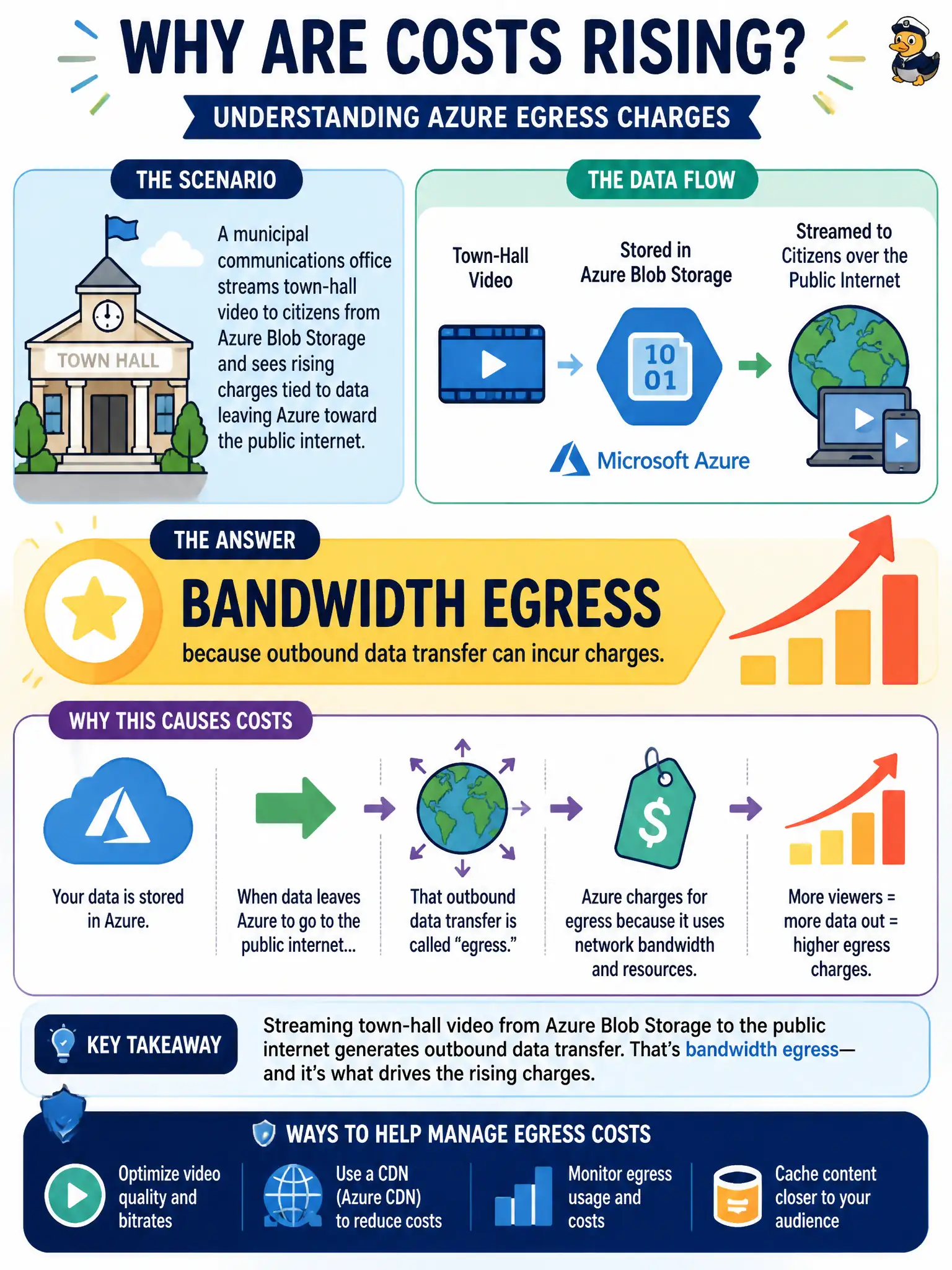
A municipal communications office streams town-hall video to citizens from Azure Blob Storage and sees rising charges tied to data leaving Azure toward the public internet. Which cost factor is primarily at work?
Select an answer to reveal the explanation.
Short Explanation
Shipping bits out of the cloud is like postage — volume adds up. Azure often meters data leaving its datacenters toward the internet. Heavy citizen streaming means egress bandwidth becomes a cost factor, not just storage sitting quietly.
Full Explanation
Outbound data transfer (egress) is a recognized Azure cost factor. When a municipal communications office streams town-hall video from Blob Storage to citizens on the public internet, bytes leaving Azure toward those endpoints are typically metered as bandwidth. Storage capacity still matters, but rising charges tied specifically to data leaving Azure point to egress rather than catalog tooling or hybrid registration. Inbound transfer is often treated more favorably than outbound, which is why public media and download-heavy civic apps watch egress closely.
Microsoft Purview catalog completeness improves data discovery and governance; it does not meter streaming egress. Azure Arc connected-server counts relate to hybrid management of non-Azure machines, not Blob-to-internet transfer charges. The number of ARM templates stored in a repo or library is configuration inventory, not a bandwidth bill driver.
Exam caveat: some patterns (CDN, caching, regional placement closer to viewers, or private connectivity designs) can change how and how much egress appears—do not treat "all outbound always costs the same" as absolute. Operational check: in Cost Management, filter or group by bandwidth/egress-related meters for the storage account or related networking, correlate spikes with town-hall stream windows, and confirm whether a CDN or caching layer is warranted before increasing origin egress further.