
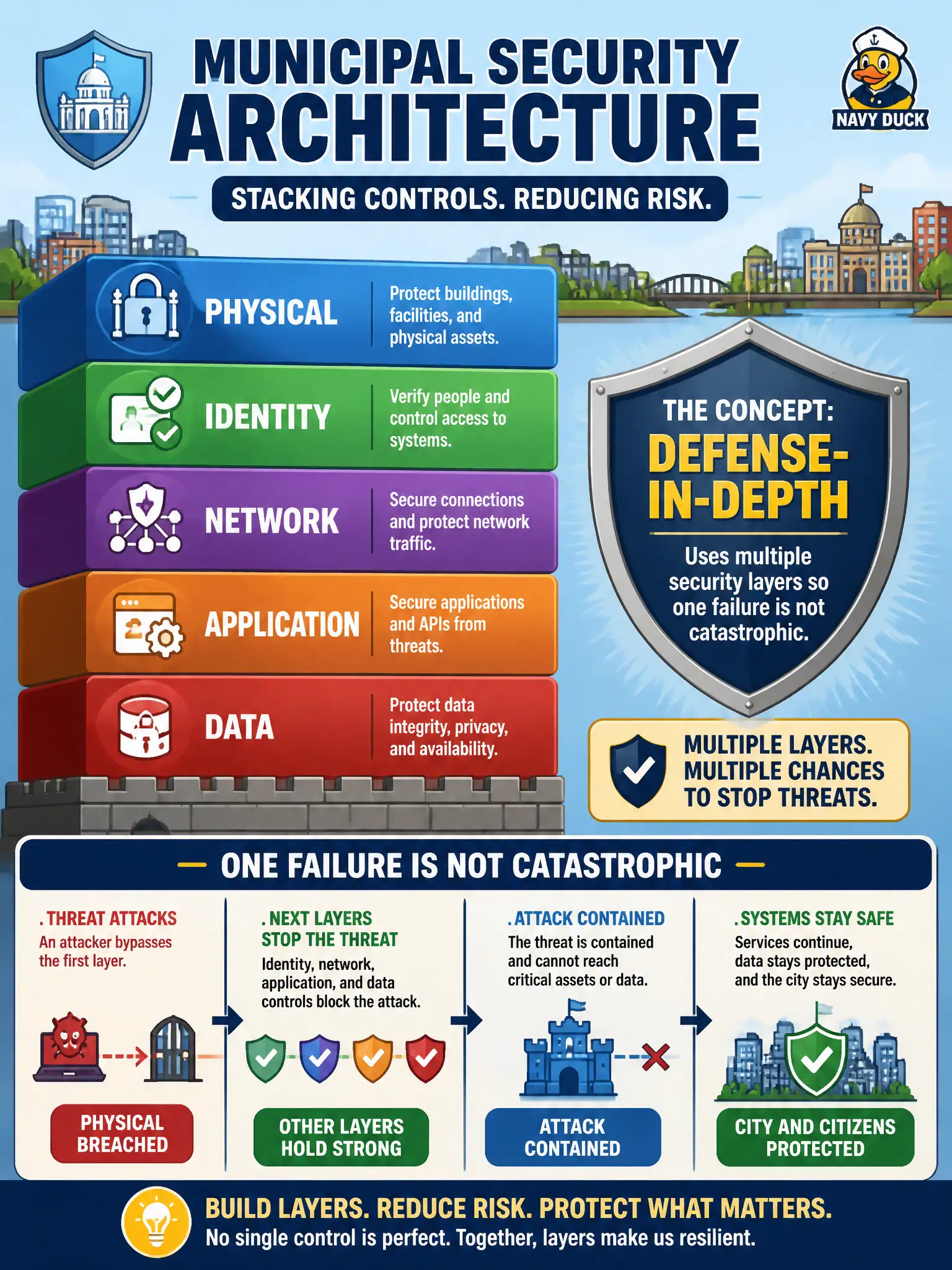
A municipal security architecture stacks physical, identity, network, application, and data controls so one failure is not catastrophic. Which concept does that layered approach describe?
Select an answer to reveal the explanation.
Short Explanation
Defense-in-depth is security lasagna—layers from the building to the data. If one layer fails, the others still matter. Betting everything on one password is the opposite idea.
Full Explanation
Defense-in-depth is the practice of stacking multiple independent security controls across layers so that failure or bypass of one control does not immediately yield catastrophic compromise. A municipal architecture that combines physical protections, identity controls, network filters, application safeguards, and data protections illustrates that model: an attacker who defeats one layer still faces others. At Azure Fundamentals depth, recognize defense-in-depth as layered risk reduction rather than reliance on any single “best” control.
Single-factor passwords as the only municipal control concentrate risk in one secret and do not constitute layered defense. Pay-as-you-go compute sizing is a billing choice and adds no security layers by itself. Geo-redundant storage improves data durability across regions but cannot replace identity, network, and application controls if presented as the sole safeguard.
Exam caveat: defense-in-depth and Zero Trust are related but not identical—Zero Trust emphasizes continuous verification and least privilege; defense-in-depth emphasizes multiple layers. Questions may use either framing.
Operational check: inventory municipal controls by layer (physical, identity, network, application, data), identify any single point of failure where only one control protects a critical path, and add a compensating control before the next security review.