
During a council briefing, someone asks which Azure portal toggle turns on Zero Trust as a single product. What is the accurate fundamentals response?
Select an answer to reveal the explanation.
Short Explanation
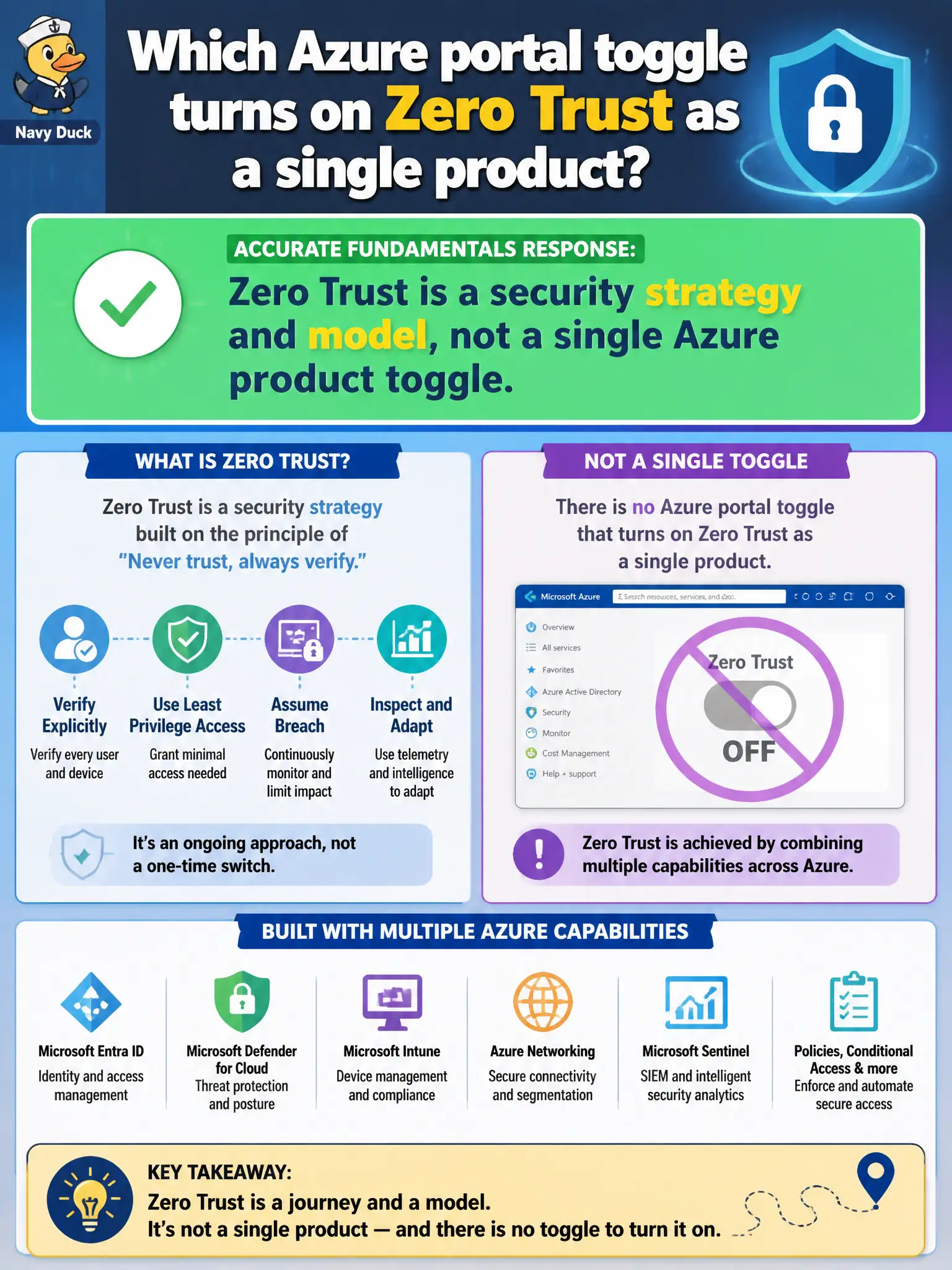
Zero Trust is a way of thinking and a layered approach—not a magic "on" switch in the portal. Cities apply it across identity, devices, apps, and data. Hunting for one checkbox misses the point.
Full Explanation
Zero Trust is a security strategy and architectural model, not a single Azure product with one portal toggle. Municipal councils and study groups should understand it as a set of principles—verify explicitly, least privilege, assume breach—implemented through coordinated controls such as strong identity, Conditional Access, device compliance, network segmentation, and resource RBAC. There is no universal “Zero Trust” checkbox on every storage account that suddenly converts an estate to the model.
It is not exclusively an Azure virtual machine size family, nor is it a reserved instance discount code. Those distractors mix compute sizing and pricing commitments with a security strategy. Treating Zero Trust as one switch encourages checkbox compliance instead of designing layered verification across identity, devices, apps, and data.
Exam caveat: when AZ-900 asks what Zero Trust “is,” prefer strategy/model language; when it asks how to apply it, look for concrete controls like MFA, Conditional Access, and least privilege rather than a fictional master toggle.
Operational check: brief leadership with a control map (identity, device, network, application, data) showing which municipal Azure and Entra features implement each Zero Trust principle—explicitly stating that progress is measured by those controls, not by enabling a single product flag.