
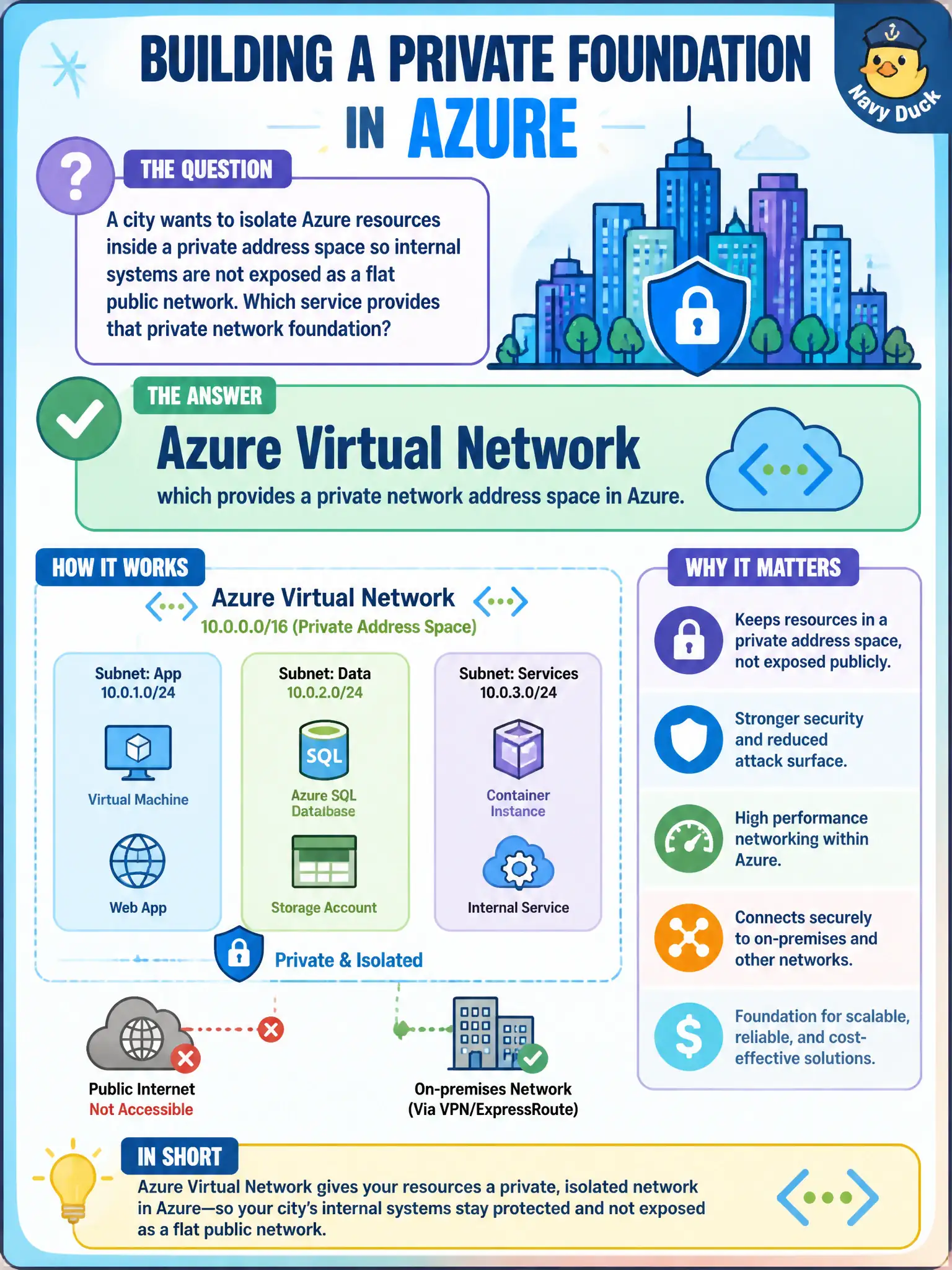
A city wants to isolate Azure resources inside a private address space so internal systems are not exposed as a flat public network. Which service provides that private network foundation?
Select an answer to reveal the explanation.
Short Explanation
A VNet is the private neighborhood for Azure resources — your own address space inside the cloud. Advisor and budgets talk money and tips; blobs store objects. Isolation in a private space means Virtual Network.
Full Explanation
Azure Virtual Network (VNet) is the foundational service that gives Azure resources a private IP address space, enabling isolation and controlled connectivity similar to an on-premises LAN segment in the cloud. A city that wants internal systems inside a private address space—not flattened onto the public internet—starts with a VNet and subnets, then places NICs, private endpoints, and related resources into that space. Azure Advisor scores and recommendations improve posture and efficiency; they do not create private networks or assign production address ranges as a networking product. Cost Management budgets track spend; they do not automatically create encrypted private networks for departments. Blob Hot tier is an access tier for frequently used object data, not a replacement for Virtual Networks or private addressing. Getting the VNet right early avoids painful renumbering when hybrid connectivity arrives later. Exam caveat: a VNet provides private addressing, but public endpoints, NSG rules, and peerings still determine what can actually reach a resource—address space alone is not a complete security design. Operational check: create or review the city’s VNet CIDR and subnet plan, confirm no accidental overlap with on-premises ranges needed for hybrid, and verify critical resources have NICs or private endpoints in the intended subnets.