
How do Azure datacenters relate to regions and availability zones at a fundamentals level?
Select an answer to reveal the explanation.
Short Explanation
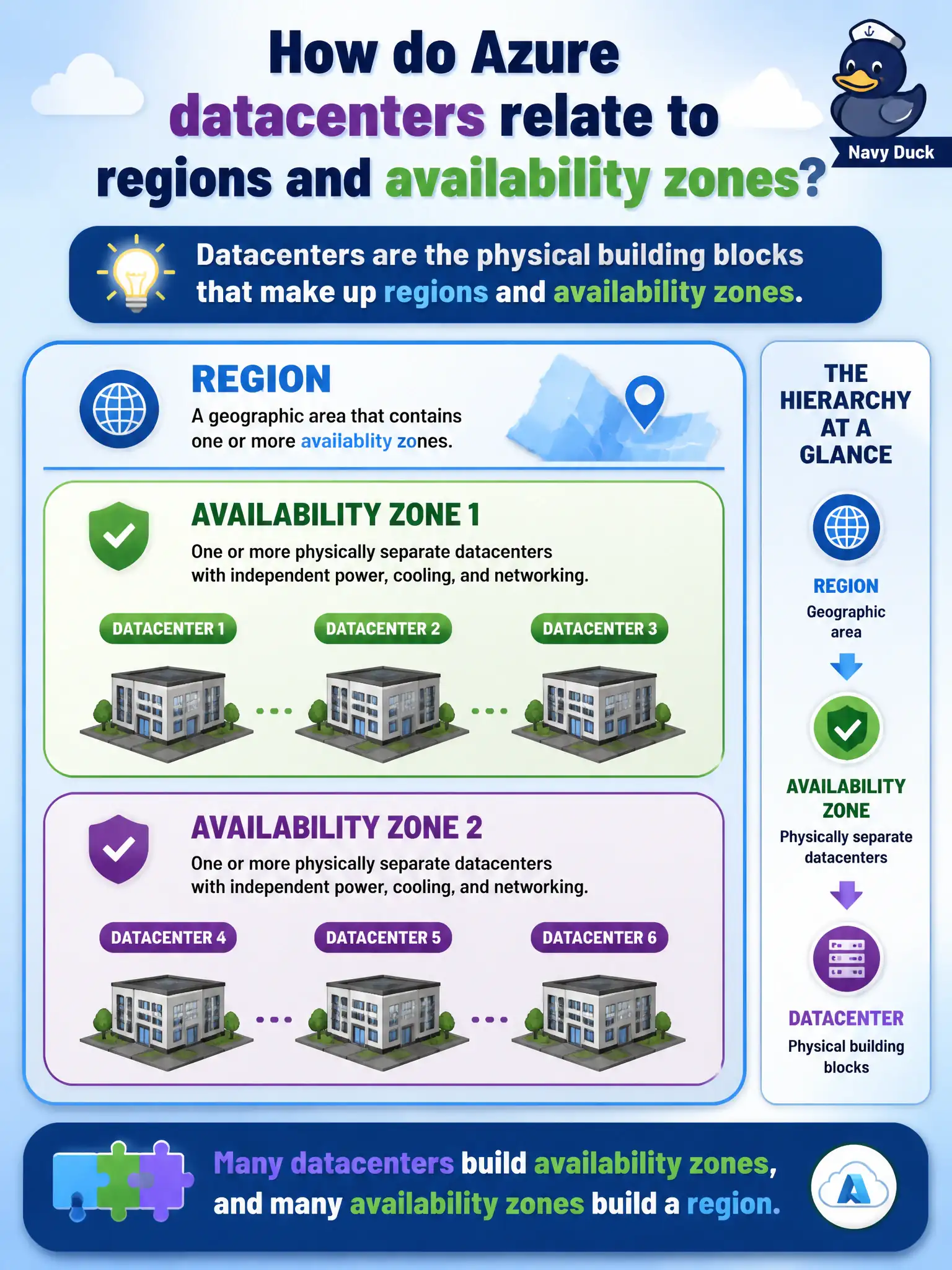
Datacenters are the Lego bricks; regions and zones are how Microsoft groups those bricks on the map. No bricks, no cloud geography. Keep the physical building block idea front and center.
Full Explanation
At a fundamentals level, datacenters are the physical building blocks that make up regions and availability zones. Microsoft groups datacenter capacity into geographic regions and, where offered, into zone fault domains. Without datacenters there is no regional footprint and no zonal separation—regions and zones are organizational and resiliency overlays on physical facilities.
Claiming datacenters exist only as diagram icons denies the hardware reality. Saying each datacenter replaces the need for regions, zones, and subscriptions reverses abstraction layers; those constructs organize and govern capacity rather than being erased by a single building. Treating datacenters as SaaS applications installed on laptops confuses physical facilities with software delivery models.
Exam caveat: customers deploy to regions and zones (and resources), not by picking an arbitrary Microsoft datacenter name in typical portal workflows—know the physical relationship without expecting datacenter-level shopping in everyday provisioning.
Operational check: review architecture docs for municipal systems and ensure they describe region and zone choices explicitly, with datacenters mentioned only as the physical underpinning—not as a substitute for selecting supported regions and zone-redundant SKUs.