
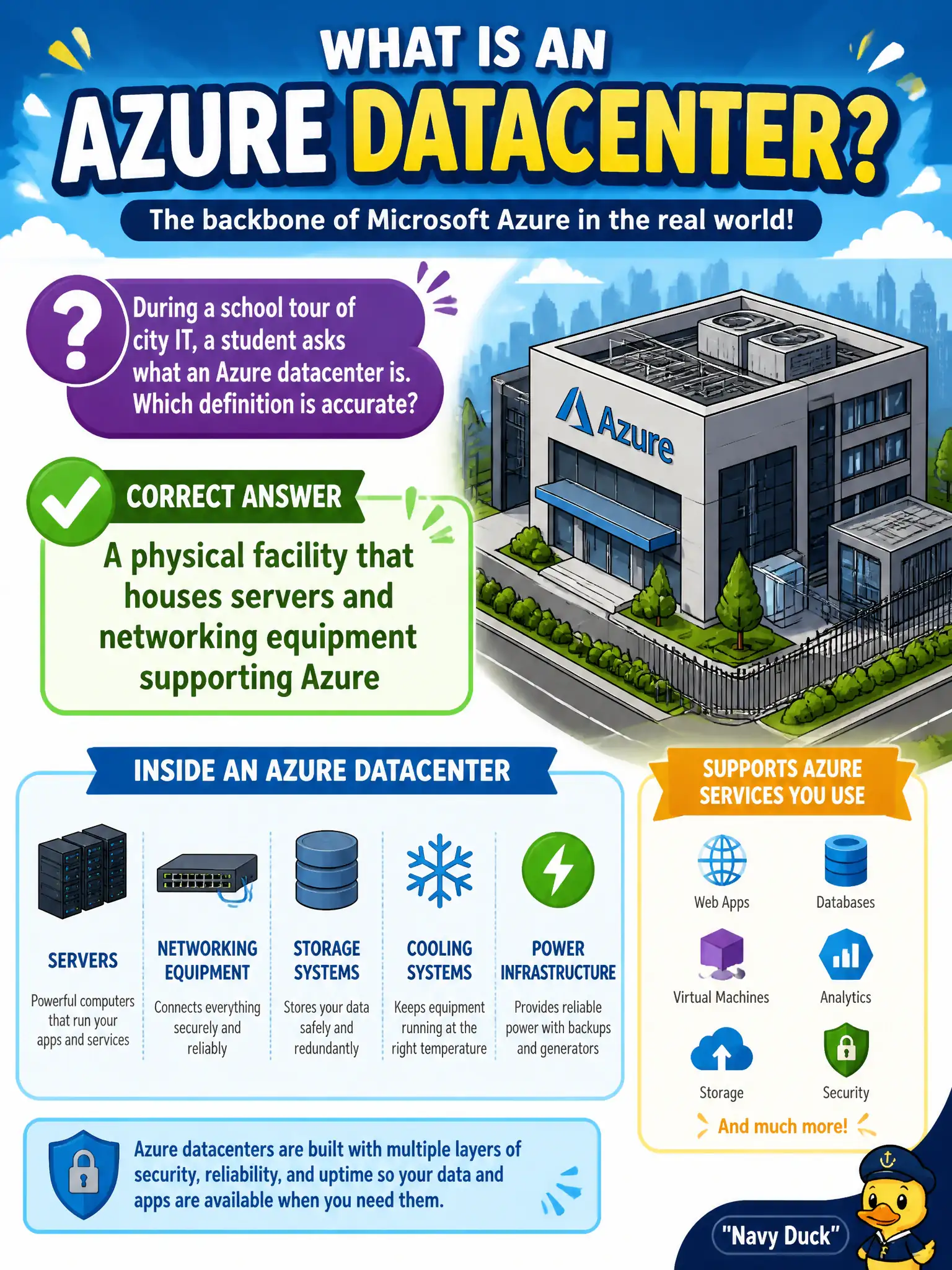
During a school tour of city IT, a student asks what an Azure datacenter is. Which definition is accurate?
Select an answer to reveal the explanation.
Short Explanation
An Azure datacenter is a real building full of servers and network gear — not a spreadsheet tag or a portal bookmark. The cloud still sits on concrete and raised floors. Physical facility first, marketing metaphors second.
Full Explanation
An Azure datacenter is a physical facility that houses servers and networking equipment supporting Azure. Fundamentals literacy starts here: cloud services are delivered over the network, but they still run in real buildings with power, cooling, racks, and fiber. School-tour explanations should anchor on that physical facility definition before metaphors about "the cloud" obscure the hardware underneath municipal portals and library systems.
A logical tag that exists only in cost reports is metadata for finance views, not a building that runs workloads. A PowerShell module name is tooling for automation, not infrastructure geography. A browser bookmark to the Azure portal home page is merely a convenience link and has no relationship to where compute and storage actually operate.
Exam caveat: customers rarely tour or directly manage Microsoft datacenters; understanding that datacenters exist is required on AZ-900, while day-to-day control remains at resource, zone, and region abstractions rather than naming individual facilities in the portal.
Operational check: when onboarding non-technical stakeholders, show a simple diagram—datacenter buildings nest into availability zones and regions—so purchasing and compliance conversations use shared vocabulary instead of treating Azure as pure abstraction without facilities. Confirm that architecture one-pagers for city systems mention region and zone choices explicitly while treating datacenters as the physical underpinning of those choices.