
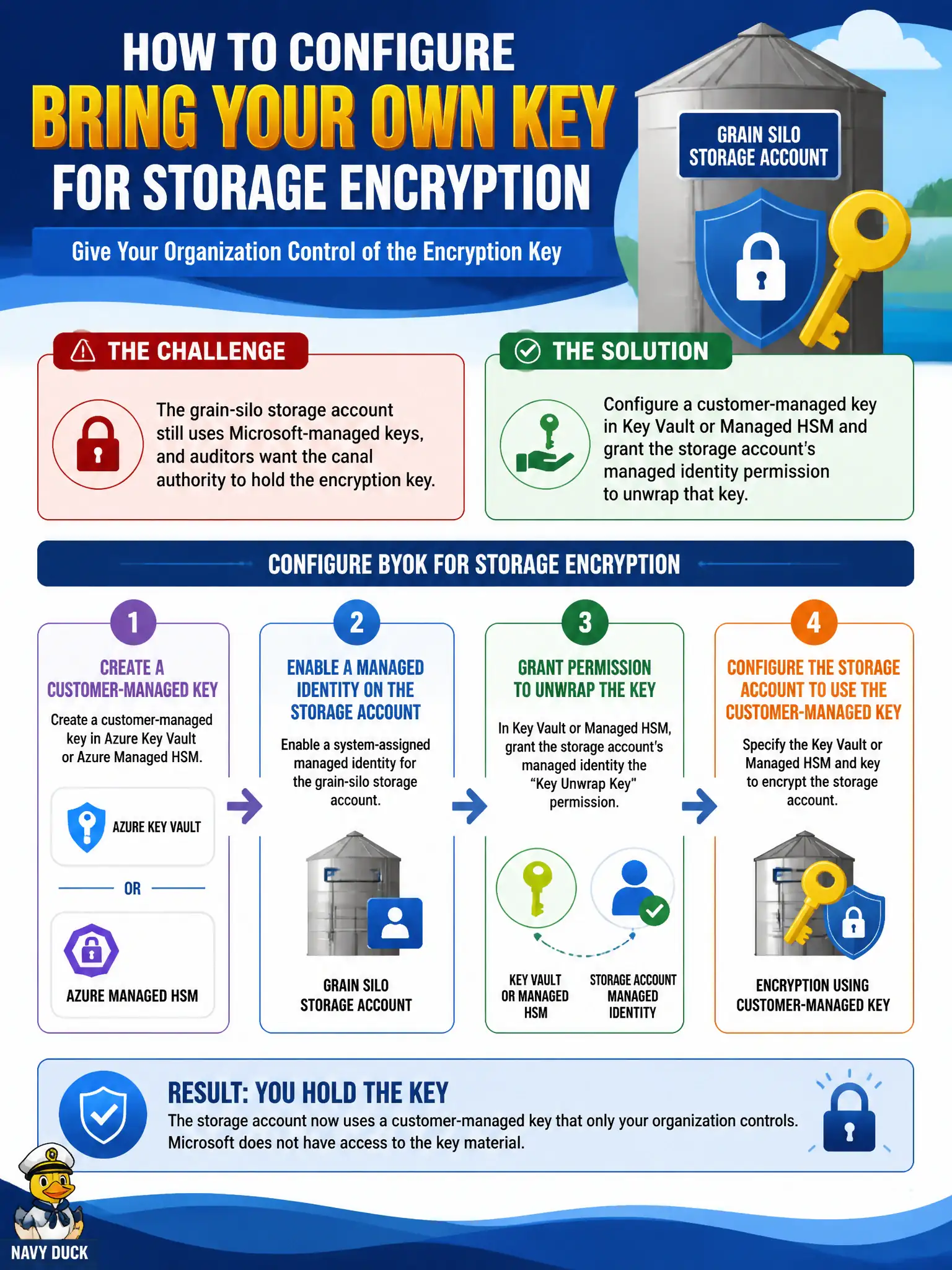
The grain-silo storage account still uses Microsoft-managed keys, and auditors want the canal authority to hold the encryption key. How do you configure Bring Your Own Key for Storage encryption?
Select an answer to reveal the explanation.
Short Explanation
Microsoft’s key is like the landlord’s master lock. BYOK means your Key Vault (or Managed HSM) holds the key, and the storage account’s managed identity is allowed to unwrap it—nothing more mystical than that.
Full Explanation
Customer-managed keys (CMK) for Azure Storage mean the account encrypts data with a key you control in Azure Key Vault or Azure Key Vault Managed HSM. You create or import the key, then grant the storage account’s system- or user-assigned managed identity permission to wrap and unwrap that key so Storage can use it for server-side encryption without embedding raw key material in the account. That is the supported bring-your-own-key path auditors expect when the canal authority wants custody of key lifecycle separate from Microsoft-managed SSE. Pasting a customer passphrase into the access-key blade does not replace Microsoft-managed encryption with CMK; access keys are account credentials, not the SSE key hierarchy. Disabling encryption at rest is not a valid control plane for “managing keys outside Azure”—Azure Storage encrypts at rest by default, and turning protection off is not the CMK design. Classic storage models and on-premises-only HSM appliances are not the modern CMK configuration for a general-purpose Azure Storage account in this exam domain. Exam caveat: CMK still uses Azure’s encryption stack; you control the key material and rotation, not a completely separate on-disk cipher that bypasses Storage. Operational check: after assigning the CMK, verify the account encryption shows customer-managed, confirm the managed identity has get/wrap/unwrap on the key, rotate or disable the key in a non-production account to validate failure modes, and ensure purge protection and soft-delete on the vault protect the key the storage account depends on.