
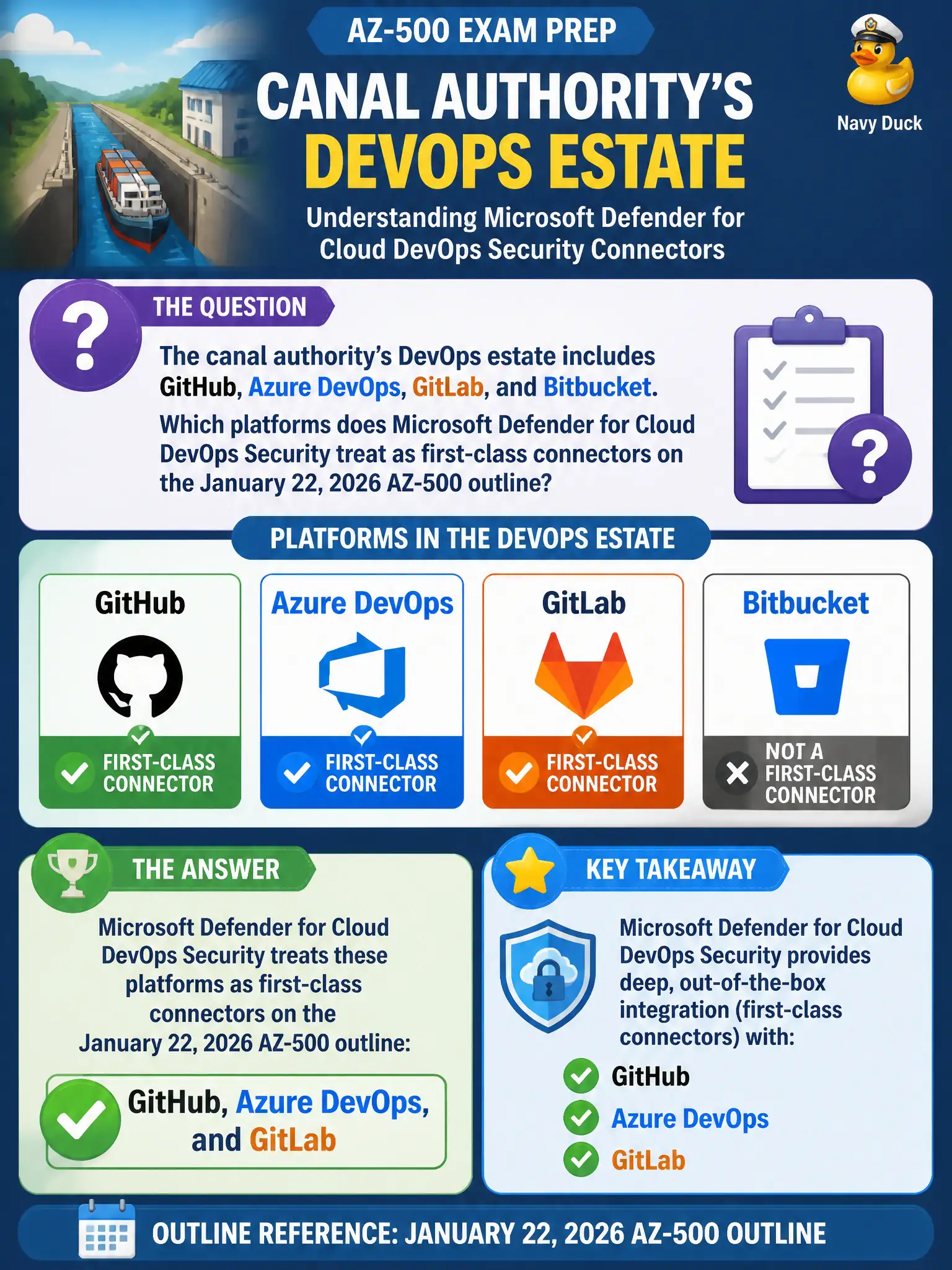
The canal authority’s DevOps estate includes GitHub, Azure DevOps, GitLab, and Bitbucket. Which platforms does Microsoft Defender for Cloud DevOps Security treat as first-class connectors on the January 22, 2026 AZ-500 outline?
Select an answer to reveal the explanation.
Short Explanation
Stick to the named trio on the study guide: GitHub, Azure DevOps, and GitLab. Bitbucket might live in the shop, but it isn’t a first-class Defender for Cloud DevOps Security connector on this outline.
Full Explanation
On the January 22, 2026 AZ-500 outline, Microsoft Defender for Cloud DevOps Security treats GitHub, Azure DevOps, and GitLab as the first-class connectors. That named trio is what the exam expects you to connect and configure for repository and infrastructure-as-code posture—not every SCM product the canal authority happens to run.
Listing Bitbucket with GitHub and Azure DevOps while omitting GitLab invents a first-class Bitbucket connector that the outline does not treat as peer to the three named platforms. Pairing GitHub, Bitbucket, and GitLab while dropping Azure DevOps makes the same mistake in the other direction and removes a platform the outline explicitly includes. Replacing any of those with Microsoft Defender XDR mixes endpoint/XDR response branding with DevOps Security connectors; XDR is not a substitute first-class SCM connector for this skill.
Exam caveat: Bitbucket may still exist in the municipal estate and may have other security tooling, but that does not make it a first-class Defender for Cloud DevOps Security connector on this outline. Operational check: in Defender for Cloud DevOps Security, verify GitHub, Azure DevOps, and GitLab connector tiles are the ones available to connect, then onboard the canal repositories you actually need findings for.