
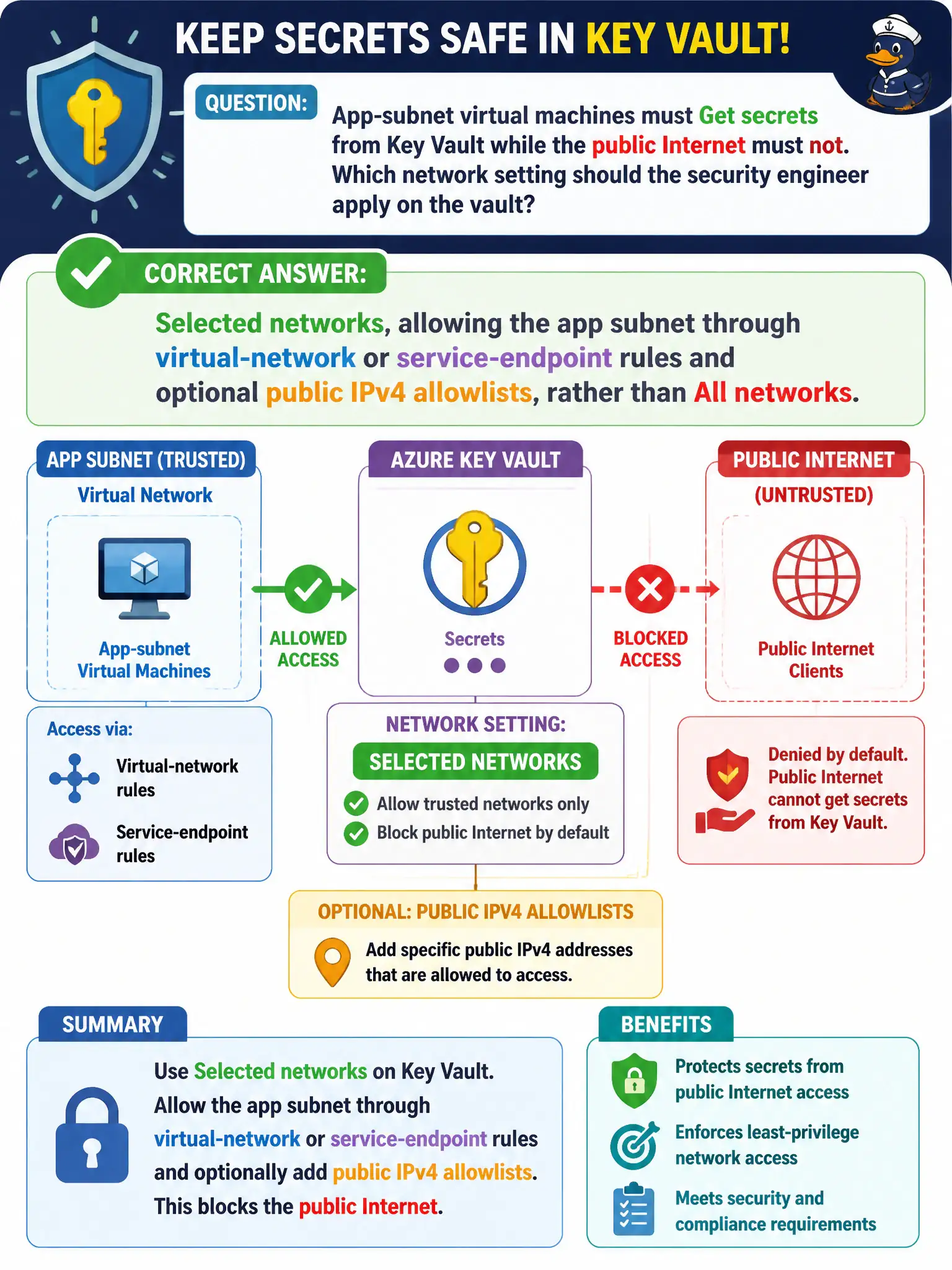
App-subnet virtual machines must Get secrets from Key Vault while the public Internet must not. Which network setting should the security engineer apply on the vault?
Select an answer to reveal the explanation.
Short Explanation
Don’t leave the vault on All networks. Flip it to Selected networks, allow the app subnet (service endpoints or VNet rules), and keep the Internet off the guest list.
Full Explanation
When app-subnet virtual machines must Get secrets while the public Internet must not, Key Vault should use selected networks: allow the app subnet through virtual-network or service-endpoint rules, optionally add specific public IPv4 allowlists for break-glass callers, and keep the default action denying everything else. That selected-networks pattern is the classic allowlist model before or alongside private endpoints for lock-lab workloads.
All networks fails by concept because it admits Internet-origin data-plane traffic to the vault. Disabling soft-delete so network rules become the only recovery control fails because soft-delete is a deletion-recovery feature unrelated to network allowlisting; turning it off increases irreversible loss risk. Removing all virtual-network rules and relying only on subscription Owner for secret Get fails because Owner is control-plane breadth, not a substitute for network restriction, and Owner does not itself perform application secret Get.
Exam caveat: selected networks still require data-plane RBAC or access policies—network allow alone does not authorize Get. Operational check: set Selected networks, add the app subnet rule, deny public residual access, verify a VM in the app subnet retrieves the secret, and verify a host outside allowed networks receives a network/forbidden failure.