
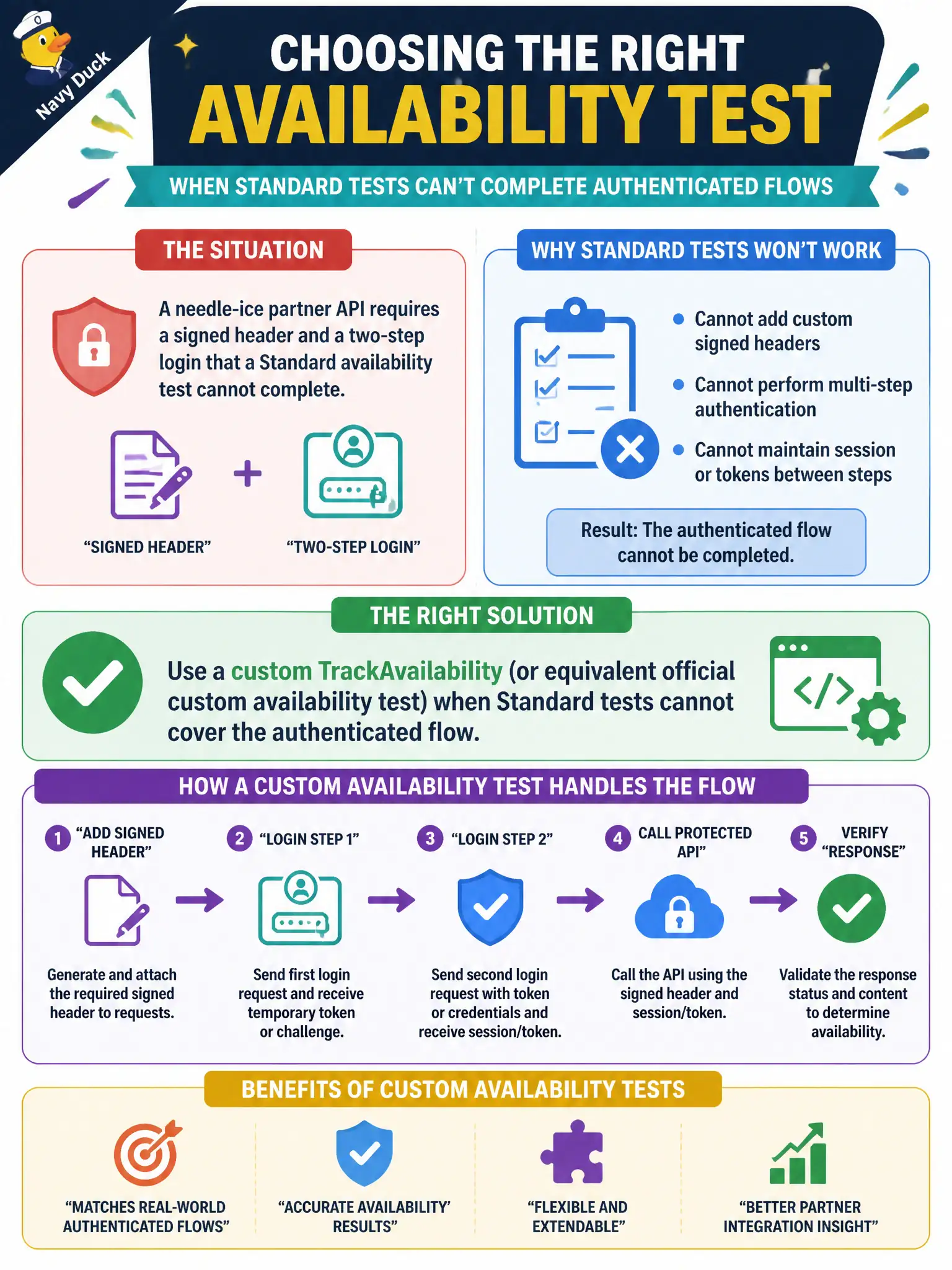
A needle-ice partner API requires a signed header and a two-step login that a Standard availability test cannot complete. What should the developer use?
Select an answer to reveal the explanation.
Short Explanation
Standard tests are the default ping. When you need signed headers or a login dance, emit custom TrackAvailability. Do not pretend Redis or autoscale is that probe.
Full Explanation
Standard availability tests cover a single public request with configurable TLS, verb, and headers. When the needle-ice partner API needs a signed header plus a two-step login that Standard tests cannot complete, emit a custom availability result with TrackAvailability (or the documented custom availability-test path) from a worker that can perform the authenticated dance. That keeps availabilityResults populated for flows Standard tests cannot express.
Only classic URL ping tests, claiming they support arbitrary multi-step auth by default, fails because classic pings are simple URL checks and are deprecated—they are not a multi-step auth solution.
Azure Cache for Redis key TTL watches as the availability substitute fails because cache key lifetime is unrelated to partner API authentication success from an outside-in or custom availability perspective.
App Service autoscale rules that scale to zero during partner API outages fails because scaling away does not probe the partner and can worsen customer impact; it is not a custom availability test.
Exam caveat: custom TrackAvailability still needs secure credential handling (managed identity, Key Vault) and should report success/failure with timing like built-in tests so alerts stay consistent. Operational check: run the custom probe against a staging partner endpoint, confirm availabilityResults rows appear with the expected test name, and wire the same alert threshold used for Standard tests.