
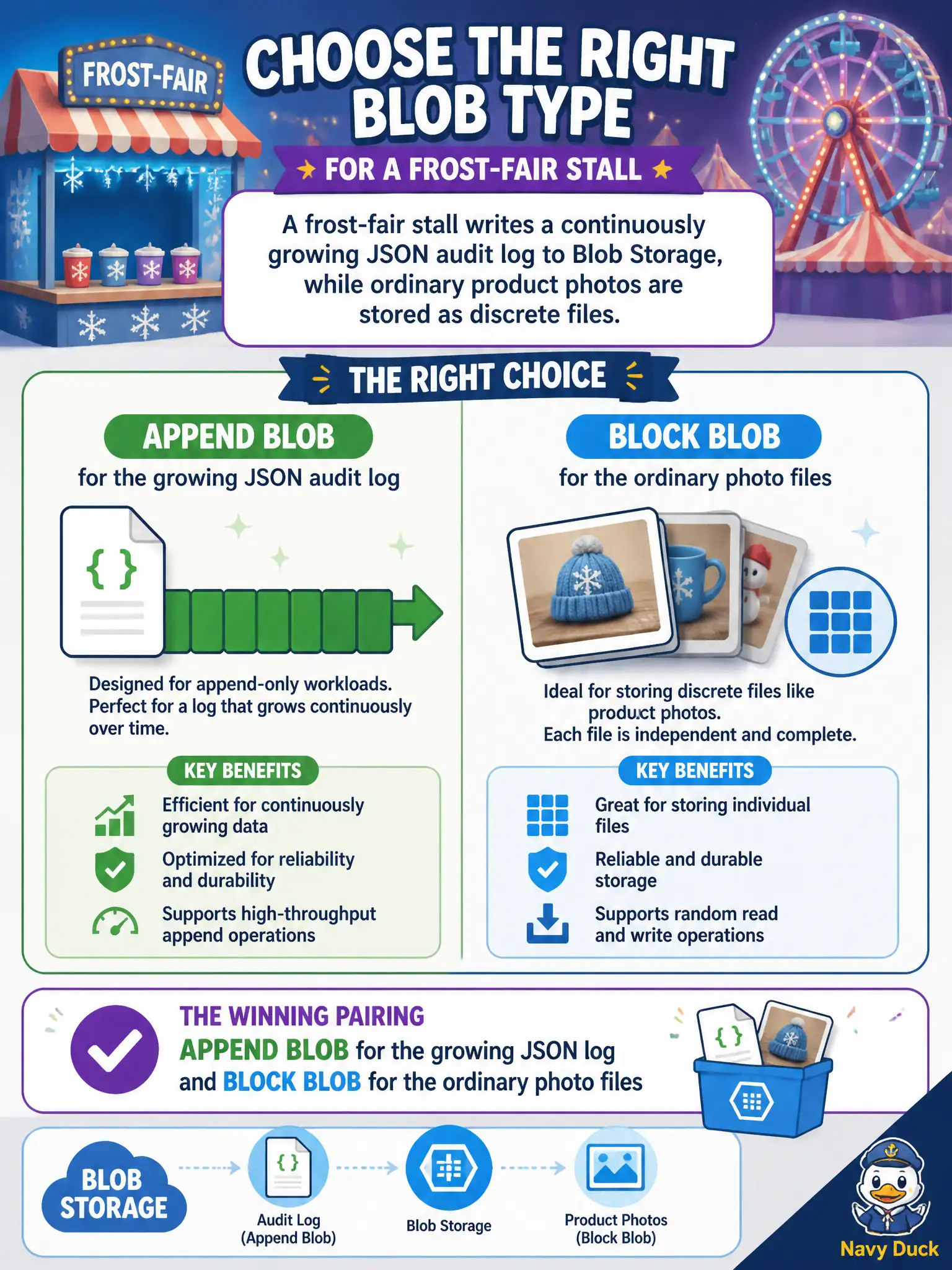
A frost-fair stall writes a continuously growing JSON audit log to Blob Storage, while ordinary product photos are stored as discrete files. Which blob type pairing should the developer choose?
Select an answer to reveal the explanation.
Short Explanation
Append blobs are the spiral notebook you keep adding lines to; block blobs are the photo prints you replace as whole files. Page blobs are for random-access disks (think VHD), not your stall’s growing JSON log or everyday images.
Full Explanation
Azure Blob Storage offers three blob types with different write patterns. Append blobs are optimized for continuous append-only growth—ideal for a JSON audit log that keeps gaining lines. Block blobs are the general-purpose type for discrete files such as product photos that are uploaded as complete objects (and optionally overwritten as wholes). The frost-fair stall therefore pairs append blob for the growing log with block blob for ordinary photos. That pairing matches how each workload mutates data.
Page blob for the JSON log and append blob for every product photo fails both sides of the pairing. Page blobs are random-write, fixed-size patterns (classically VHDs/disks), not line-oriented logs. Append blobs are a poor fit for discrete photo files that are replaced as units rather than appended.
Page blob for both log and photos fails because neither workload is a virtual disk image. Using page blobs for general files adds complexity and wrong IO semantics without benefit.
Block blob for the log only if Azure SQL first stores each JSON line fails because it invents an unnecessary SQL dependency and still points at the wrong primary pattern for a continuously growing blob log. Append blobs exist so you can append without rewriting the entire object or parking every line in SQL first.
Exam caveat: append blobs have block/append size limits and are not freely editable in the middle—use them for append-only telemetry, not for rewrite-heavy documents. Operational check: append several JSON lines to an append blob and upload a sample photo as a block blob, then verify blob type properties on each object match the intended pairing.