
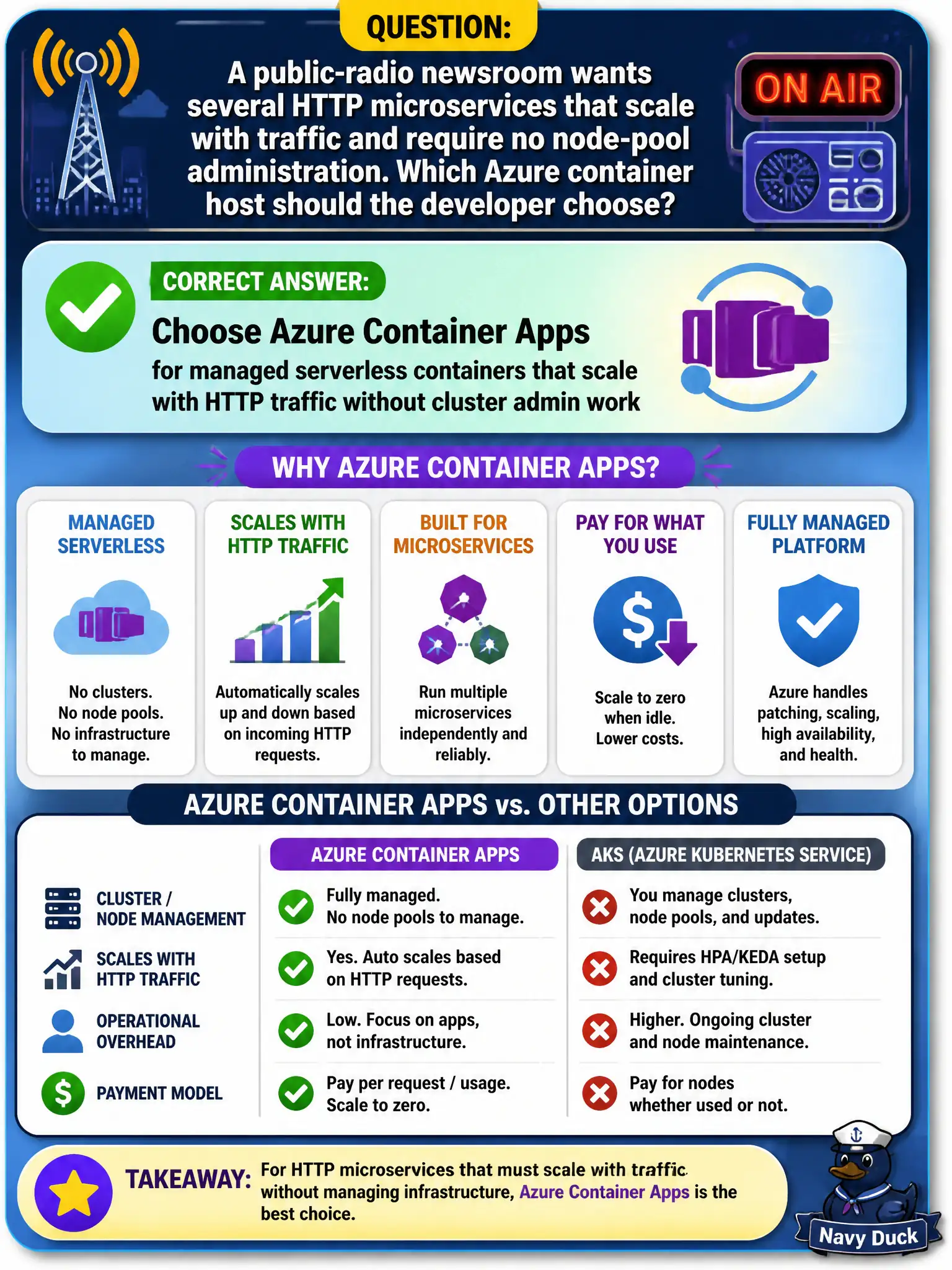
A public-radio newsroom wants several HTTP microservices that scale with traffic and require no node-pool administration. Which Azure container host should the developer choose?
Select an answer to reveal the explanation.
Short Explanation
Several HTTP services that grow and shrink with listeners, and zero desire to babysit nodes—that is Azure Container Apps. ACI is the simple one-off booth; AKS is the full theater crew you did not ask to manage.
Full Explanation
Azure Container Apps is the AZ-204-oriented host for several HTTP microservices that must scale with traffic without node-pool administration. The public-radio newsroom gets managed revisions, HTTP scale rules, and ingress without operating kubectl or AKS node pools directly. That matches “scale with listeners, no babysitting nodes.”
Making AKS node pools and kubectl the primary answer for every HTTP container ignores Container Apps as the managed path when cluster admin work is explicitly unwanted. Azure Container Registry alone only stores images; pushing never creates scaled HTTPS front ends by itself. A single always-on ACI instance without scale rules fits simple isolated jobs poorly for bursty multi-service HTTP traffic.
Exam caveat: Container Apps may run on platform-managed Kubernetes underneath, but the developer contract is the Container Apps resource model—not day-2 node pool operations. Choose AKS when you truly need cluster-level control.
Operational check: create a Container Apps environment, deploy two HTTP services with min/max replicas and HTTP scale rules, generate load against each ingress FQDN, and confirm replica counts move without any manual node-pool changes.