
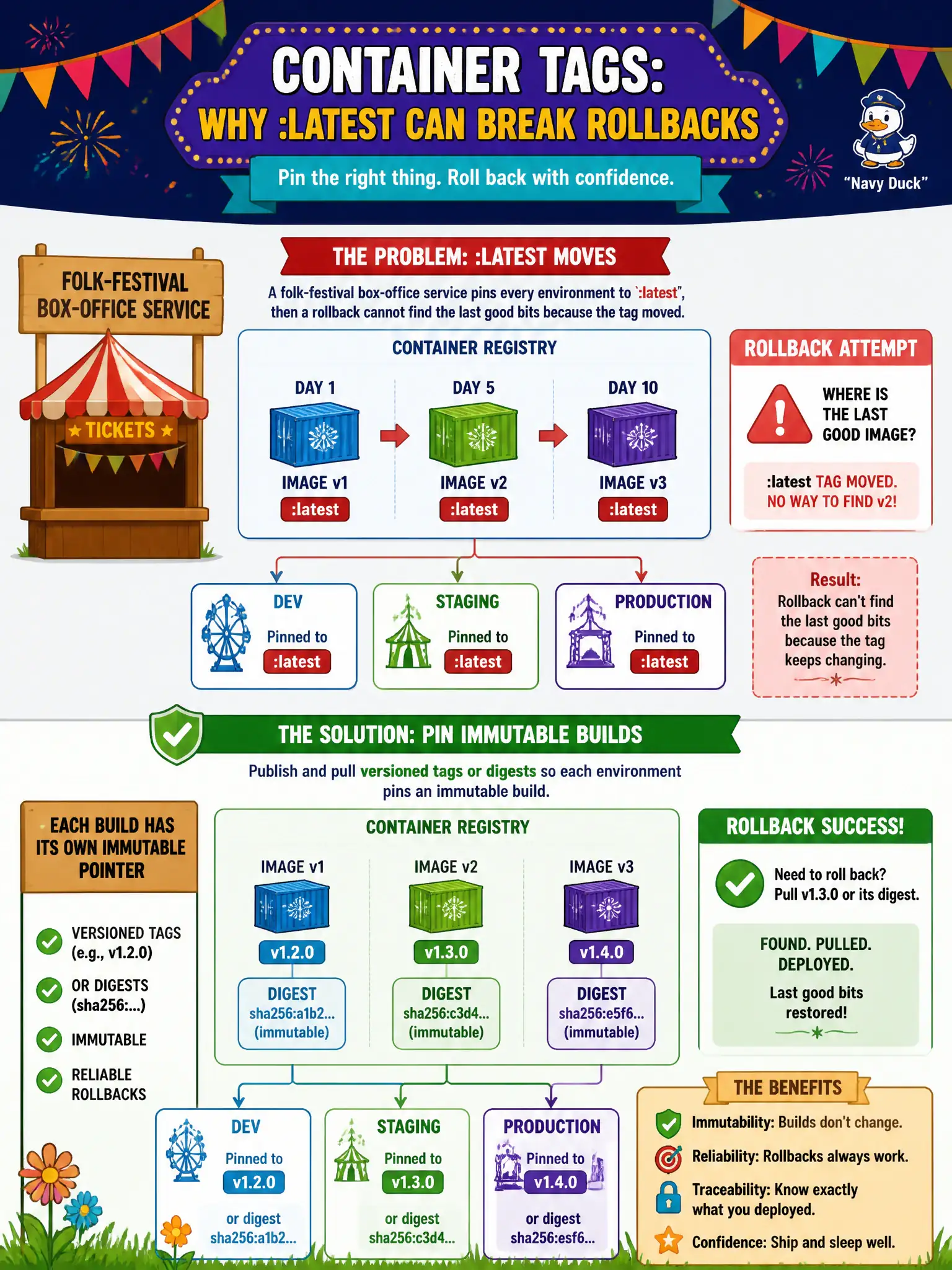
A folk-festival box-office service pins every environment to :latest, then a rollback cannot find the last good bits because the tag moved. Which image-management practice restores a reliable artifact pointer?
Select an answer to reveal the explanation.
Short Explanation
:latest is a sticky note that keeps getting peeled and moved. Versioned tags or digests are permanent library call numbers—you can always pull the edition that worked last Saturday.
Full Explanation
Production and staging must pin immutable artifacts. Publishing and pulling versioned tags (build numbers, semantic versions) or content digests gives the folk-festival box-office service a stable pointer to the last known-good bits. When :latest advances, prior environments still hold their explicit tag or digest for rollback.
Deleting the registry after each release destroys history and shared repositories instead of fixing tag hygiene. Relying on floating :latest in production while storing timestamps only in commit messages leaves the runtime without a pullable immutable reference. Pushing untagged manifests only removes the human-friendly pin environments need; digests alone without recorded references still make operational rollback painful.
Exam caveat: digests are the strongest immutability guarantee because tags can be overwritten unless registry policies prevent retagging. Many AZ-204 answers accept either unique version tags or digest pins.
Operational check: record the tag and digest at release, deploy with that explicit reference (not :latest), then perform a dry-run rollback by redeploying the previous tag/digest and confirming the host pulls the expected digest from ACR.