
A botanical-garden kiosk team says they “deployed the registry” after only tagging a local image, then later says “the image is running” when they mean a live instance. Which statement keeps image, container, and registry correctly apart?
Select an answer to reveal the explanation.
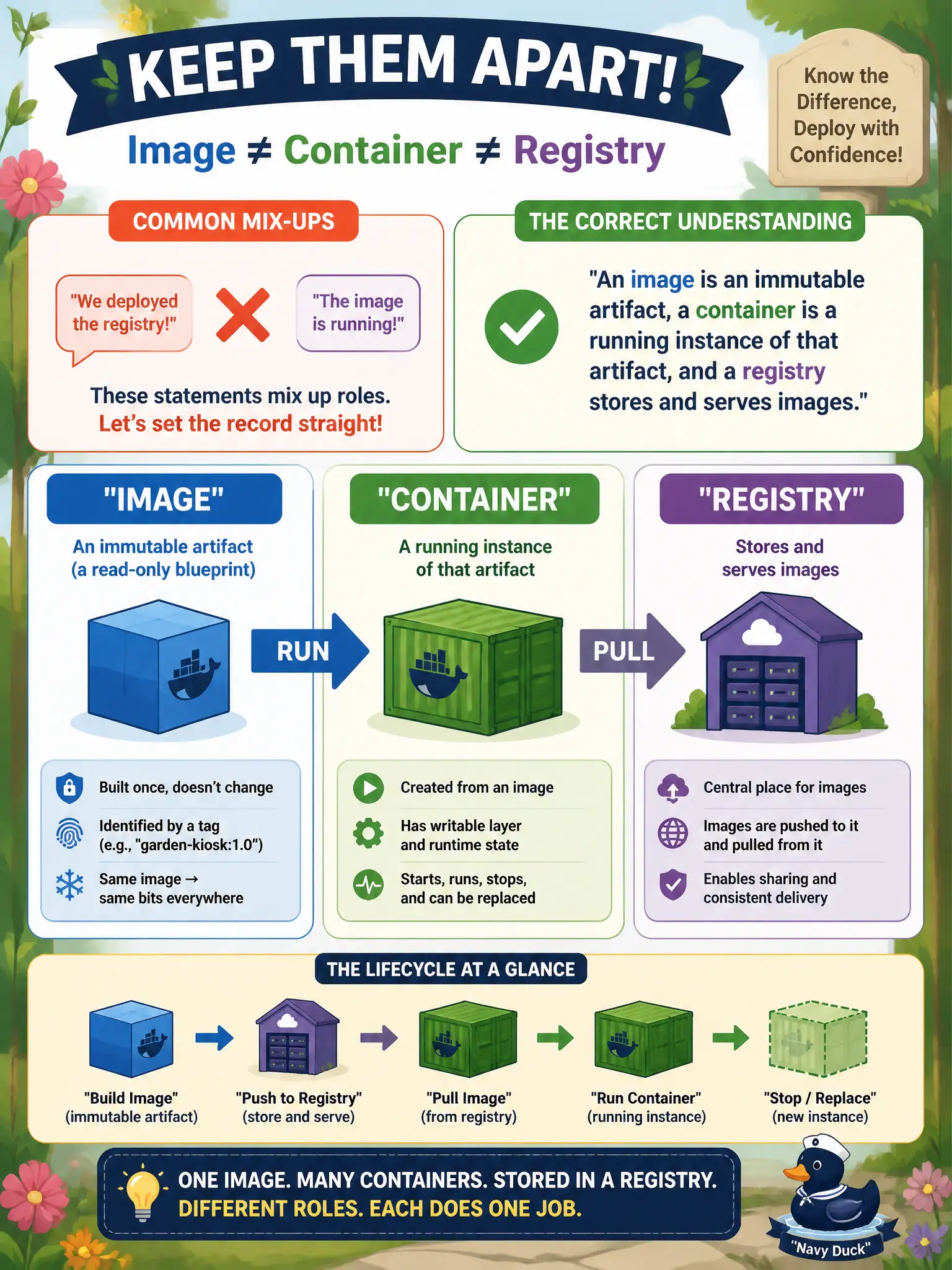
Short Explanation
Call the image the printed recipe card, the container the meal cooking on the stove, and the registry the recipe bookshelf. Tagging a card on the counter is not the same as shelving it—or serving dinner.
Full Explanation
Keep three vocabulary boxes separate for the botanical-garden kiosk team. An image is an immutable filesystem artifact produced by a build. A container is a running (or exited) instance created from an image. A registry such as Azure Container Registry stores and serves those image artifacts to hosts. Tagging a local image only names a local artifact; it neither publishes to ACR nor starts a live process.
Calling the registry the running process, the image a subscription, or the container a build cache scrambles every troubleshooting conversation. Equating an image with a VM SKU, a container with a VNet, and a registry with a resource-group rename imports unrelated Azure resource types into the container workflow. Local tagging also does not create a public ACR endpoint that serves live HTTP—publish requires login, a fully qualified tag, and push, and serving still needs a compute host.
Exam caveat: the same digest can be referenced by multiple tags; tags move, digests do not. Operators must know whether they are discussing a tag pointer, an image digest, or a live container instance.
Operational check: after a change, verify three distinct facts—docker images (or ACR repository list) for the artifact, docker ps / ACI show for the instance, and az acr repository show-tags for what was actually published—before declaring a deploy complete.