
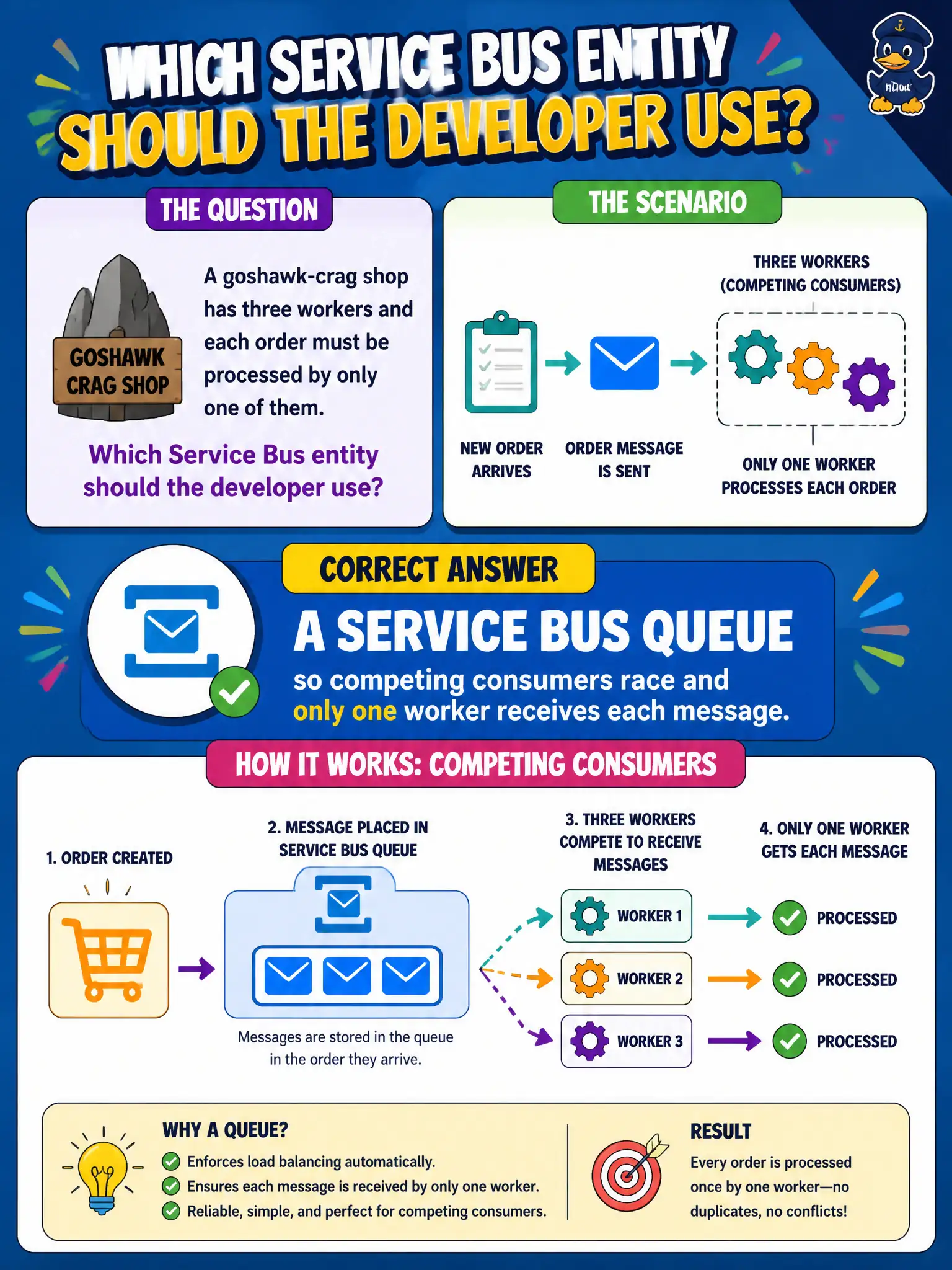
A goshawk-crag shop has three workers and each order must be processed by only one of them. Which Service Bus entity should the developer use?
Select an answer to reveal the explanation.
Short Explanation
One order, one winner — that is a queue. Point the three workers at a Service Bus queue and let competing consumers fight over each message.
Full Explanation
When a goshawk-crag shop has three workers and each order must be handled by only one of them, a Service Bus queue is the correct entity. Competing consumers race on the same queue; under normal completion, only one worker receives and completes each message, giving point-to-point load distribution without requiring workers to coordinate among themselves.
A Service Bus topic with three identical unmanaged broadcasts and no competing consumers fails because topics are publish-subscribe: each subscription gets its own copy, which would triplicate work rather than elect a single winner. An Event Hubs partition key equal to the worker hostname fails conceptually—that keys events to partitions for stream processing; it does not implement a competing-consumer work queue for exclusive order handling. A Storage account static website that lists open orders fails because a static site is not a transactional messaging entity and cannot safely assign exclusive ownership of each order to one worker.
Exam caveat: peek-lock with abandon or lock expiry can cause another worker to receive the same message—design idempotent order processing. Operational check: enqueue several orders, run three competing receivers against one queue, and verify each message is completed by only one worker while throughput is shared across the pool.