
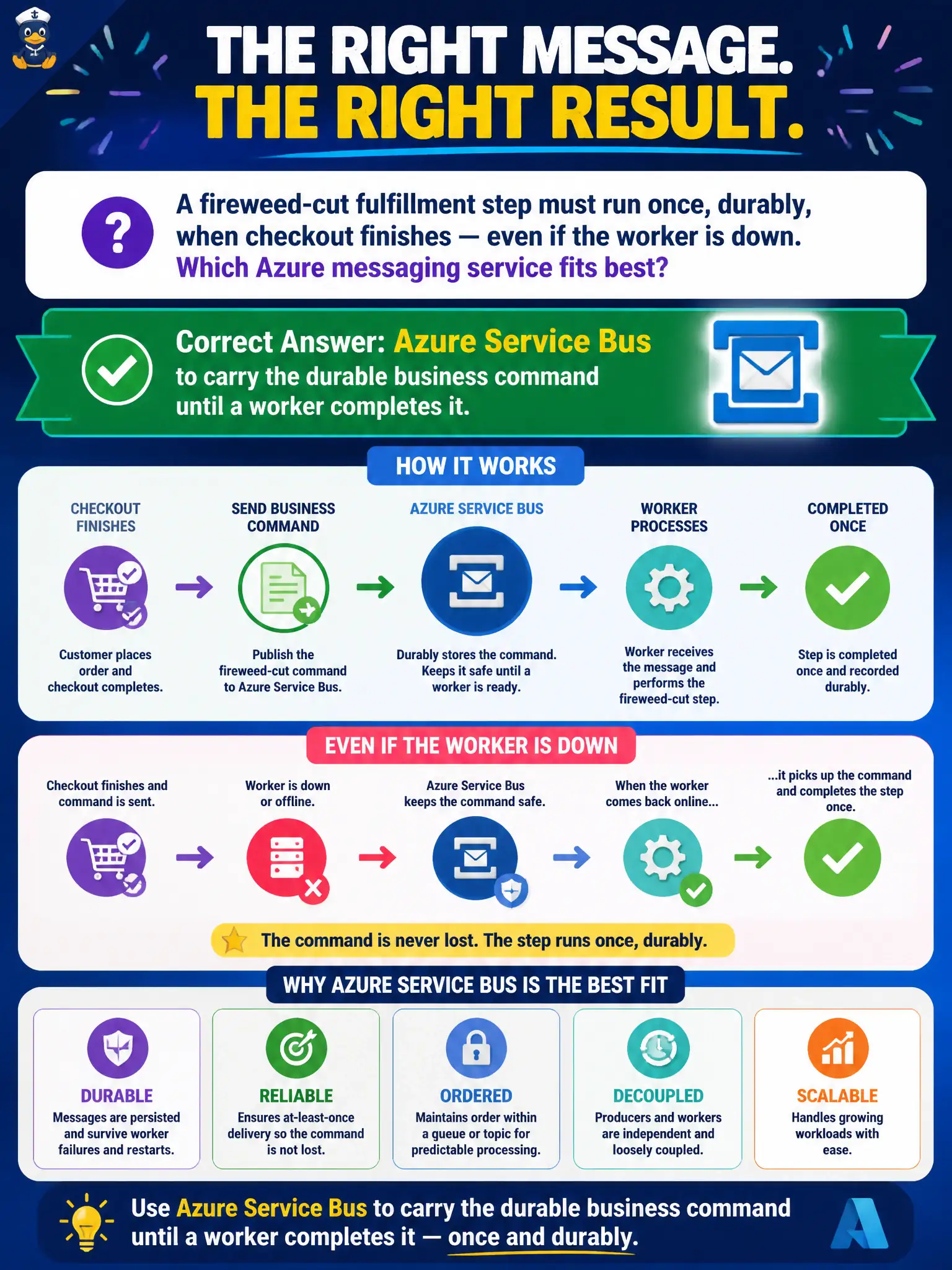
A fireweed-cut fulfillment step must run once, durably, when checkout finishes — even if the worker is down. Which Azure messaging service fits best?
Select an answer to reveal the explanation.
Short Explanation
Checkout commands need a durable mailbox, not a firehose or a pure event fan-out. Service Bus holds the work until a worker is up and completes it.
Full Explanation
A fireweed-cut fulfillment step that must run once and survive worker downtime is a durable business command, which maps to Azure Service Bus. The broker retains the message until a worker receives it with peek-lock semantics and completes processing, so checkout can finish even when fulfillment capacity is temporarily offline. That durable mailbox pattern is the Domain 5 fit for workflow commands rather than pure event fan-out or telemetry.
Choosing Event Grid alone because every command looks like a discrete blob-created event fails when the requirement is durable work holding until a worker completes—not merely notifying subscribers of a fact. Choosing Event Hubs because order commands seem like high-volume telemetry partitions fails conceptually: Event Hubs optimizes streaming ingress and parallel log readers, not Service Bus command features such as sessions and DLQ for fulfillment. Azure CDN purge messages as the fulfillment queue fails because CDN purge is a content invalidation operation, not a message bus for orders.
Exam caveat: at-least-once delivery means handlers must be idempotent; a retry after a crash can redeliver a message that was partially processed. Operational check: send a fulfillment message while workers are stopped, start a worker later, and confirm the message is still available, lockable, and completable without data loss.