
An eider-cove GET /tides is hit every second and the origin response is cheap to cache at the gateway. Which APIM policy pair should the developer use?
Select an answer to reveal the explanation.
Short Explanation
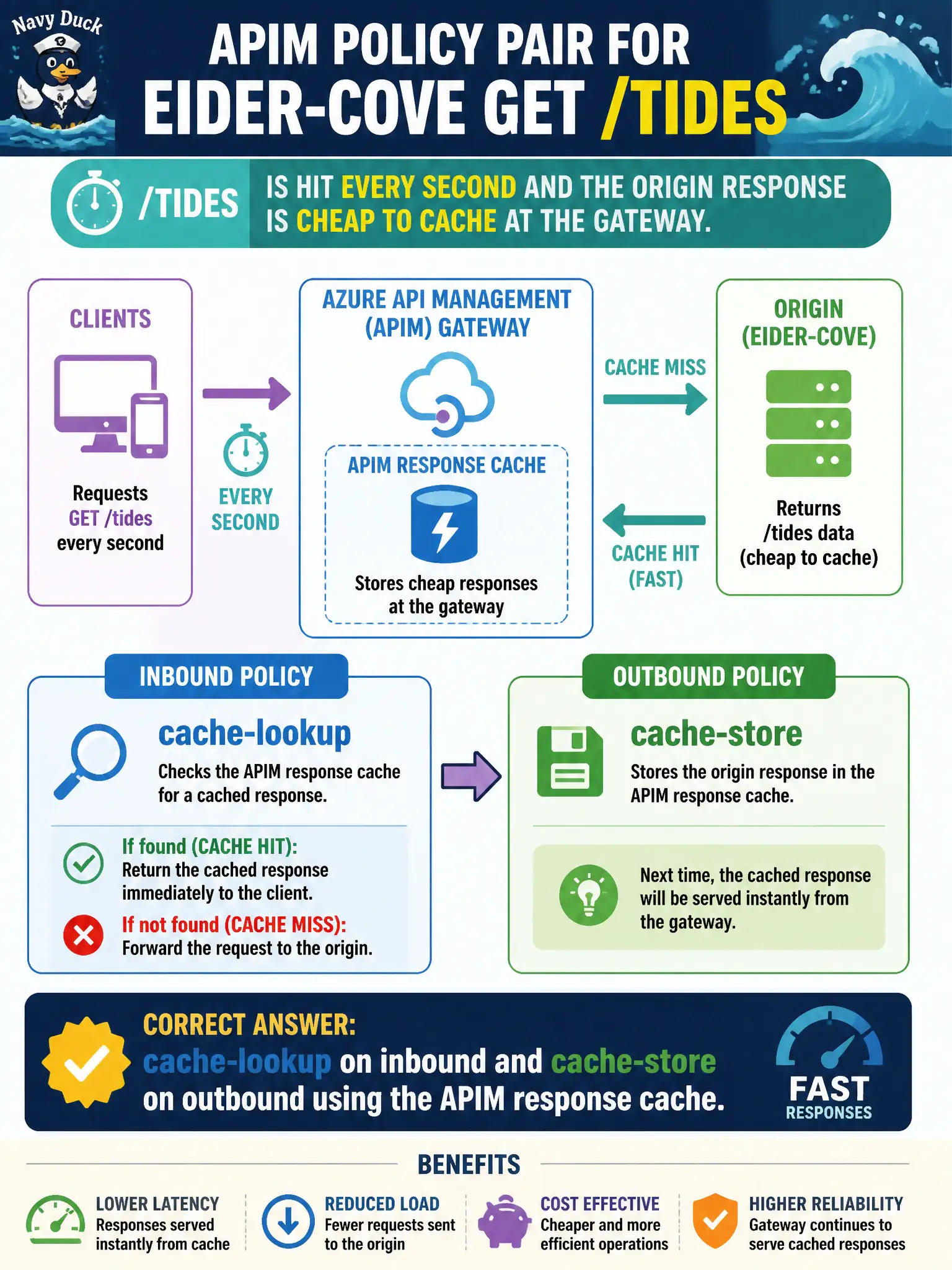
Look before you fetch, store after you succeed. cache-lookup inbound plus cache-store outbound is the APIM response-cache pair—Redis is not the Domain 5 skill here.
Full Explanation
For a cheap, frequently hit GET such as eider-cove /tides, API Management’s built-in response cache is the Domain 5 skill: use cache-lookup on inbound to serve a prior response when present, and cache-store on outbound to save a successful origin response for later callers. That pair keeps hot GETs off the origin without inventing a parallel caching product for this scenario.
Standing up Azure Cache for Redis as the required Domain 5 answer and ignoring APIM policies fails this item’s intent. Redis is a valid Azure cache elsewhere, but the question asks for the APIM response-cache policy pair, not a separate Redis deployment.
Disabling caching and polling Blob Storage from every client fails because it increases origin and storage load and does not implement gateway response caching for the GET.
Wrapping every GET in a Durable Functions orchestration to “simulate a cache” fails because Durable Functions coordinate long-running workflows; they are not APIM cache-lookup / cache-store.
Exam caveat: caching is appropriate for idempotent GETs with acceptable freshness—do not cache personalized or rapidly mutating responses without Vary-aware keys and TTLs. Operational check: enable cache-lookup inbound and cache-store outbound with a short duration, call /tides twice, and confirm the second call is a cache hit in APIM traces while origin request count does not double.