
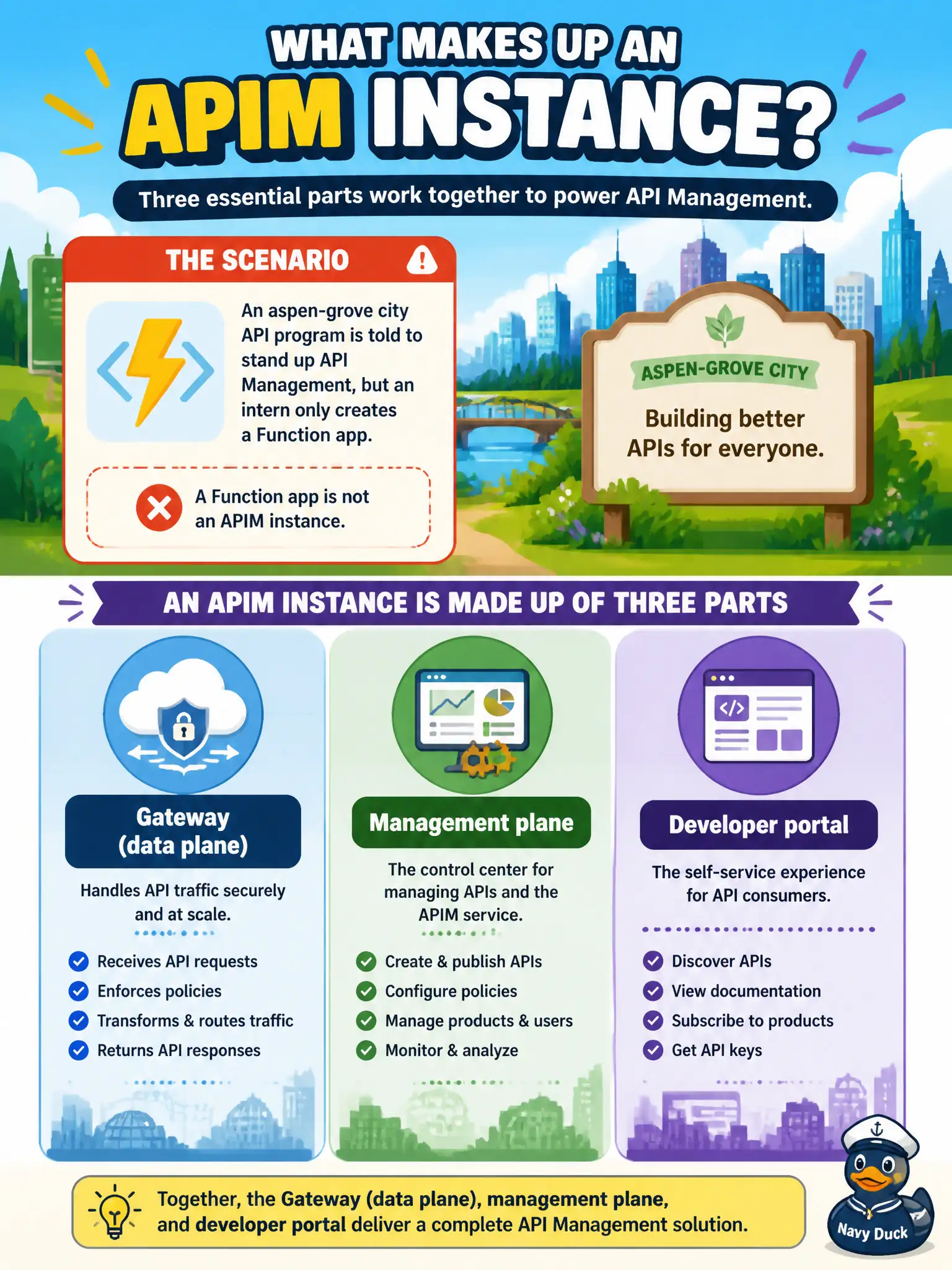
An aspen-grove city API program is told to stand up API Management, but an intern only creates a Function app. Which three parts make up an APIM instance?
Select an answer to reveal the explanation.
Short Explanation
APIM is gateway plus management plane plus developer portal—not “just another Function.” Callers hit the gateway; admins use the management plane; partners use the portal.
Full Explanation
An Azure API Management instance is not “just another Function app.” Its component model is three parts: the gateway (data plane) that proxies caller traffic and enforces policies; the management plane used by administrators to define APIs, products, policies, and subscriptions; and the developer portal where partners discover docs, try operations, and subscribe. The aspen-grove city API program needs that full instance shape, not a lone Function host.
Application Gateway, Front Door, and a WAF policy are edge and Layer-7 load-balancing / global entry controls—they do not provide APIM’s product catalog, subscription keys, or developer portal. Event Grid, Event Hub, and Service Bus are messaging fabrics for events and queues, not an API facade with a portal. A storage account’s blob, queue, and table services store data; they are unrelated to the APIM component triad.
Exam caveat: knowing the three-part model helps distinguish APIM from look-alike networking or messaging services that appear in distractors on AZ-204.
Operational check: after provisioning APIM, open the Azure portal blade for the instance and confirm you can reach gateway endpoints (or the default gateway hostname), management configuration for APIs/products, and the developer portal URL—then place a simple API behind the gateway and call it through the gateway hostname rather than the origin.