
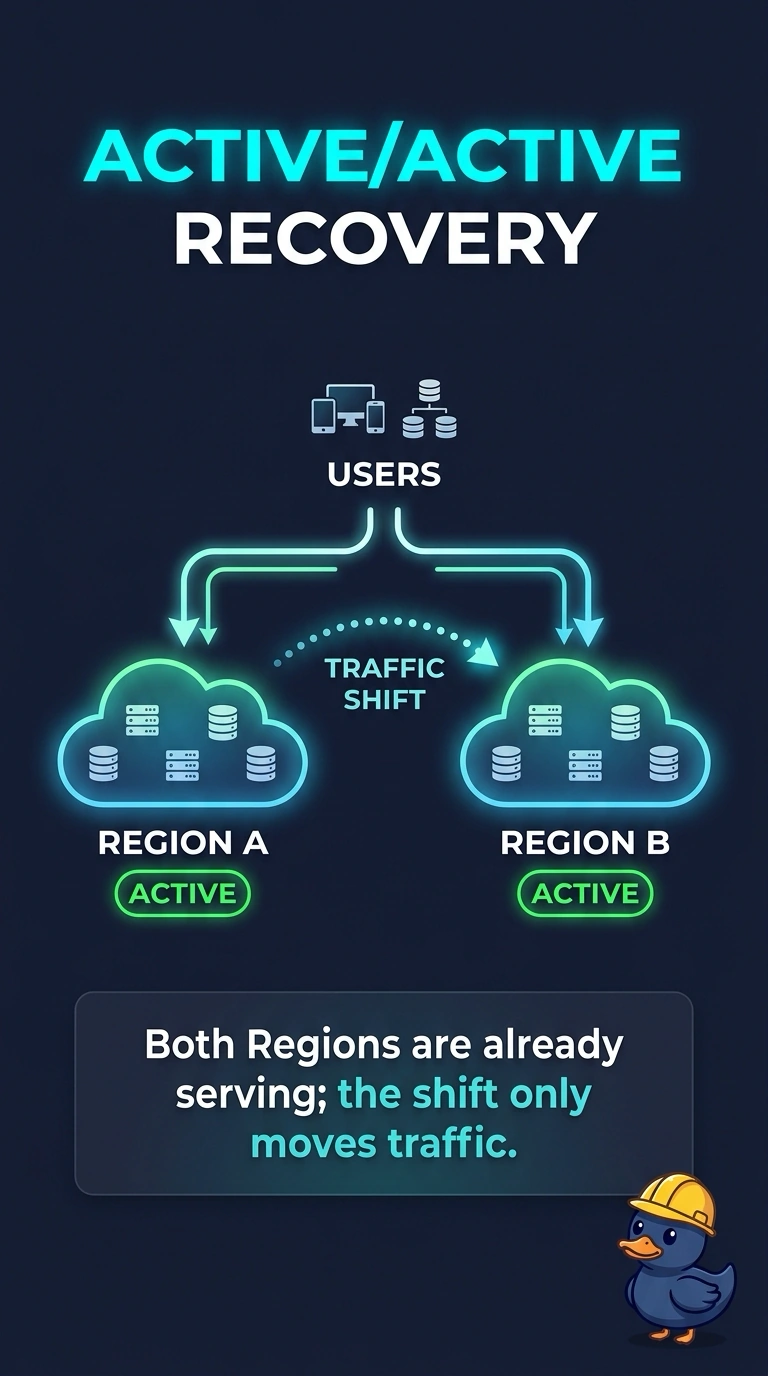
Two Regions serve this application's production traffic all the time. When one Region is unhealthy, traffic shifts to the other, and nothing has to be launched for that shift. Which disaster-recovery pattern is this?
Select an answer to reveal the explanation.
Short Explanation
Both kitchens are already cooking for customers, so a closed kitchen means you send diners next door. Both Regions already serve production traffic, and failover is a traffic shift with nothing to launch, which is active/active. Pilot light and backup and restore would still have to build the other side, and warm standby would be a reduced copy you scale up rather than a full site already serving.
Full Explanation
Active/active means both Regions are already serving production traffic, and a failure is a shift of that traffic onto the Region that is still healthy. Nothing has to be launched for the shift, which matches this application. Pilot light keeps a core, usually data, running and launches the application at failover. This second Region is not dark, and the shift does not launch it. Backup and restore rebuilds an environment from backups before it can serve. A traffic shift with nothing to launch is not a rebuild from the latest backup. Warm standby runs a reduced copy and scales it up to carry the load. Here both Regions already serve production all the time, and the shift does not depend on scaling a small copy first. Caveat: active/active still needs the data layer to tolerate writes in both Regions, or the traffic shift succeeds while the two copies of the data diverge. Operational check: shift a test weight to one Region, confirm users are served there with nothing newly launched, and shift it back.