
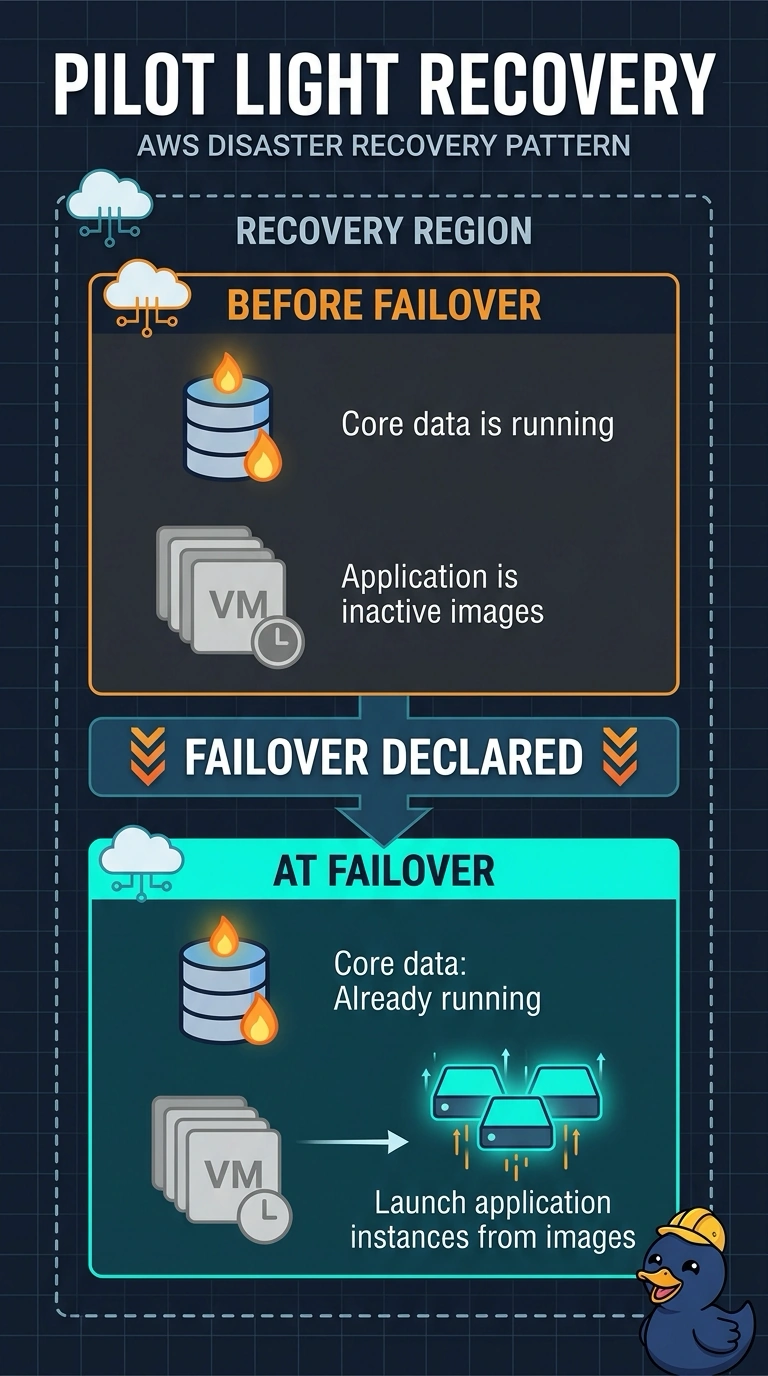
In the recovery Region, only the database is running. Application instances are launched from images when a failover is declared, and no scaled-down copy of the application is already serving there. Which disaster-recovery pattern is this?
Select an answer to reveal the explanation.
Short Explanation
The generator is running in the spare building, and the lights are still in the truck. Only the database is up in the recovery Region, and the application is launched when you declare failover, which is pilot light. Warm standby would already have a scaled-down application running there, and active/active would already be serving users from both Regions.
Full Explanation
Pilot light keeps the critical core running in the recovery Region, often the database, and brings the rest of the stack up when failover is declared. That is this design: the database is already running, and the application instances are launched from images only at failover. No scaled-down application is already serving. Warm standby would already have a functional copy of the application running at reduced scale, ready to take traffic and then be scaled up. A database alone is not that copy. Active/active would have both Regions serving users all the time. A database that is running does not mean the recovery Region is serving the application. Backup and restore has nothing running in the recovery Region until a restore builds it. Here the database is already running, so the pattern is past a cold restore and is not waiting to create the core. Caveat: pilot light still needs a tested way to launch the application and to shift traffic, or the running database sits unused during the incident. Operational check: run a failover exercise that launches the application from the images and points a test name at the recovery Region.