
A media company's Aurora Serverless v2 writer sits at its minimum capacity while new connections queue, and the cluster minimum and maximum capacity are set to the same value. What should the operator change?
Select an answer to reveal the explanation.
Short Explanation
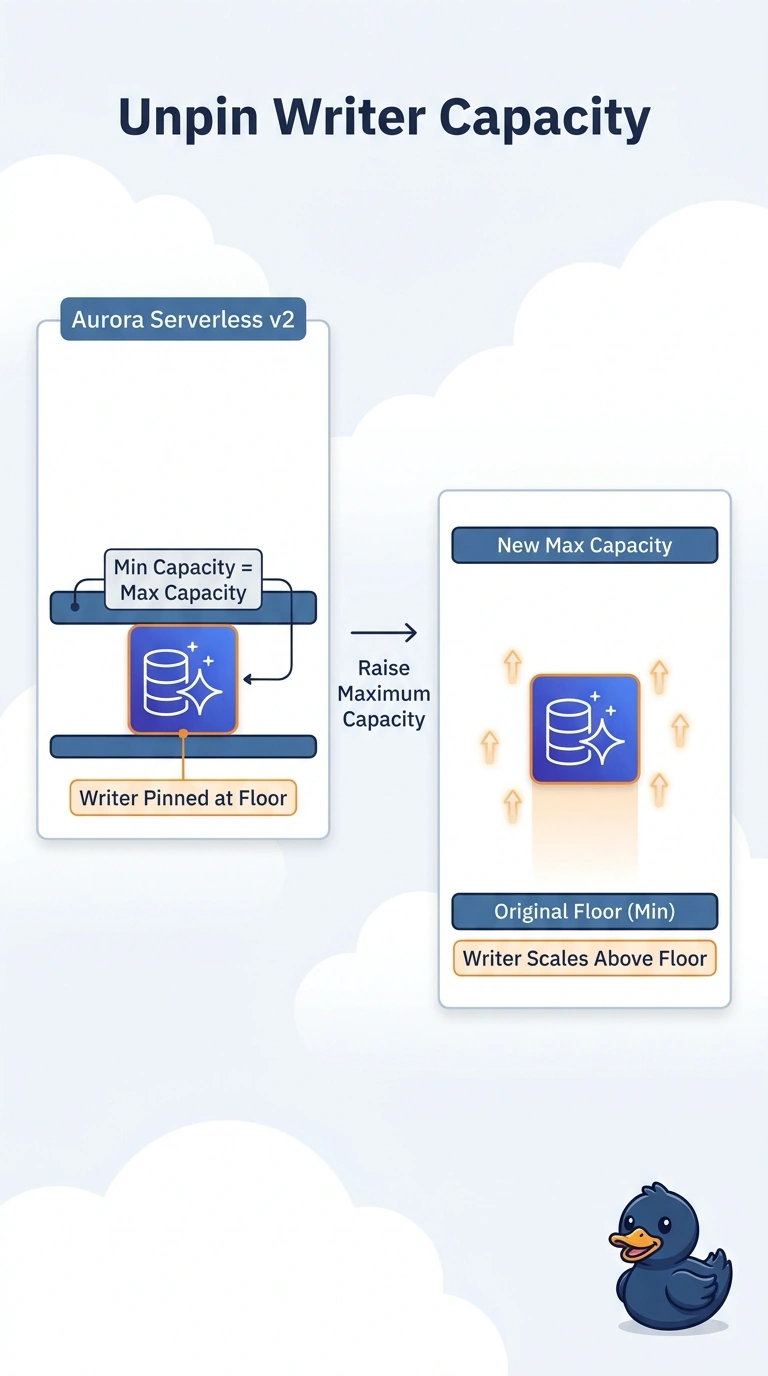
The throttle is already against the floor, and the ceiling is bolted to that same floor. You set the Aurora Serverless v2 minimum and maximum capacity to one value, so the writer cannot scale up while connections queue. A reader in another Region will not take those writes, and lowering the minimum only makes the floor smaller.
Full Explanation
Aurora Serverless v2 scales a writer only inside the capacity range set on the cluster. When the minimum and the maximum are the same value, capacity stays there no matter how many connections are waiting, which is why the writer looks pinned at the minimum. Raising the maximum opens room above that floor so the writer can add capacity as the load grows. Connections queue because the pinned size has no remaining CPU and memory for new work. A cross-Region reader accepts read traffic and does not drain a queue of connections that need the writer. Lowering the minimum only reduces how small the writer may shrink when it is idle, and it gives a saturated writer no extra CPU or memory. Backup retention controls how long snapshots are kept and does not turn retained backups into compute capacity. Caveat: a higher maximum lets a busy writer run larger, so choose a ceiling you are willing to operate, not an open-ended one. Operational check: after the change, watch the writer capacity metric climb above the old floor and confirm new connections stop queueing.