
ECS tasks stay pending. The service uses a capacity provider backed by an Auto Scaling group, and that group is already at its maximum size. The instances are full. What is the limit?
Select an answer to reveal the explanation.
Short Explanation
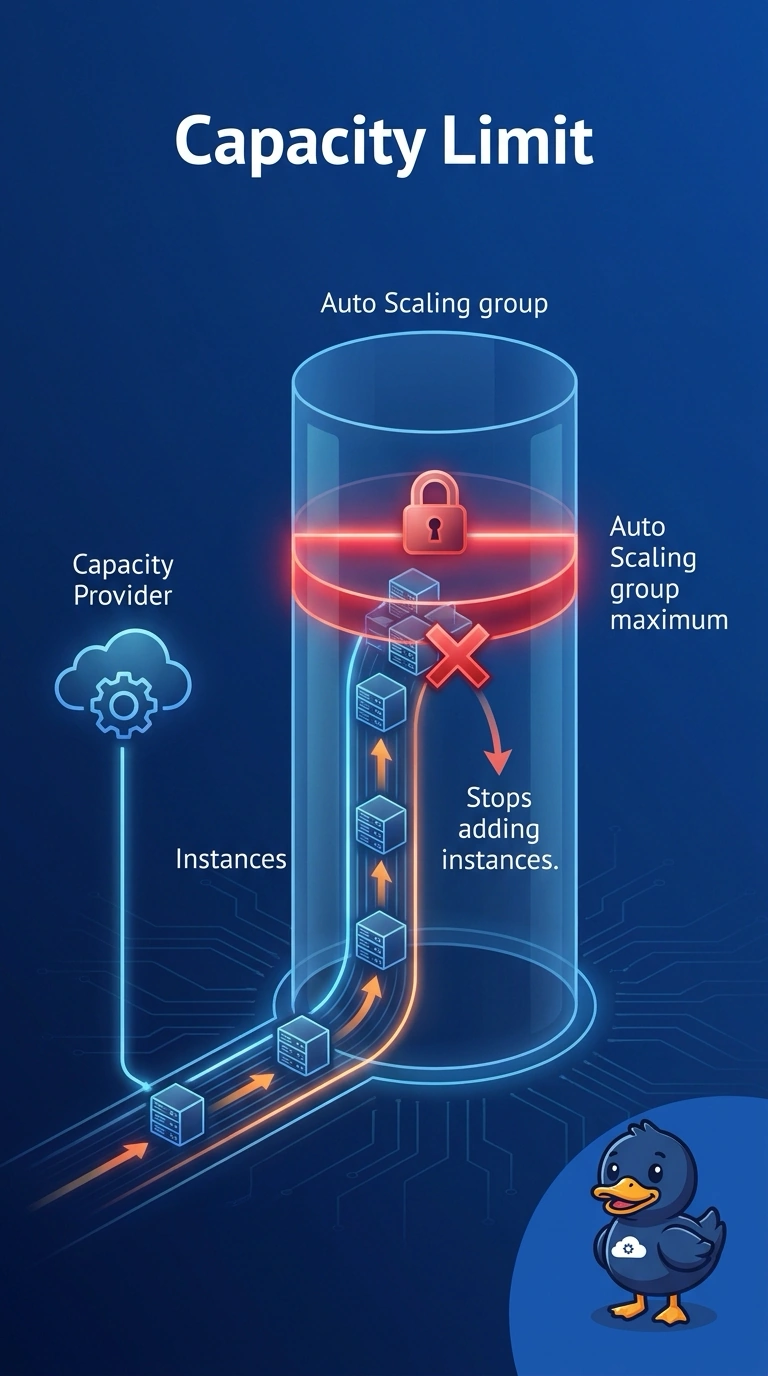
Your capacity provider would add instances, but the Auto Scaling group has reached the maximum you set, so it cannot create more room for pending tasks. A Route 53 weight affects DNS routing, not ECS task placement.
Full Explanation
A capacity provider backed by an Auto Scaling group scales that group when tasks cannot be placed. When the group reaches its maximum size and its instances are full, it cannot add instances, so tasks remain pending. If the pending work is legitimate, raise the Auto Scaling group maximum or free capacity; reducing task size can help when oversized tasks are consuming instance capacity. A CloudFront TTL controls how long content is cached, not ECS task placement or group size. S3 versioning preserves object versions in a bucket; it does not block ECS tasks from starting. A Route 53 weight influences DNS traffic distribution, not task placement or Auto Scaling limits. Exam caveat: managed scaling also respects the group's minimum and the capacity provider's target capacity, so check those if raising the maximum does not resolve scaling. Practical check: confirm the group's desired count can rise above its former maximum, inspect any placement error on pending tasks, and verify that tasks move to running. If desired capacity rises but scaling stops early, check the provider's target capacity.