
Scale-out for a retail Auto Scaling group works, but new instances take several minutes to serve traffic and the warm pool is empty. The team is about to raise only the health-check grace period. What addresses the slow start?
Select an answer to reveal the explanation.
Short Explanation
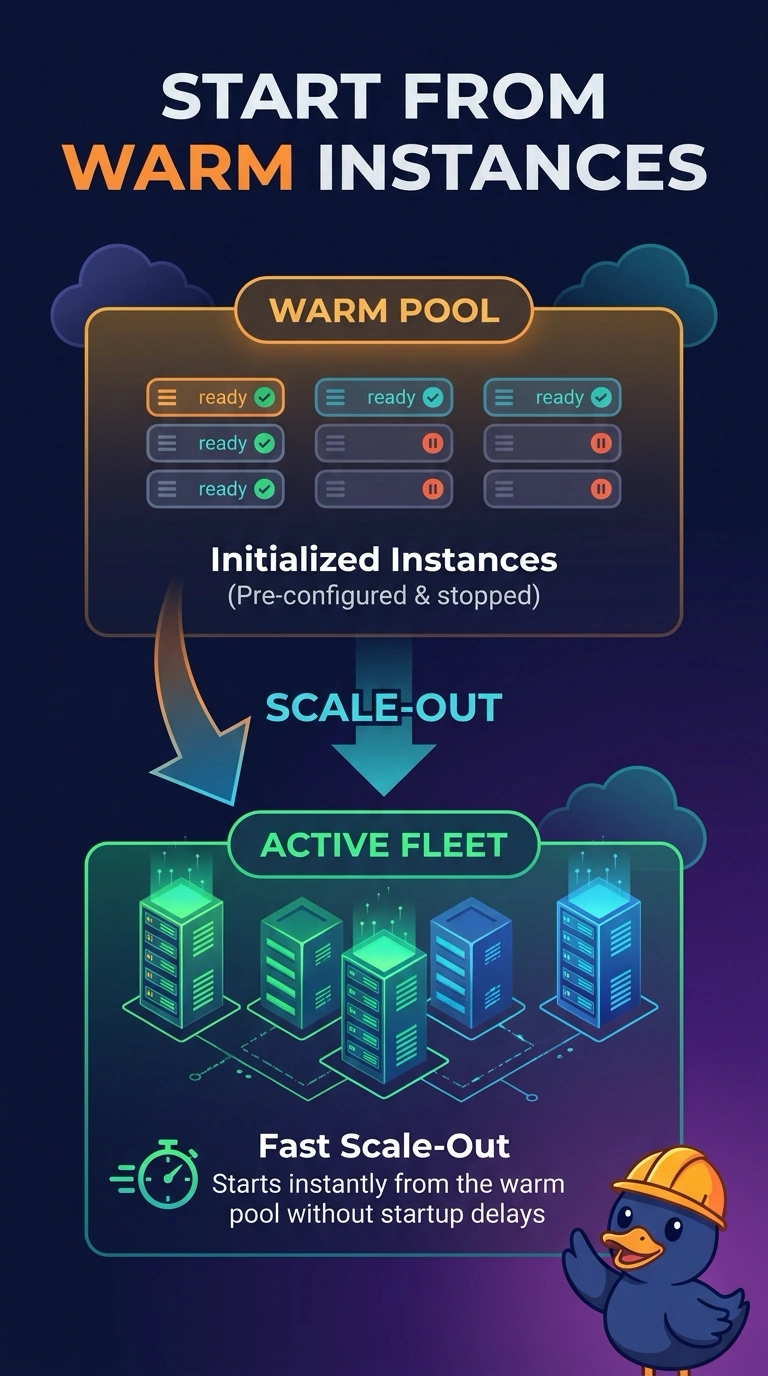
A longer grace period tells the group to wait more patiently for a cold start. It does not preheat anything. You fill the warm pool so the next scale-out wakes instances that already did the slow initialization, because patience is not a warm instance.
Full Explanation
A warm pool keeps initialized instances stopped or running so a scale-out can take them instead of launching from a cold AMI. An empty pool means every scale-out pays the full boot. Raising only the health-check grace period avoids killing instances that are still booting; it does not make the boot faster. Deleting the scaling policy stops scale-out. Transfer Acceleration does not affect instance launch time. Caveat: the warm pool has its own size and reuse policy, and a bad AMI in the pool just makes bad instances available faster. Operational check: the pool should show warm instances, and the next scale-out activity should take less time than a cold launch. The warm pool is configured on the group, with a minimum size and a state of Stopped or Running. Stopped instances skip the longest boot steps and still need a short start. An empty pool means the setting was never given instances or they were not retained. Grace period stays useful so a slow boot is not marked unhealthy, and it is not a substitute for the pool. Time a scale-out before and after the pool has warm capacity.