
Magazine editors replaced an object in the origin this morning, but viewers still receive yesterday's file from CloudFront. No invalidation has been created, and the cached object has not expired. Why do viewers still see yesterday's file?
Select an answer to reveal the explanation.
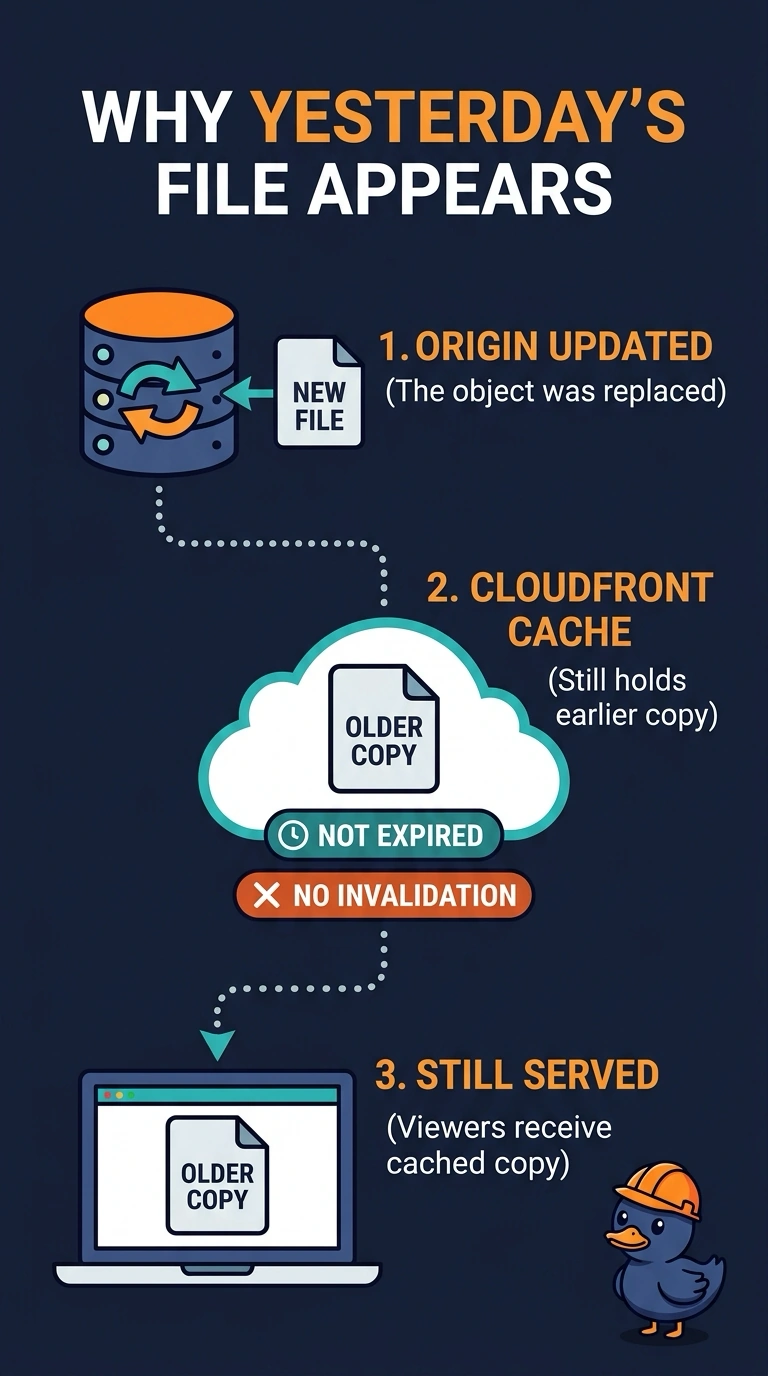
Short Explanation
The newsstand is still selling this morning's stack because nobody pulled it and the sell-by time has not passed. You are seeing yesterday's object because CloudFront still holds a copy that has not expired and was not invalidated. An access-control denial would not hand out the old file, and the load balancer does not replay it.
Full Explanation
CloudFront serves a cached object until that object's lifetime ends or an invalidation removes it. The editors replaced the origin object, but no invalidation has been created and the cached copy has not expired, so viewers keep receiving yesterday's file. Origin access control either allows CloudFront to fetch the origin object or denies it. A denial does not substitute the previous file as a successful response. A Route 53 failover record would send viewers to a different distribution only if that routing were in place, which is not the condition given here. The stale file matches a cache that has not expired. A load balancer idle timeout closes quiet connections. It does not store yesterday's object or replay it to viewers. Caveat: an invalidation applies to the path you submit, and viewers can still see the old object until you invalidate it or the cache lifetime ends. Operational check: create an invalidation for the object path, request it again, and confirm the response matches the file now in the origin.