
A hospital is moving a public DNS name to a new endpoint and wants only a small share of queries to receive the new address. The rest must keep the current endpoint. A geolocation record for one country was proposed. Which policy performs that canary?
Select an answer to reveal the explanation.
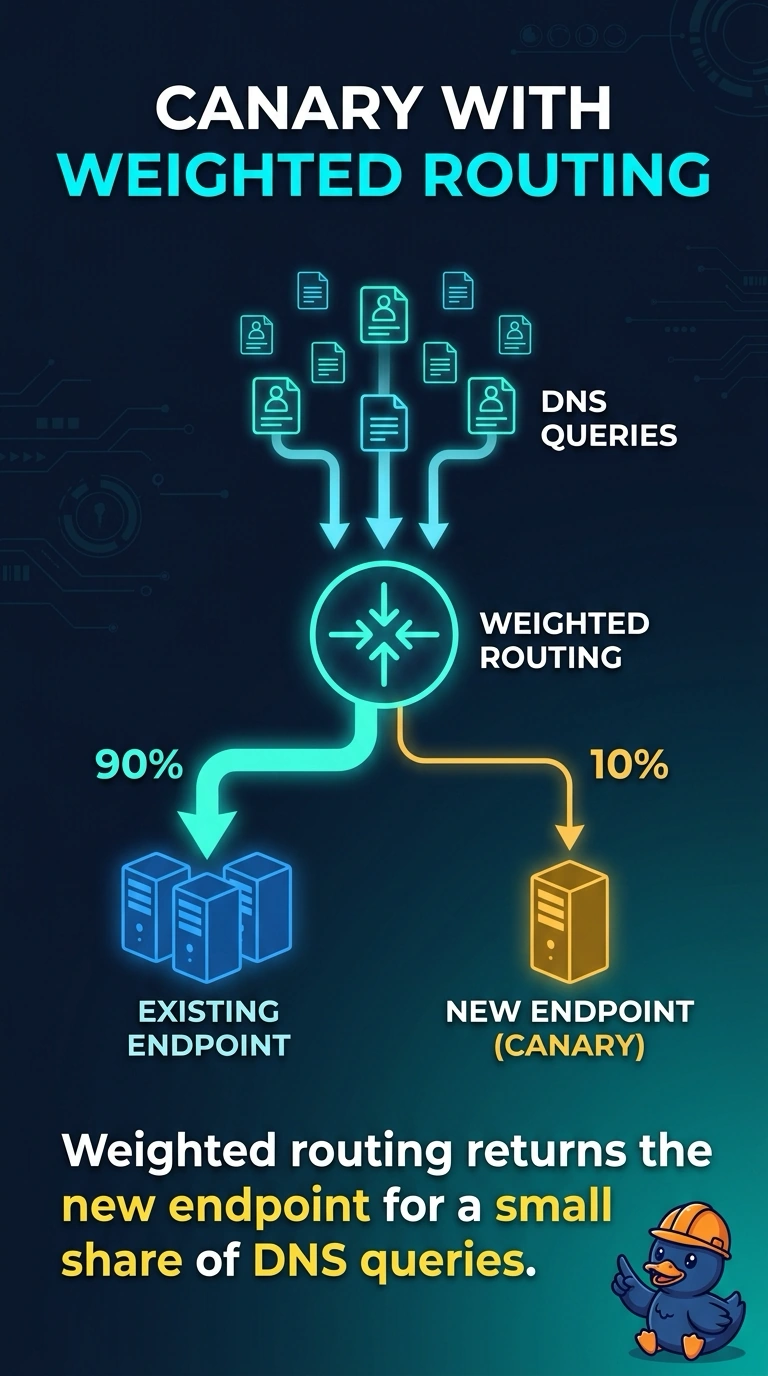
Short Explanation
A canary is a small taste, not a map of one country. You send a small share of the DNS answers to the new endpoint with weighted routing, and everyone else keeps the current address. The trap is geolocation, which cuts over a place instead of a share of the queries.
Full Explanation
Weighted routing assigns relative weights to records for the same name and type. A small weight on the new endpoint and the remaining weight on the current endpoint returns the new address for a small share of queries and keeps the rest on the current endpoint. Failover routing is active-passive and sends queries to the secondary when the primary is unhealthy, not as a steady share while both are healthy. Latency routing selects the lower-latency endpoint for the resolver and will not hold a fixed canary split. Geolocation routing returns the record for the resolver's location, so one country would receive the new endpoint and other countries would not, which is a geographic cut rather than a share of all queries. Weights are ratios, and resolvers cache answers, so the mix clients see lags the weight change for the TTL. Query the name repeatedly from one place and confirm both endpoints appear, with the new endpoint only as the small share. Health checks on the weighted records keep a failing endpoint from receiving its share, which is separate from the size of the weight itself.