
A freight carrier's Route 53 record sends users to a primary Application Load Balancer. DNS must switch to a secondary load balancer only when the primary health check fails. Which routing configuration does that?
Select an answer to reveal the explanation.
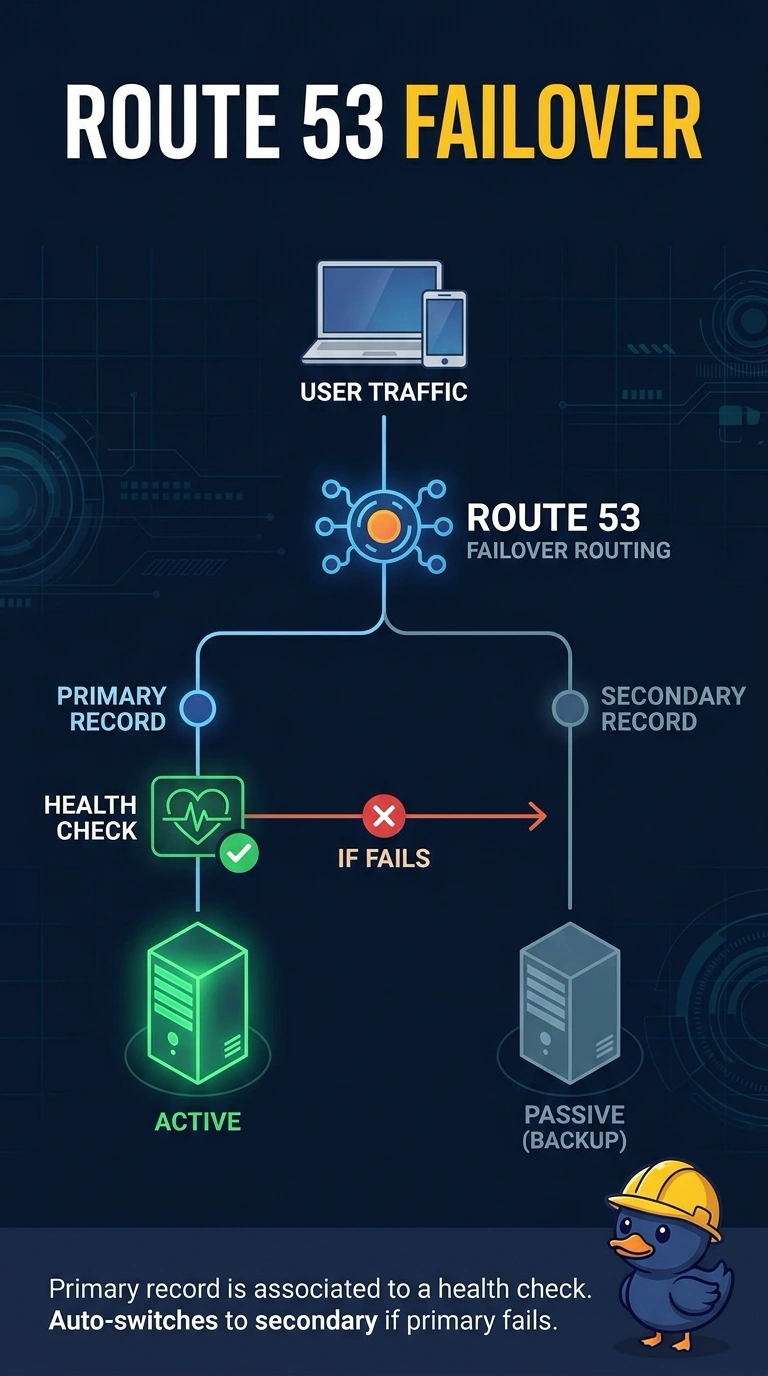
Short Explanation
Failover routing is a light with a sensor: when the primary health check goes dark, DNS answers with the secondary. A weight of 100 and 0 that never looks at health is just a sign you nailed to the primary, including after it falls over.
Full Explanation
Route 53 failover routing returns the primary while its health check passes and the secondary when that check fails. That is the behavior the carrier asked for. A weighted pair frozen at 100 and 0 has no health input, so Route 53 keeps answering with the primary after it is dead. Geolocation chooses by the client's location, not by the health of a designated primary. Multivalue answers can return several healthy records at once, which is not a single primary that moves only on failure. Caveat: the health check must observe the load balancer the users actually depend on, or DNS will fail over while the primary is fine, or refuse to move when it is not. Operational check: review the failover pair, confirm only the primary is primary, and trigger the health check to see the answer change in a test query.