
A Windows line-of-business application must share one folder using SMB and Windows access control lists. Which service should host that share?
Select an answer to reveal the explanation.
Short Explanation
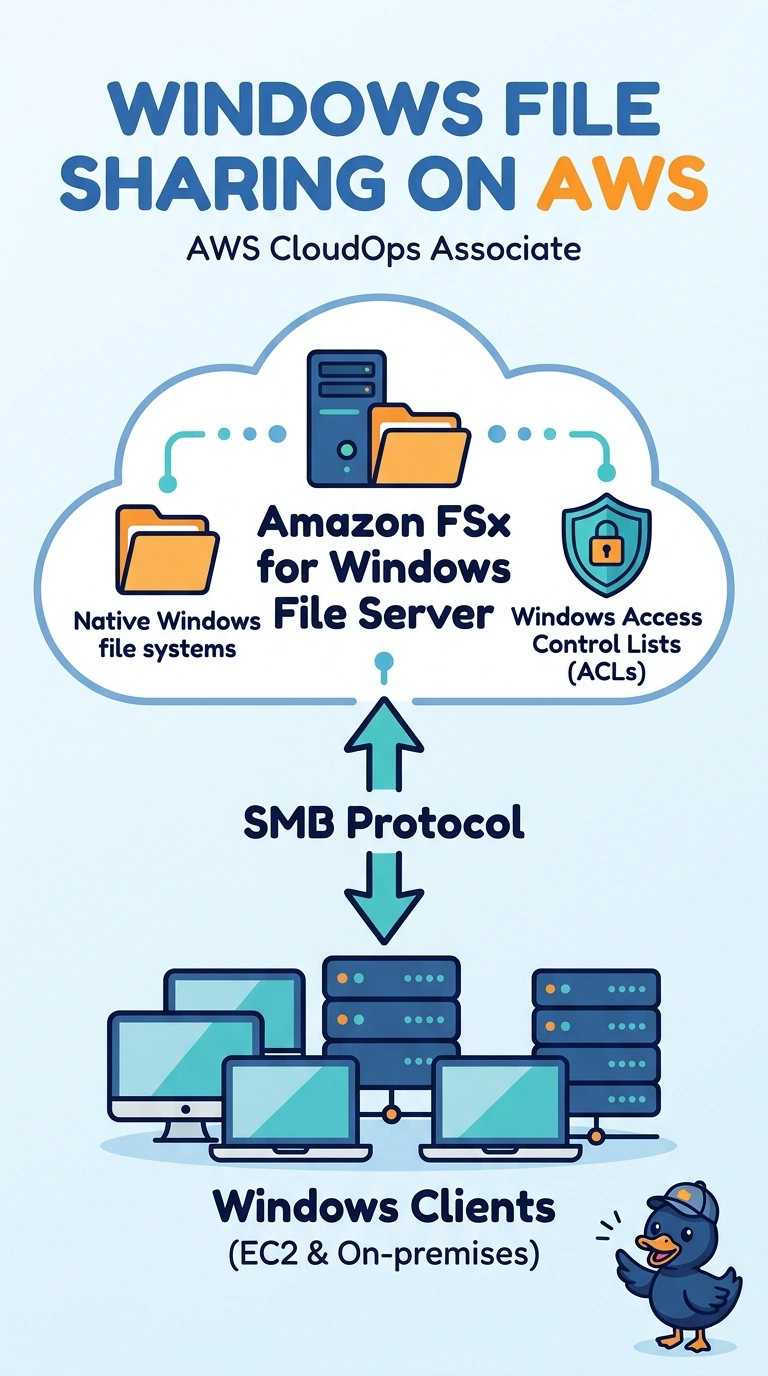
This share speaks SMB, and EFS speaks NFS, so the clinic would be handed the wrong language. You host the folder on Amazon FSx for Windows File Server so Windows clients get SMB and Windows access lists. A single EBS volume cannot be the shared drive for every instance at once.
Full Explanation
The application needs SMB and Windows access control lists. Amazon FSx for Windows File Server presents a Windows file share over SMB and enforces those Windows permissions. That is the service that matches the protocol and the permission model. Amazon EFS is a POSIX file system reached over NFS. A Windows host that can mount NFS is still not receiving an SMB share with Windows access control lists. An S3 website endpoint serves HTTP. It does not map a bucket as an SMB drive with Windows permissions. One NTFS EBS volume attaches in a single Availability Zone. It cannot be the shared folder mounted by every Windows instance at the same time. Caveat: FSx for Windows File Server has to be joined to Active Directory so the access control lists have identities to evaluate. An NFS mount cannot carry Windows access control lists for this line-of-business share, which is why EFS is the wrong protocol. Operational check: from a domain-joined test host, map the SMB share and confirm a permission change on a test folder is enforced for a second user.