
A freight logger writes large sequential files to a data volume. Time is spent moving those bytes, not serving small random reads. An operator wants to raise the gp3 IOPS setting as high as it will go. Which volume change fits this workload?
Select an answer to reveal the explanation.
Short Explanation
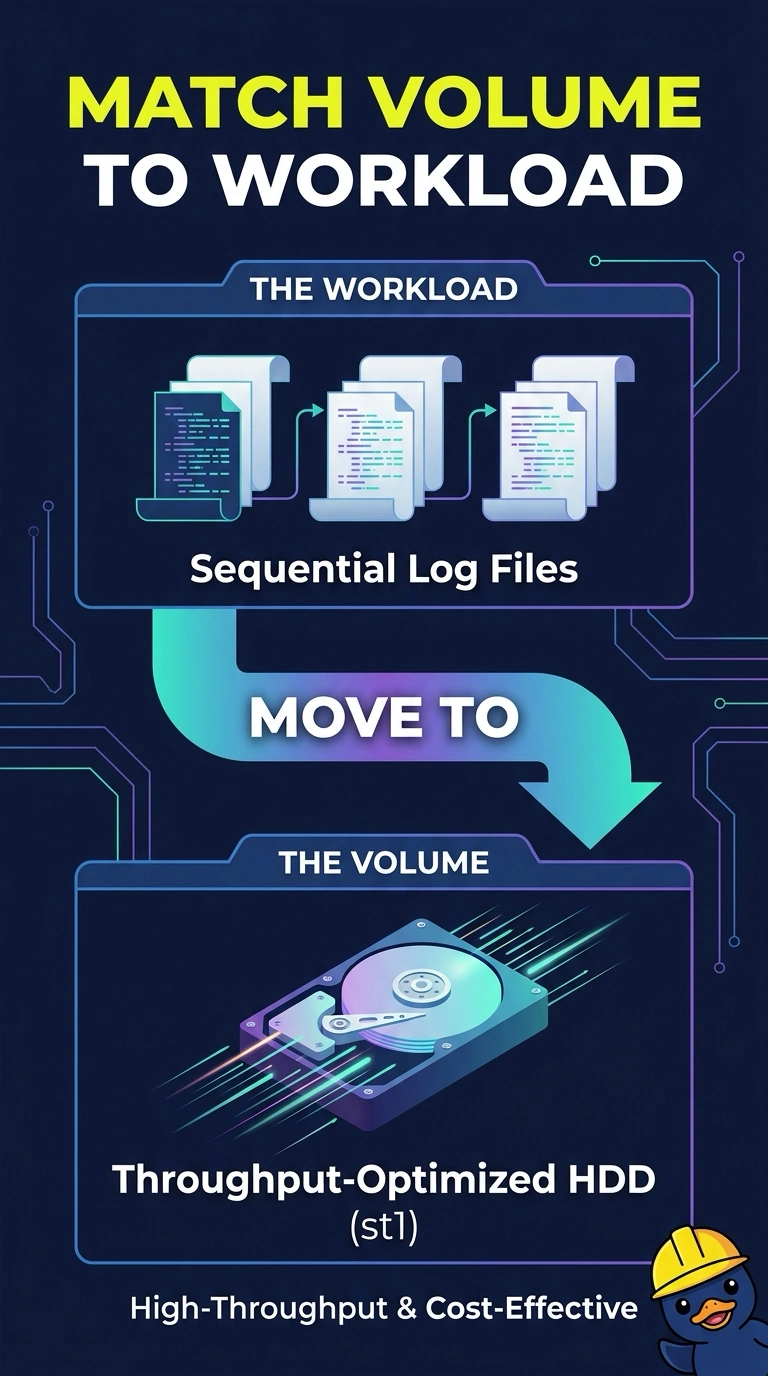
You are buying more parking spaces when the problem is the width of the road. This log volume streams large sequential writes, so a throughput-optimized HDD matches it better than maxing your gp3 IOPS. The IOPS dial is the wrong one for big sequential chunks.
Full Explanation
A throughput-optimized HDD (st1) is the EBS type aimed at frequently accessed, large, sequential I/O such as logs and other streaming writes. The workload described is that pattern, so the log data belongs on st1 and the operating system stays on a separate SSD. Raising the gp3 IOPS control buys random-I/O capacity. It does not retarget the volume at large sequential throughput, which is the axis this logger is actually using. Cold HDD (sc1) is for infrequently accessed sequential data, and neither HDD type can be a boot volume, so a Cold HDD disk that also boots the logger is the wrong tool. An io2 volume is built for sustained IOPS at low latency, which is a database-shaped purchase for a sequential log stream. Caveat: st1 is a poor fit for small random I/O, and the boot volume must remain an SSD because an HDD type cannot be the root disk. Operational check: during a log push, confirm the data volume is the throughput-optimized HDD, the boot volume is unchanged, and queue length on the log volume falls without an IOPS increase on gp3.