
A factory database data volume is gp2 and does random writes. During peak, its EBS burst balance sits at zero and write latency climbs. The team needs more IOPS without a much larger disk. Which change addresses that limit?
Select an answer to reveal the explanation.
Short Explanation
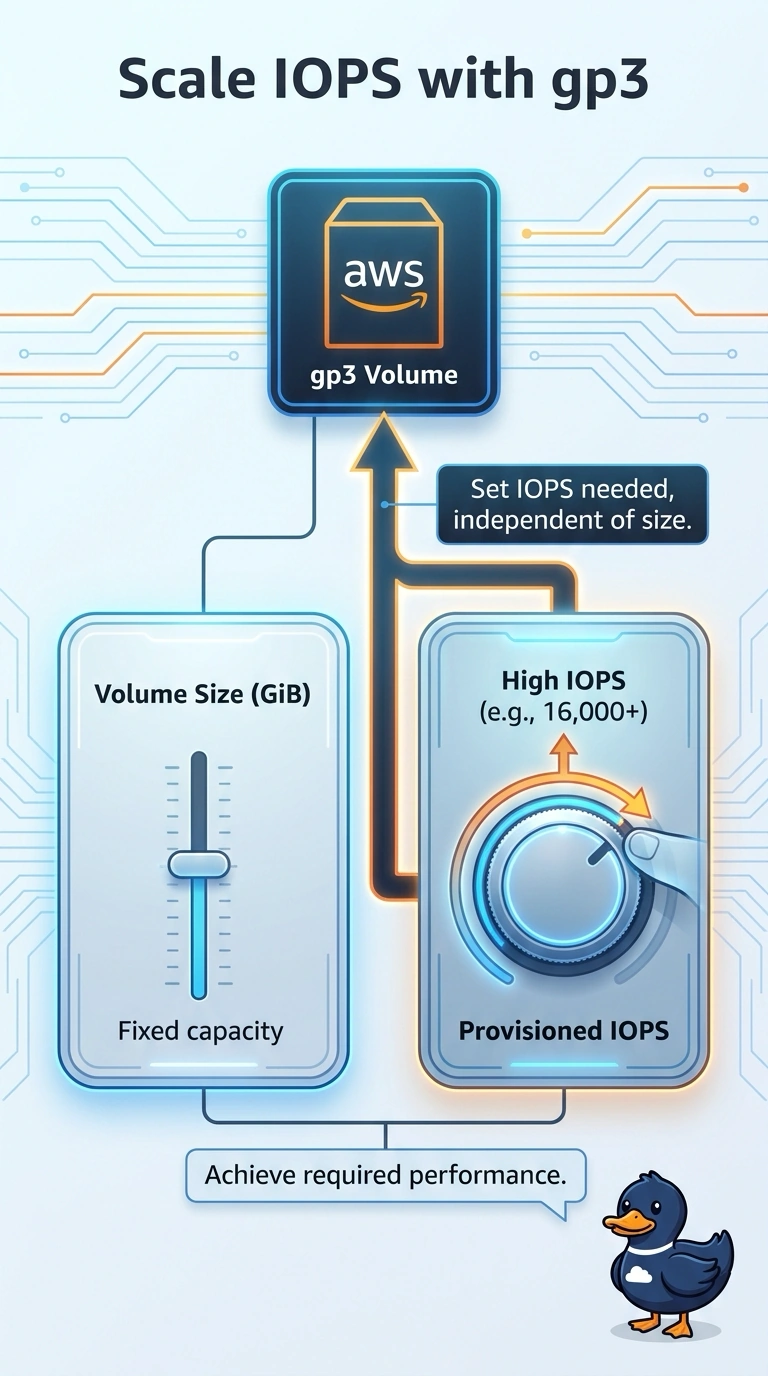
gp2 earns its IOPS by the gallon of disk you buy, then lets you burst until the balance hits empty. You are out of burst and you do not want a bigger gallon. gp3 lets you order the IOPS on their own.
Full Explanation
On gp2, baseline IOPS grows with volume size and extra demand spends a burst balance. A balance stuck at zero means the volume is down to that baseline, which matches the latency. gp3 lets you provision IOPS and throughput apart from size, so a modify to gp3 raises performance without a large capacity purchase. Growing the gp2 volume does raise baseline IOPS, but it is the spend the stem says to avoid. A throughput-optimized HDD is built for large sequential IO, not a database's random writes, and it is a poor fit for this latency. A cluster placement group changes how close instances are to each other; it does not add IOPS to an EBS volume. Caveat: a volume modify has a performance transition and a modification cooldown, so do it in a window and watch the queue length after. Operational check: confirm the volume type is gp3, the provisioned IOPS match the plan, and burst balance is no longer the metric you depend on.