
A media streaming platform runs CloudFront, API Gateway, Lambda, and DynamoDB with strict latency SLOs and needs to decide log sources, metrics, and retention before building dashboards. Architects must map critical user journeys to observability inputs and compliance needs. Which analysis approach best determines monitoring requirements for the workload?
Select an answer to reveal the explanation.
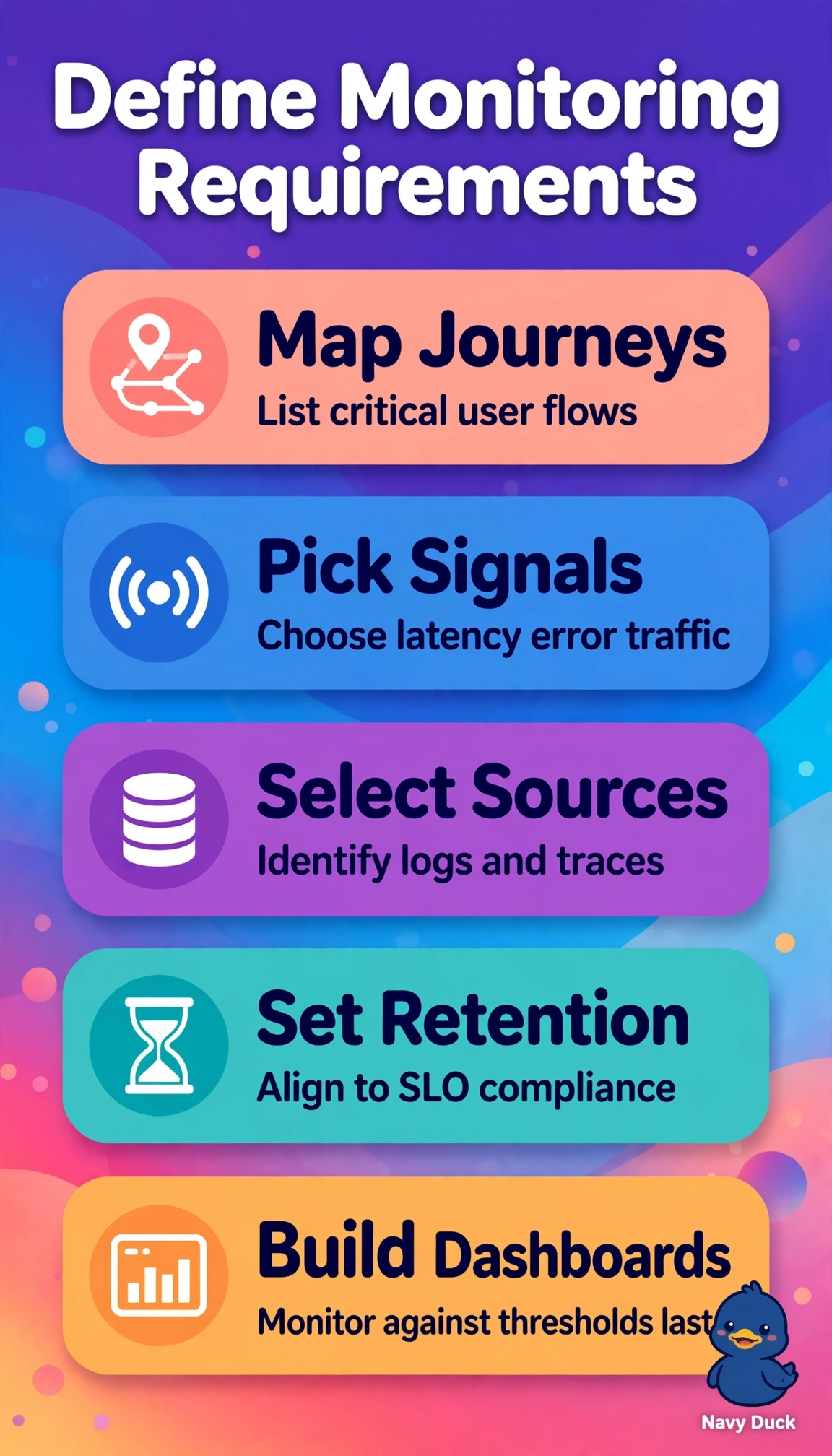
Short Explanation
Dashboards come last, requirements come first. Mapping journeys to telemetry-needs tells you exactly what to log and how long to keep it.
Full Explanation
The correct approach profiles critical transactions because latency SLOs for journeys like playback, search, and purchase dictate which CloudFront, API Gateway, Lambda, and DynamoDB metrics, logs, and traces prove performance and where retention must support both diagnosis and compliance before dashboards are designed. Assessing infrastructure capacity trends is valuable for scaling and cost forecasting, yet it focuses on resource utilization rather than user-journey success, so it cannot select transaction-level signals or SLO burn indicators. Reviewing compliance audit mandates is necessary to set legal retention floors, yet it defines how long to keep data rather than which telemetry captures latency across distributed components. Inventorying service quota limits helps prevent throttling and documents API ceilings, yet it addresses platform constraints rather than mapping observability inputs to business-critical flows. A common exam caveat is to choose the answer that covers journeys, signals, and retention together when the stem explicitly links them, rather than a partial practice that satisfies only operations, governance, or limits. A practical check is to take one latency-sensitive journey, state its SLO, then confirm every proposed metric, log source, trace span, and retention value directly proves or troubleshoots that objective.