
A regional bank stores 40 TB of loan records in S3 Standard that auditors must be able to read but no one can delete for 7 years, and finance requires lower storage cost after 90 days without manual jobs. Versioning is enabled. Which S3 retention and lifecycle design meets the immutability and cost requirements?
Select an answer to reveal the explanation.
Short Explanation
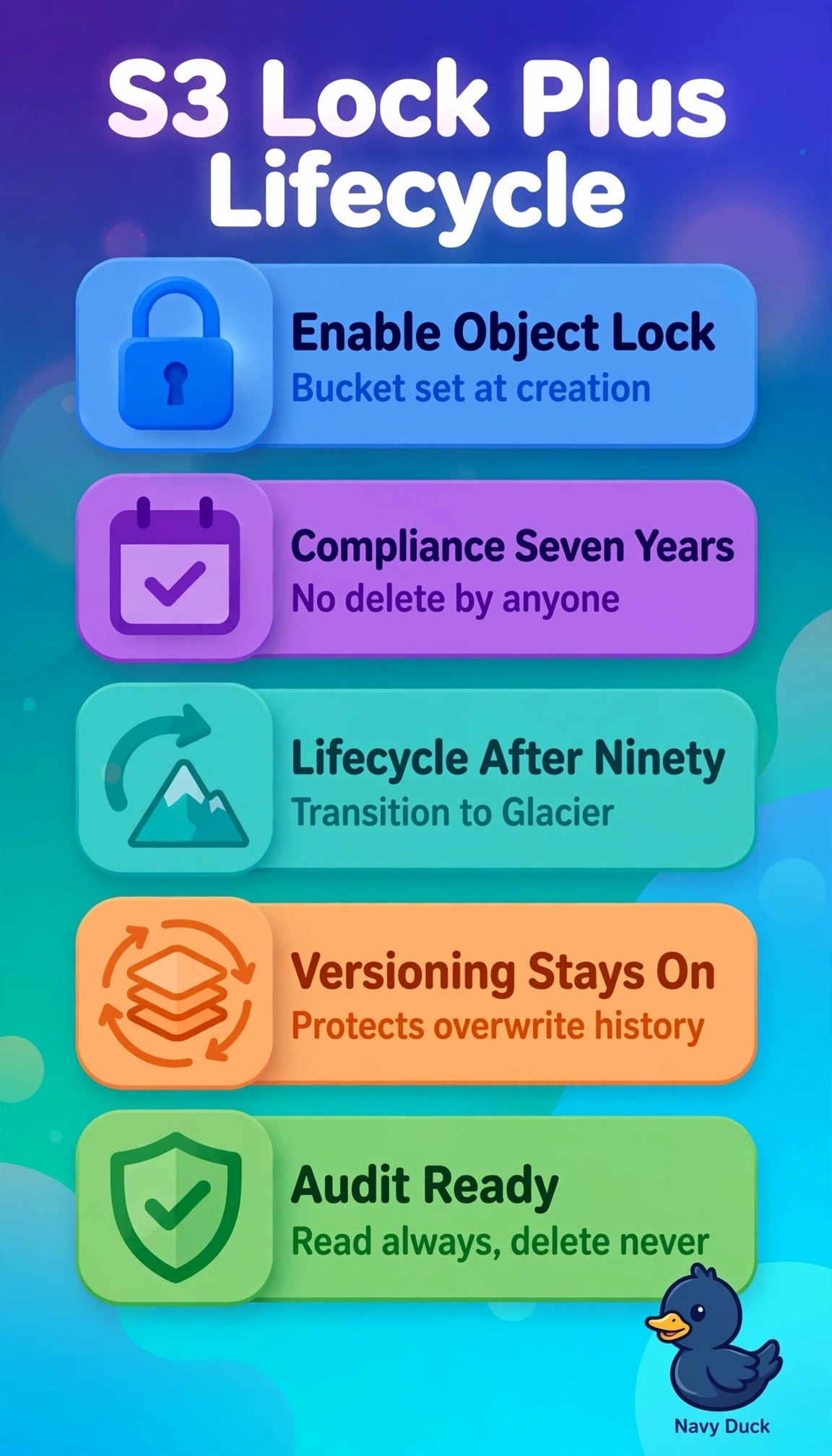
You get both a vault and a thermostat here. Compliance-mode Object Lock keeps auditors happy for seven years while Lifecycle quietly trims your bill after day 90.
Full Explanation
S3 Object Lock in Compliance mode enforces write-once-read-many retention that even the root user cannot shorten, satisfying the seven-year non-deletable audit requirement, and a Lifecycle transition action moves objects to Glacier Flexible Retrieval after 90 days to reduce cost without deleting them or requiring manual jobs. Versioning with MFA Delete still allows privileged deletion and does not provide time-based immutability, so it fails the strict retention mandate. Governance mode with expiry after 90 days allows privileged users to bypass retention and would delete data far too early, violating both immutability and durability. Intelligent-Tiering with bucket policies cannot provide Object Lock retention guarantees and policy denies are reversible, so they do not meet regulated WORM controls. Exam caveat: remember Compliance mode cannot be shortened by anyone, while Governance mode allows bypass with special permission. Practical check: verify Object Lock is enabled on the versioned bucket (it can be enabled at creation or on an existing bucket) and test Lifecycle transitions in a non-production prefix first.