
A manufacturer must migrate a 4 TB Oracle database with stored procedures to Aurora PostgreSQL with under 30 minutes downtime, plus 12 TB of NFS engineering files to S3 with permissions preserved. Cutover is in 6 weeks. Which database and data migration strategy combines DMS with DataSync?
Select an answer to reveal the explanation.
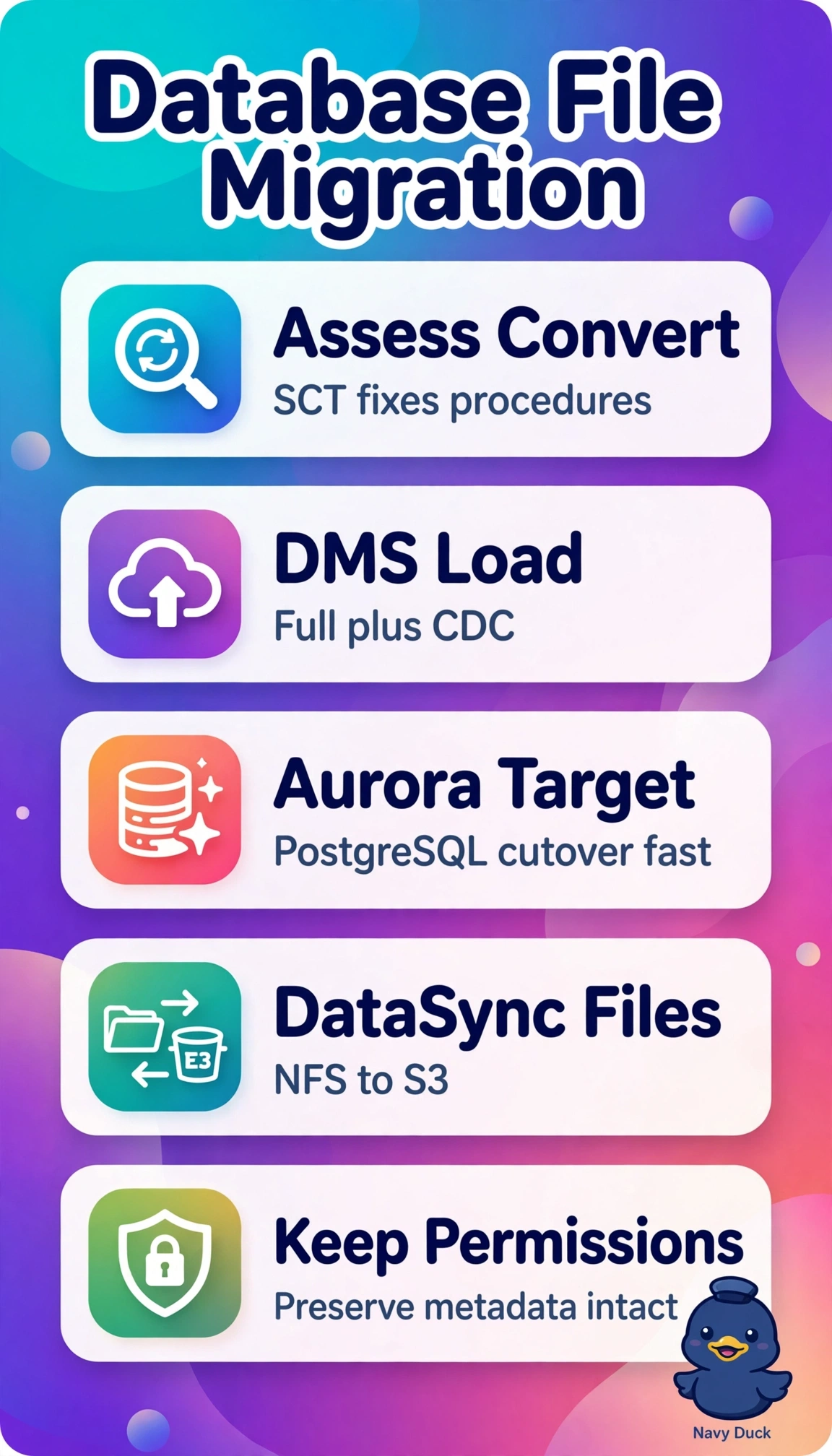
Short Explanation
Databases and files move very differently under pressure. Pairing DMS replication with file sync hits your downtime and permissions goals together.
Full Explanation
The correct strategy succeeds because DMS full load plus ongoing CDC keeps the 4 TB Oracle source and Aurora PostgreSQL target synchronized until cutover, enabling switchover within the 30-minute window, while SCT handles heterogeneous conversion of schema and stored procedures from Oracle PL/SQL to PostgreSQL, and DataSync efficiently transfers 12 TB of NFS files to S3 with metadata and permissions preserved plus scheduling and validation suited to the six-week timeline. A full load without CDC fails on continuity concept because copying terabytes without continuous replication forces a prolonged outage for final delta copy and validation. Omitting SCT conversion fails on heterogeneity concept because DMS replicates tables and changes but does not automatically rewrite procedural logic, data types, and functions that require assessment and conversion. Directing DataSync to EFS instead of S3 fails on target-service concept because despite preserving file semantics it places engineering data on the wrong storage with different durability, cost, access, and lifecycle characteristics. Exam caveat: carefully distinguish DMS for database replication, SCT for schema and code conversion, and DataSync for file transfer, since prompts often test confusing database replication with file synchronization. Practical check: run an SCT assessment, size the DMS instance and monitor CDC latency, then run DataSync discovery with a permissions audit and S3 prefix verification before final cutover.