
A national retailer runs checkout microservices on Amazon EKS in us-east-1 with stateless services, ECR images, and DynamoDB global tables. Leadership requires survival of a full Regional outage with minutes-level failover and identical Kubernetes manifests in both Regions. Which multi-cluster container strategy provides high availability and disaster recovery for Amazon EKS?
Select an answer to reveal the explanation.
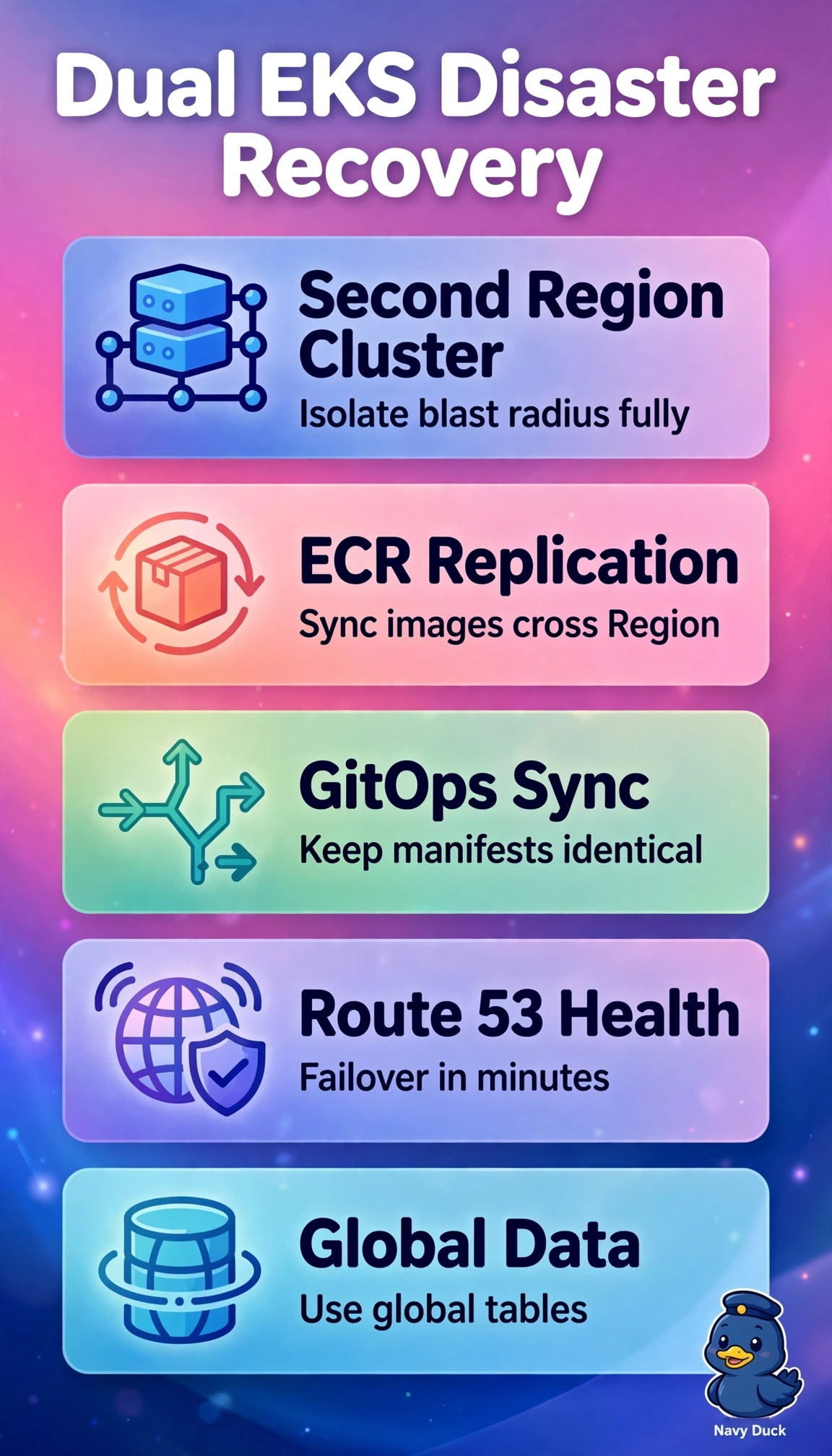
Short Explanation
You've got regional survival on the line, so dual clusters win every time. Replication plus GitOps keeps both sides identical and failover stays fast and clean. A single Region can't survive a Regional outage.
Full Explanation
A second EKS cluster in a separate Region provides true fault isolation for Regional disaster recovery, while Amazon ECR cross-Region replication ensures identical container images are available without rebuild delay and a GitOps controller keeps Kubernetes manifests synchronized to avoid configuration drift. Amazon Route 53 health-based routing detects Regional failure and shifts traffic within minutes, satisfying the failover objective while DynamoDB global tables preserve data continuity outside the container layer. Scaling one EKS cluster across Availability Zones protects against zonal failure but leaves all control-plane dependencies in one Region and therefore fails the Regional outage requirement. Migrating to a single ECS Fargate cluster improves serverless operations but retains the same single-Region fate-sharing and does not address cross-Region image or manifest parity. Running two Regions with independent manual manifests and long DNS TTL undermines consistency and slows failover, violating identical-manifest and minutes-level recovery goals. Exam caveat: distinguish multi-AZ high availability from multi-Region disaster recovery for containers. Practical check: verify ECR replication status, GitOps sync health, and Route 53 health check failover in a game day.