
A retailer runs a ten-year-old monolithic order system on EC2 with frequent outages. Leadership wants to decompose to microservices and serverless incrementally without a risky big-bang rewrite, keeping the storefront online during migration. Which refactor strategy enables incremental modernization?
Select an answer to reveal the explanation.
Short Explanation
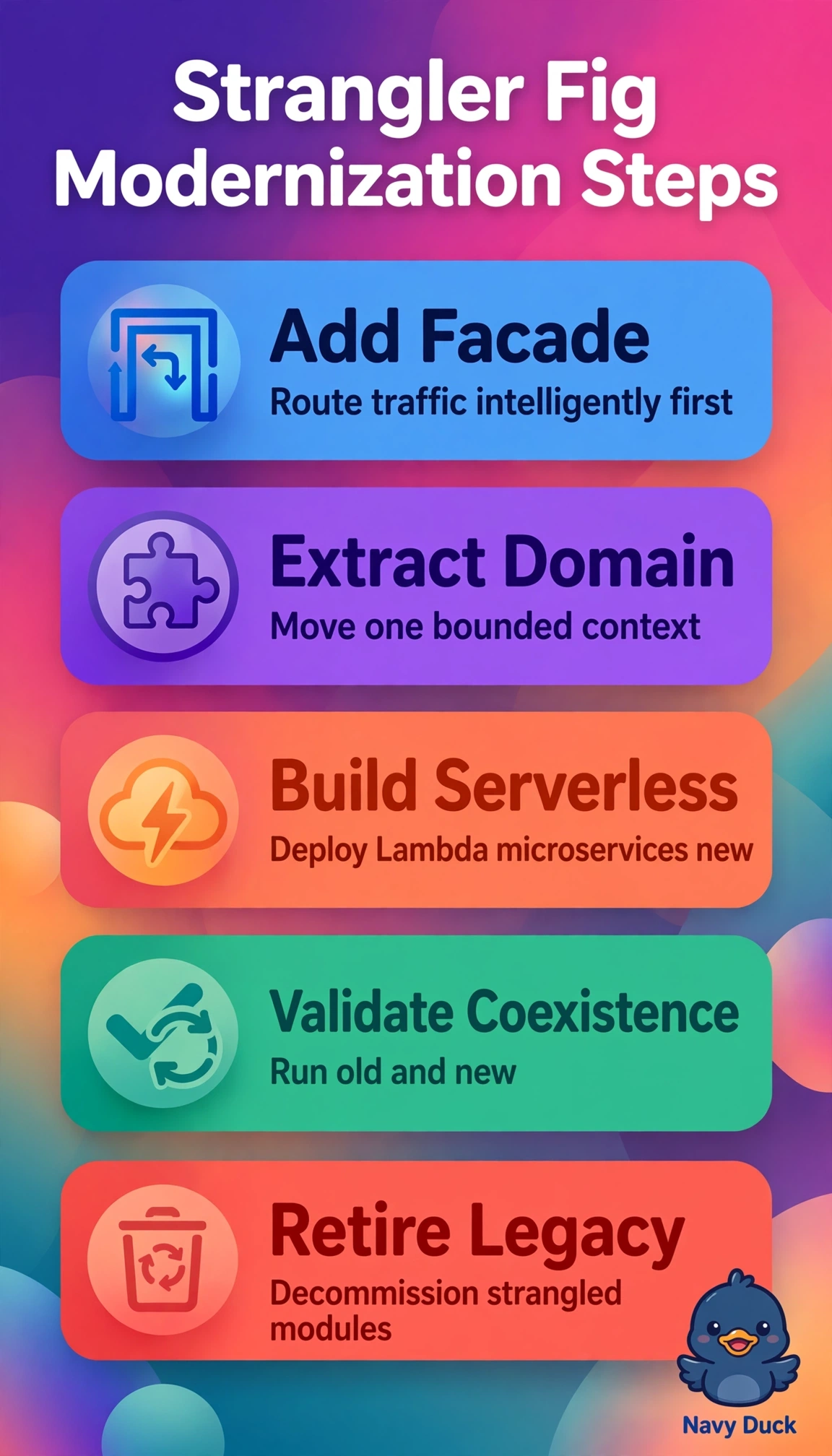
You're rebuilding the ship while it sails, one deck at a time. Strangler fig peels off order or inventory routes behind a facade, so wins land early without sinking the storefront.
Full Explanation
The correct strategy succeeds because the strangler fig pattern places a routing facade over the legacy order system and progressively redirects bounded contexts such as inventory, checkout and fulfillment to independently deployable microservices and Lambda functions, which satisfies incremental decomposition, serverless adoption, continuous storefront availability and avoidance of big-bang risk in a single coherent migration. The replatforming approach fails by concept of rehost versus refactor, since moving the unchanged monolith to Fargate with autoscaling improves resilience but preserves tight coupling and a single deployment unit and therefore does not achieve decomposition to microservices and serverless. The EKS extraction approach fails by target architecture, since incremental containerized microservices with weighted routing meet incrementality and availability goals but retain always-on servers and operational overhead instead of delivering the mandated Lambda-based serverless operating model. The facade caching approach fails by strangler scope, since adding serverless edges for reads while leaving all transactional writes in EC2 code leaves the monolith as the system of record and never retires legacy domain logic. For exams, distinguish replatform and refactor triggers carefully, as stability alone does not satisfy a decomposition prompt even when autoscaling is mentioned. In practice, verify incrementality by confirming each domain has its own data store, cutover route and rollback path with storefront health monitored continuously during traffic shifting.