
A retail group has sales data in three member accounts registered to S3, needs governed cross-account discovery of curated tables only, plus privacy-preserving joins with a supplier without sharing raw data. Which data cataloging and sharing pattern meets all needs?
Select an answer to reveal the explanation.
Short Explanation
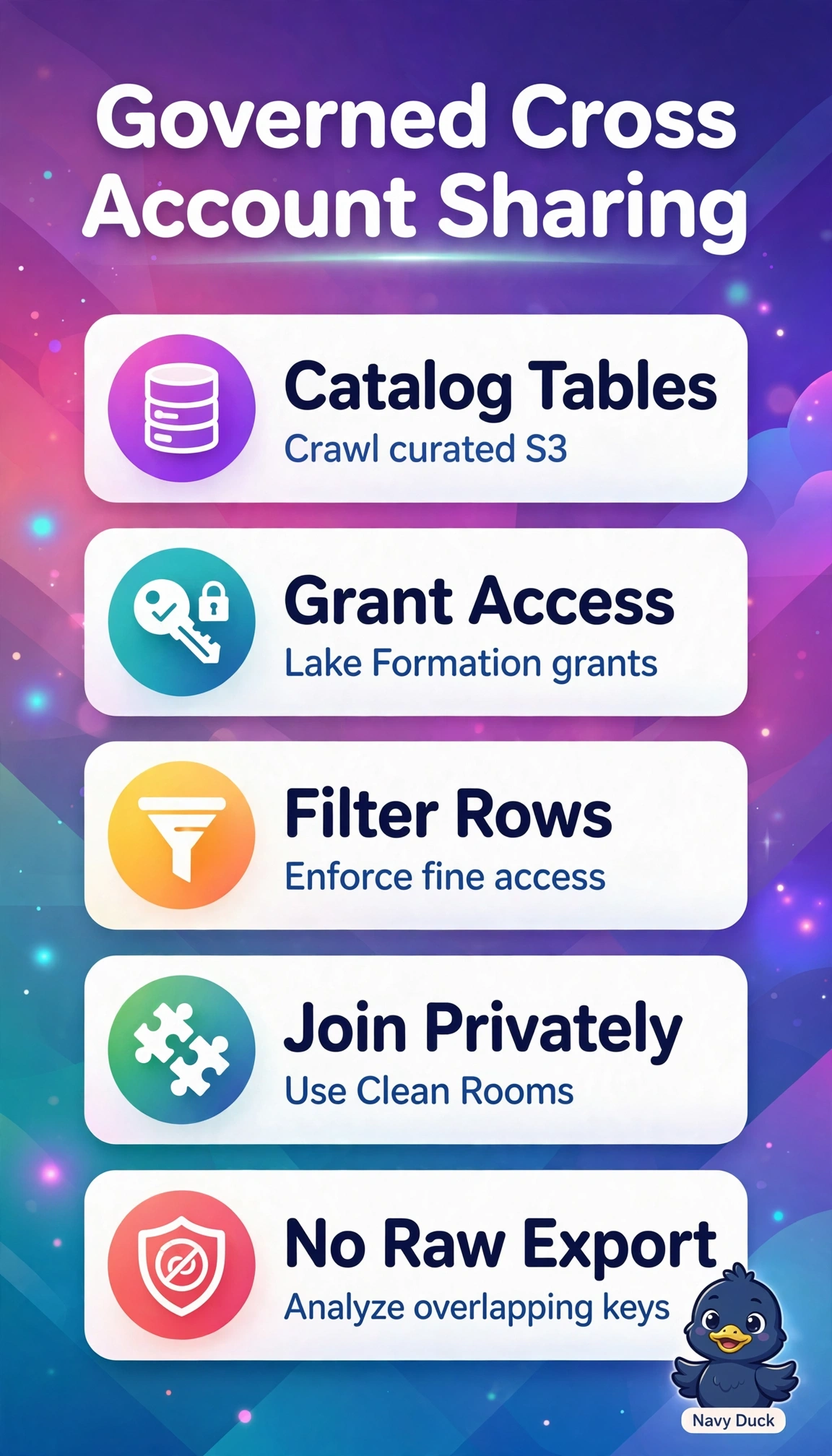
You've got the right touch when you share only curated Glue tables using cross-account Lake Formation grants while your raw data stays locked away. You're letting the supplier compare shopping lists through a frosted window, so your Clean Rooms overlap check stays private yet useful.
Full Explanation
The correct pattern succeeds because Lake Formation cross-account grants provide column, row, and tag-based governance so analysts in member accounts can discover only the curated tables while the underlying S3 locations remain protected, and AWS Clean Rooms then enables the retail group and supplier to run SQL overlap and measurement on configured tables with cryptographic controls and no raw data movement. One distractor describing a central Glue catalog with Lake Formation tags is architecturally sound for intra-group governance but fails on collaboration concept because cataloging alone does not create a privacy boundary, leaving the supplier join to require direct table or file access. Another distractor that includes bronze and curated tables with Lake Formation and Clean Rooms correctly uses both services but fails on data minimization because exposing uncurated zones widens schema drift, quality risk, and sensitive attributes beyond the stated curated-only scope. The remaining distractor using Glue resource policies plus Clean Rooms correctly preserves privacy for the join but fails on governance concept because resource policies alone provide coarse access without fine-grained permissions, audit, and LF-tag enforcement across accounts. An exam caveat is that DataZone, Glue catalog sharing, and Clean Rooms often appear together, so focus on which service enforces governed access versus which enables governed discovery versus which enforces privacy-preserving computation. As a practical check, confirm the grant principals see only the curated database with Describe and Select, the S3 data locations are registered with Lake Formation, and the Clean Rooms collaboration uses configured tables and analysis rules that prohibit raw export.