
A fintech startup will operate 150 VPCs across dev, test, and prod with overlapping team CIDRs, must prevent IP exhaustion, enforce segmentation between tiers, and provide auditors with a single view of allocations. Which VPC addressing and segmentation design ensures scalable isolation?
Select an answer to reveal the explanation.
Short Explanation
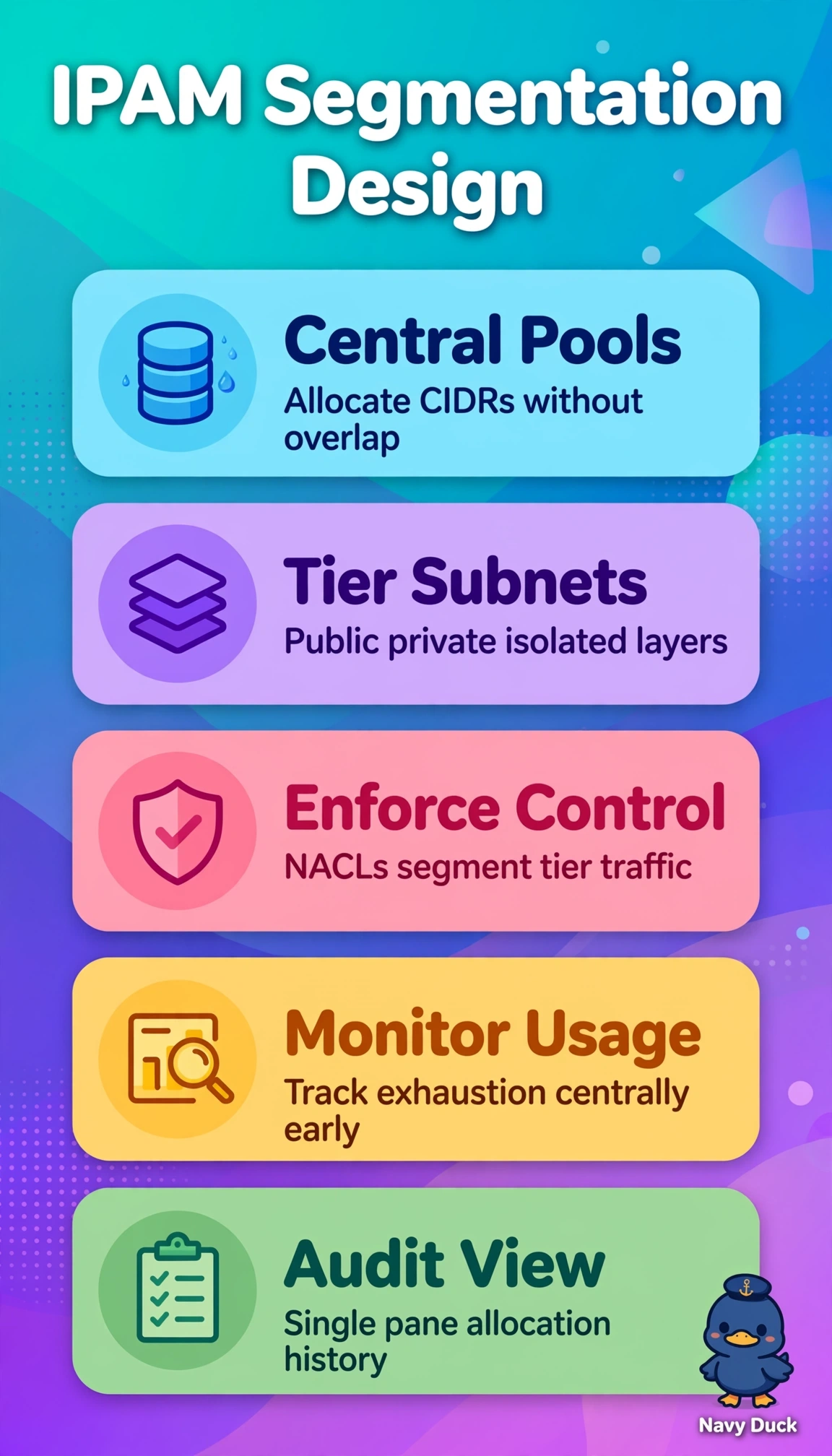
You'll outgrow spreadsheets fast with 150 VPCs, like trying to run a library with sticky notes. IPAM gives you automatic, non-overlapping pools plus tiered subnets that keep your traffic neatly separated for auditors.
Full Explanation
VPC IPAM provides centralized automated CIDR planning, hierarchical pools per environment, overlap detection, and utilization monitoring across 150 VPCs, while tiered public, private, and isolated subnets with NACLs and route tables enforce network segmentation and auditors gain a single allocation view. Manual /16 assignments with spreadsheets risk overlap, waste address space, cause exhaustion, and lack enforcement or live visibility. A single large shared VPC with flat subnets violates blast-radius isolation and mixes dev, test, and prod contrary to segmentation requirements. Using tiny /28 blocks limits host capacity and full peering creates transitive complexity without addressing planning or tier isolation. For the exam, link large multi-VPC growth to IPAM plus structured subnets, and verify pool hierarchy, compliance rules, and NACL plus security group layering.