
A global streaming platform serves 20M requests daily from an ALB origin in one Region, seeing high origin load, cache misses on popular videos, and outages when the origin fails. Viewers span continents and demand low latency with resilient failover. Which content delivery design using origin selection caching and failover should the architect implement?
Select an answer to reveal the explanation.
Short Explanation
You need neighborhood pantries plus a backup warehouse. CloudFront with Shield is like local stores stocked from a regional hub with a spare supplier.
Full Explanation
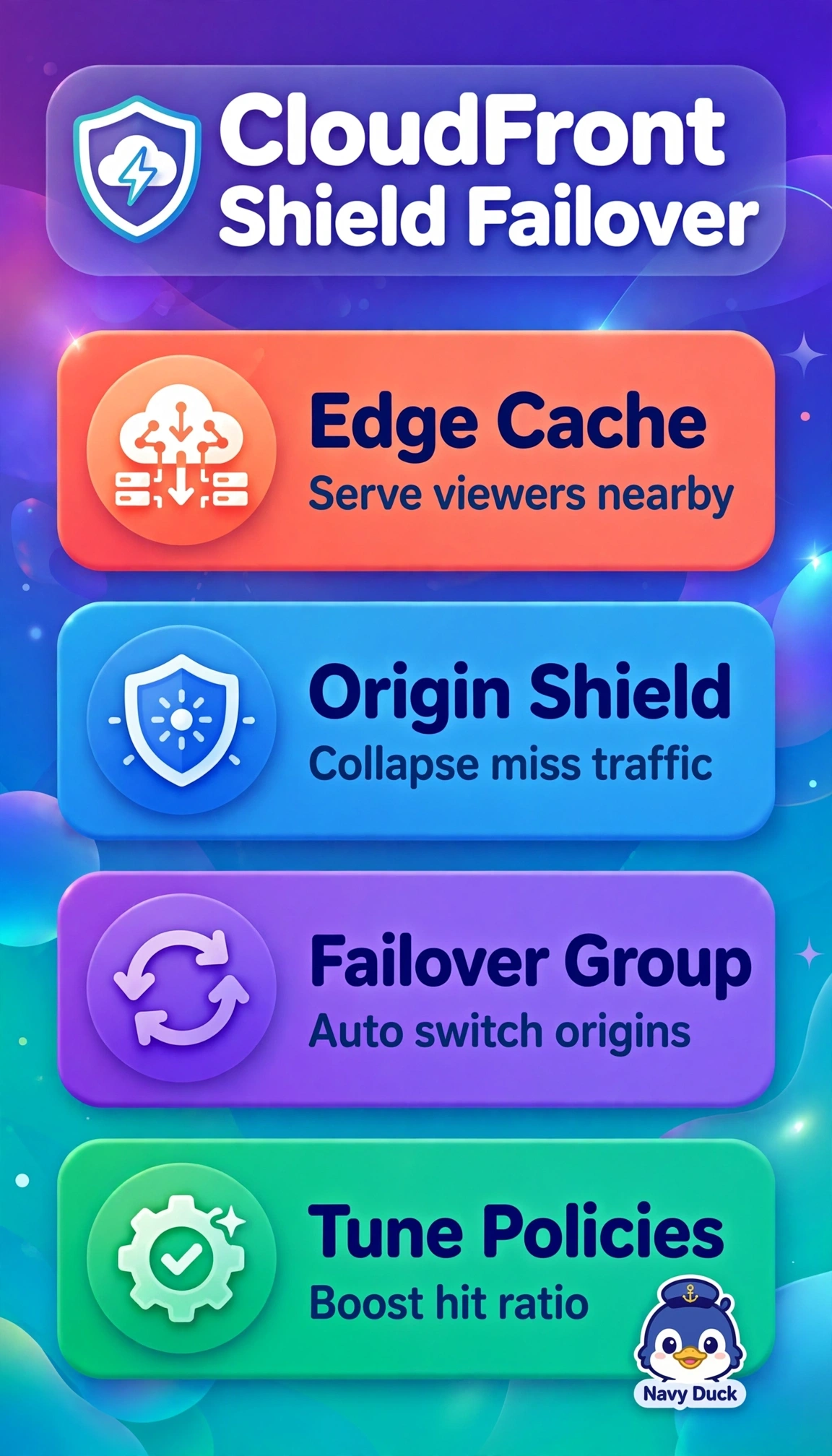
The correct design succeeds because CloudFront terminates viewer requests at global edge locations and applies optimized cache policies for video objects, raising hit ratio for popular content and lowering intercontinental latency for 20M daily requests, while Origin Shield adds a regional mid-tier cache that collapses concurrent misses into one origin fetch to protect the single-region ALB from overload, and built-in origin failover continuously health-checks the primary and shifts to the secondary origin on failure for resilient delivery. The CloudFront design without Shield or failover fails on origin protection and resilience because dispersed edges still forward misses directly to the same ALB, preserving thundering-herd load and a single point of failure. The Route 53 failover design between ALB origins fails on acceleration because DNS health checks improve availability but provide no edge caching, request collapsing, or protocol optimization, so latency remains high and every repeat view still reaches the origin. The ElastiCache design in front of the ALB fails on distribution because regional in-memory caching eases compute pressure locally but never moves bytes closer to distant viewers and offers no CDN failover, leaving global latency and regional outage risk unresolved. The exam caveat is that global scale plus cache misses plus origin outage together point to edge CDN with Shield and failover, not to DNS routing or regional caching alone. The practical check is to monitor cache hit ratio, origin request volume, and failover metrics in CloudWatch and rehearse primary-origin failure during peak replay to confirm uninterrupted low-latency playback.