
A trading platform runs active-passive in us-east-1 and eu-west-1 with Aurora Global Database, requiring automatic DNS failover in 60 seconds and controlled traffic shifting with rollback. Which multi-Region disaster recovery design using replication and failover features achieves rapid automated recovery?
Select an answer to reveal the explanation.
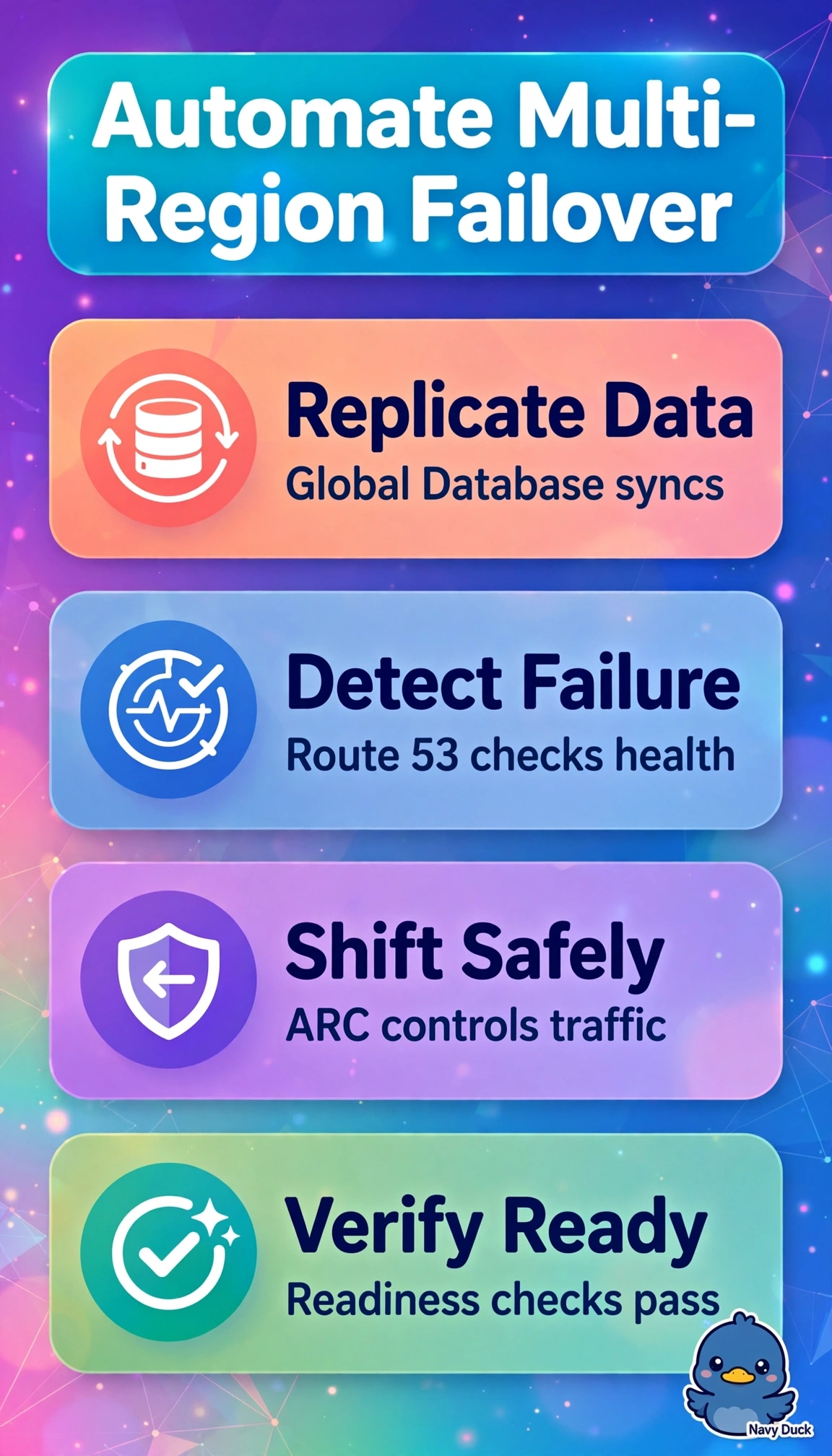
Short Explanation
You're wiring fast detection to safe steering. Health checks spot trouble while ARC lets you shift and undo cleanly, and orchestration turns panic into procedure.
Full Explanation
Aurora Global Database provides low-latency cross-Region storage replication for fast RPO, Route 53 health checks detect endpoint failure and trigger DNS failover to the secondary Region, and Amazon Application Recovery Controller routing controls and their safety rules enable controlled, reversible traffic shifting for application recovery. Global Accelerator improves availability but manual AMI copy is slow and non-automated, violating the 60-second automated requirement despite replication. Periodic snapshot copy yields higher RPO and slower promotion than Global Database continuous replication, so it cannot meet rapid recovery even with correct routing. CloudFront signed URLs control content access, not inter-Region failover, and zonal autoshift handles zonal events within a Region rather than orchestrated multi-Region failover. For the exam, pair continuous data replication with health-based routing plus ARC safety, and in practice validate routing control states, Route 53 TTLs, and ARC safety rules before game days.