
A bank deploys a SageMaker credit model with 50ms SLA, nightly retraining, and Bedrock agents assisting analysts. Drift and slow agent tool calls recently caused mis-scores. Which monitoring design tracks model performance, inference latency, agent behavior, and drift?
Select an answer to reveal the explanation.
Short Explanation
You’ll catch silent score slips like you’d spot a leaky faucet before it floods your kitchen. Model Monitor watches your drift and quality while CloudWatch alarms and log insights keep your latency and agent steps honest.
Full Explanation
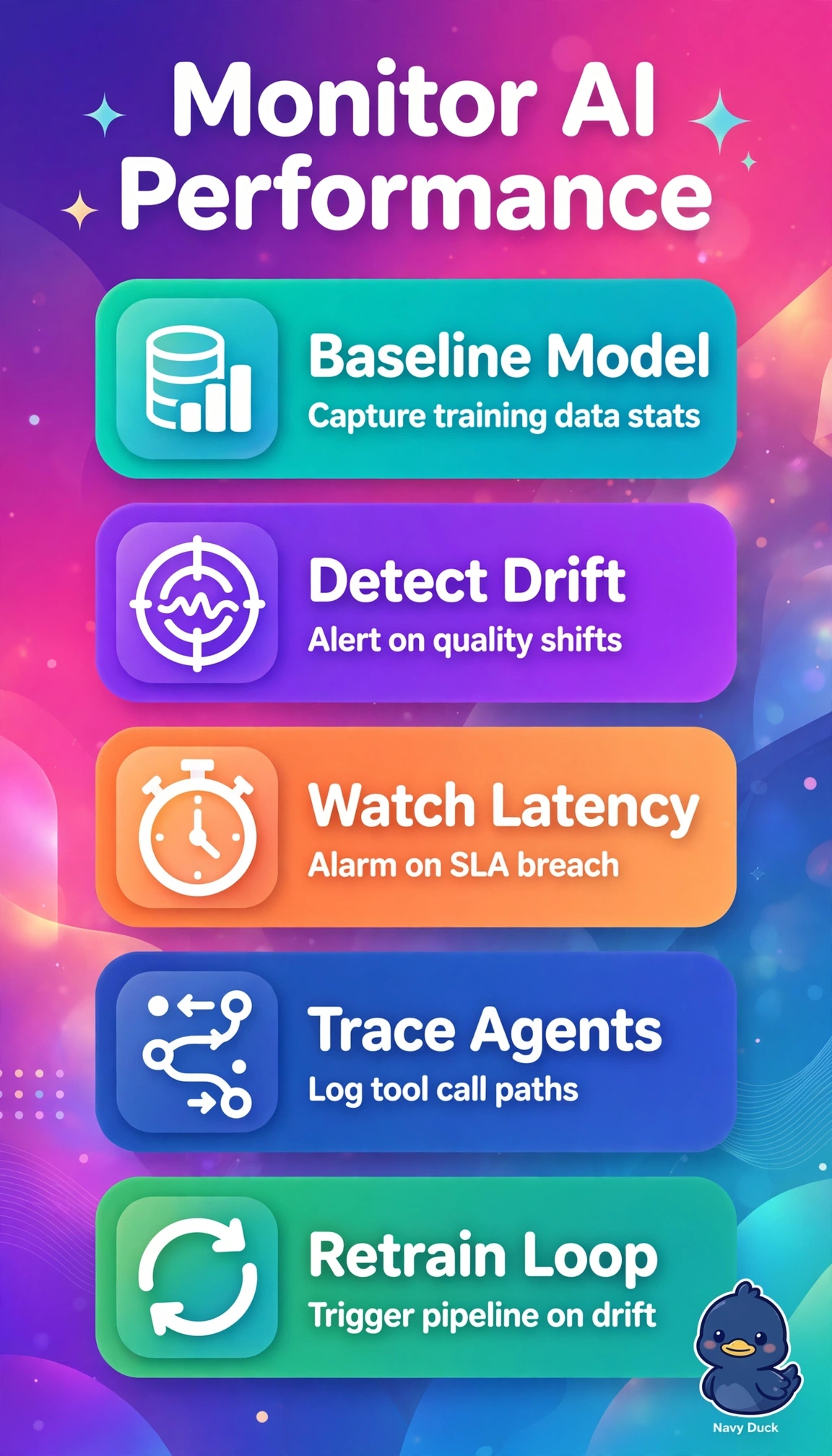
The correct design is complete because SageMaker Model Monitor compares live endpoint data to the training baseline across nightly retrains to expose data drift and quality decline behind mis-scores, CloudWatch alarms enforce the 50ms SLA in real time, and Bedrock agent tracing to CloudWatch Logs Insights isolates slow tool calls and execution paths. One incomplete design pairs Model Monitor and latency alarms with nightly Batch Transform validation jobs, which validates retraining well but provides no agent invocation tracing and cannot diagnose slow Bedrock tool behavior. Another design uses CloudWatch SLO monitoring with agent tracing and SageMaker Clarify checks, which covers latency and agent observability plus bias review, yet Clarify measures fairness rather than statistical drift and ongoing prediction quality, leaving drift undetected. A further design enables Model Monitor for drift with latency alarms and agent tracing, which captures drift, latency and agent signals but omits ground-truth quality monitoring and cannot confirm scoring accuracy. For exams, distinguish drift monitoring from bias explanation and latency tracking. As a practical check, verify monitor schedules, sub-50ms alarm thresholds, and Logs Insights queries by trace ID and tool duration.