
An e-commerce team must validate that losing one Availability Zone does not drop checkout success below 99.9%, needs a controlled blast radius with automatic rollback if latency spikes, and wants reusable hypotheses comparing steady-state metrics before and after faults. Which resilience validation approach proves AZ tolerance safely?
Select an answer to reveal the explanation.
Short Explanation
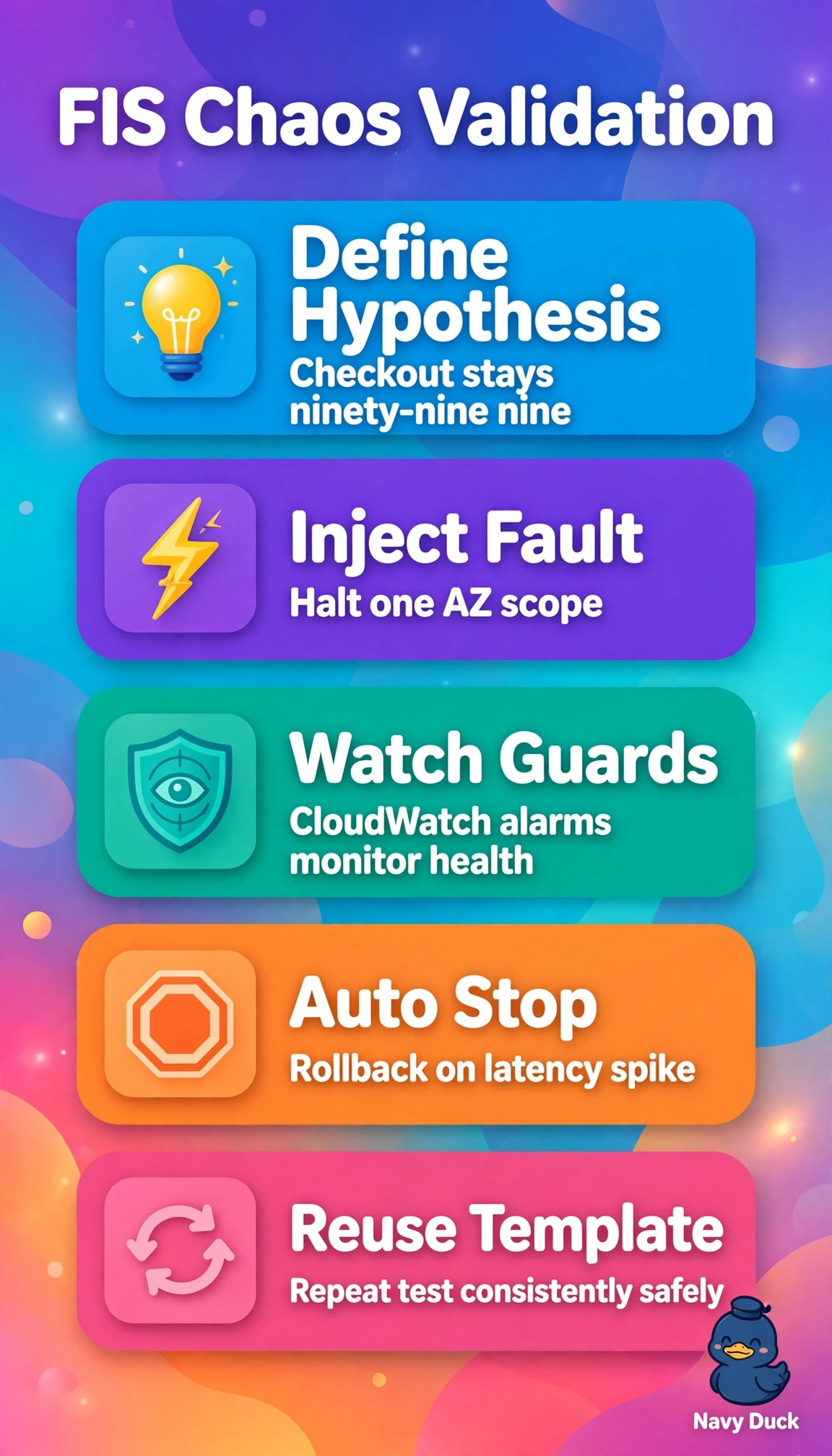
Guessing about AZ failure isn't enough for checkout. Fault Injection Service lets you rehearse the outage with guardrails that stop the test if shoppers suffer.
Full Explanation
Fault Injection Service provides parameterized experiment templates with steady-state hypothesis checks, precise blast-radius controls such as AZ-scoped faults, and stop conditions tied to CloudWatch alarms for checkout success and latency that trigger automatic rollback, making results repeatable and safe. Manual GameDays lack guardrails, repeatability, and automated rollback, increasing risk to production checkout. Route 53 failover with load balancer health checks improves real failover capability but does not inject controlled faults or measure hypotheses, so it cannot prove the resiliency target. Resilience Hub assesses architecture against best practices and Chaos Toolkit can run scripts, but neither delivers AWS-managed controlled AZ fault injection with integrated steady-state validation. For the exam, link controlled failure plus hypothesis plus stop conditions to FIS, and confirm IAM experiment roles and CloudWatch alarms are configured before running in production.