
A manufacturing firm must exit its on-premises data center in 12 weeks and move 200 VMware virtual machines to AWS without refactoring applications or changing IP dependencies. Continuous replication with minimal cutover downtime is required. Which rehosting migration strategy achieves rapid lift-and-shift with minimal downtime?
Select an answer to reveal the explanation.
Short Explanation
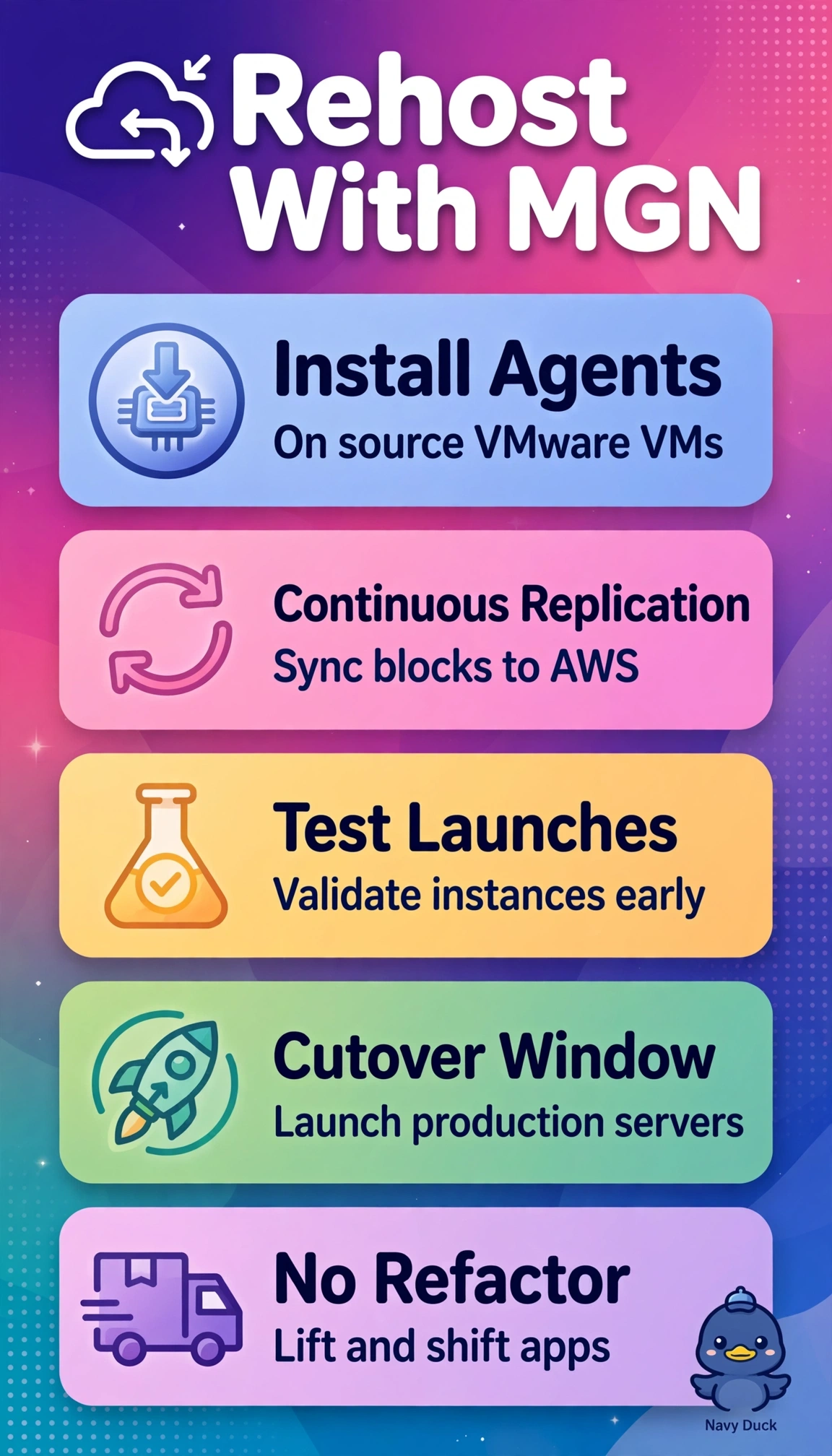
You've got a ticking clock and can't touch code, so rehosting with block-level replication is perfect. It mirrors machines continuously then flips over in minutes.
Full Explanation
AWS Application Migration Service (MGN) performs agent-based block-level continuous replication of source servers to AWS, supports testing and cutover launches with rightsizing and post-launch templates, and preserves lift-and-shift without refactoring, meeting the timeline and downtime goals. AWS Database Migration Service replicates databases and supports heterogeneous migrations but does not lift entire VM operating systems and applications, so it cannot rehost the 200 machines. AWS DataSync accelerates file and object transfers and can sync shares but does not perform server-state replication, OS conversion, or automated EC2 launch orchestration for rehost. Server Migration Service and legacy VM Import approaches are deprecated or manual export-based and lack continuous replication and orchestrated cutover at this scale. For the exam, choose Application Migration Service (MGN) for rehost, DMS for database moves, and DataSync for file shares. In practice validate network bandwidth, test launches early, and automate cutover runbooks.