
An e-commerce platform sees HTTPS bursts for checkout via browsers and persistent MQTT connections from 200k IoT price tags needing low-latency passthrough. Cost must scale per pattern. Which ingress pattern using load balancers and API Gateway optimizes resources for each usage pattern?
Select an answer to reveal the explanation.
Short Explanation
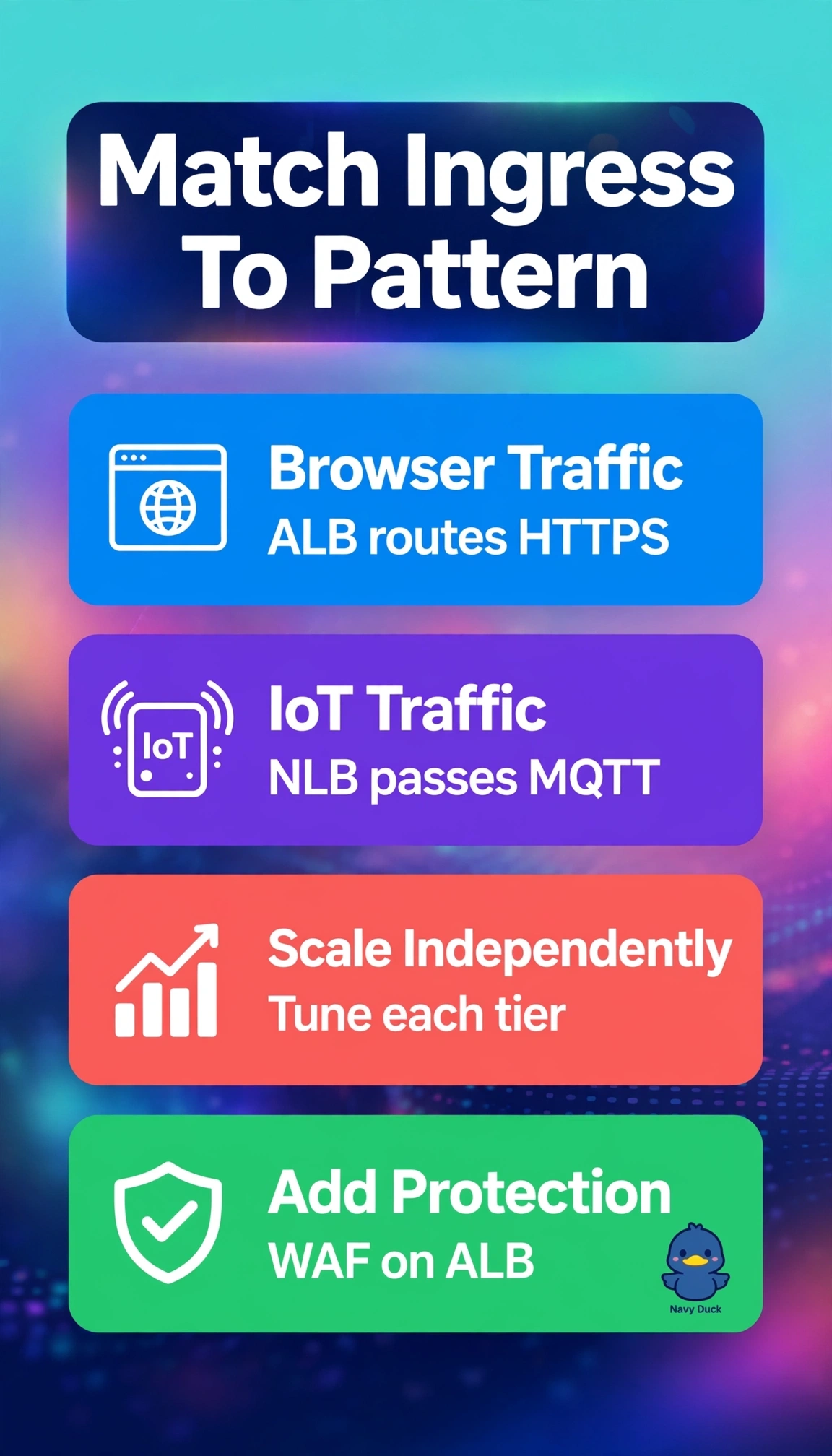
You're matching the doorman to the crowd. ALB speaks fluent HTTP for browsers while NLB handles millions of raw sockets, and segmentation saves money and latency.
Full Explanation
Ingress optimization matches protocol needs to load balancer capabilities, with Application Load Balancer providing Layer 7 routing, header and path rules, and WAF integration ideal for HTTPS browser checkout, while Network Load Balancer provides ultra-high-throughput Layer 4 TLS passthrough ideal for many persistent MQTT TCP connections with low latency. Reversing them fails because ALB does not natively terminate MQTT TCP streams and NLB cannot do content-based HTTP routing efficiently. API Gateway WebSocket APIs suit bidirectional messaging but add unnecessary cost and complexity for standard HTTPS checkout and do not natively handle MQTT, while ALB cannot ingest MQTT. A single Gateway Load Balancer is for transparent third-party appliance insertion, not for HTTP routing or high-scale IoT ingestion, and would bottleneck both patterns. For the exam, map ALB to HTTP, NLB to TCP/UDP scale, and API Gateway to managed APIs, and in practice verify with AWS Load Balancer Controller target types and connection idle settings.