
A 12-person retail team runs 25 microservices with spiky checkout traffic, has no Kubernetes expertise, and must deploy quickly across AZs without managing EC2 nodes. Uptime and simplified operations matter more than pod-level control. Which container orchestration approach for microservices should the architect choose?
Select an answer to reveal the explanation.
Short Explanation
You need a kitchen that cooks without you fixing the ovens. ECS on Fargate is like catering — you bring recipes, AWS handles stoves and space.
Full Explanation
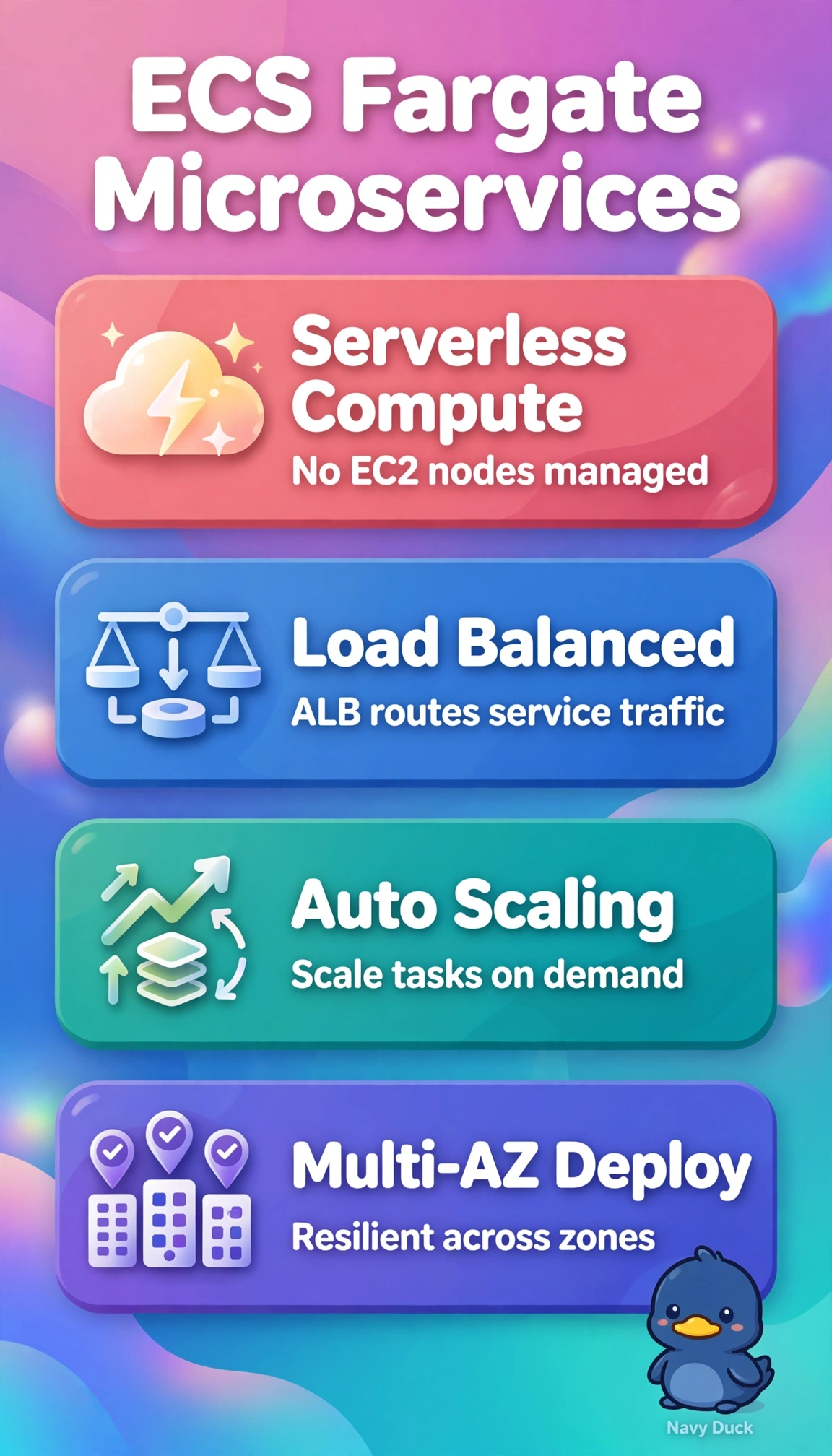
The correct approach fits because Amazon ECS on AWS Fargate is serverless container orchestration that removes EC2 provisioning, patching and capacity planning while spreading tasks across multiple Availability Zones behind an Application Load Balancer, and Service Auto Scaling with target tracking on CPU or request count absorbs spiky checkout traffic without Kubernetes knowledge, which directly matches simplified operations prioritized over pod-level control. The ECS on EC2 launch type with Auto Scaling groups behind a load balancer is a proven production pattern for cost optimization and specialized networking needs, but by concept it reintroduces node management, AMI patching and capacity planning that violates the explicit requirement to avoid managing EC2 nodes. The EKS on Fargate pattern with Ingress and Kubernetes autoscaling is widely used for portability and fine-grained pod control, but by concept it requires manifests, controllers and cluster lifecycle skills that contradict the stated lack of Kubernetes expertise and preference for simplicity. The Fargate deployment with fixed task counts behind a load balancer offers simplicity and multi-AZ placement, but by concept a static desired count cannot respond to peaks, causing overprovisioning or checkout failures during spikes and undermining uptime. As an exam caveat, phrases like without managing nodes and no Kubernetes expertise are decisive filters, so do not select EKS even when Fargate removes nodes and do not select ECS on EC2 even when Auto Scaling is present. As a practical check, confirm Fargate tasks in at least two subnets across AZs, enable Service Auto Scaling on ALB RequestCountPerTarget, and validate execution roles, CloudWatch alarms and deployment circuit breaker before load testing checkout.