
A global travel booking platform runs on Amazon Aurora PostgreSQL in eu-west-1 with heavy read traffic in us-east-1 and ap-southeast-2. The business requires regional reads under 50 ms, RPO of about a second, and managed cross-Region failover within a few minutes. Which database scaling solution provides high availability with fast global failover?
Select an answer to reveal the explanation.
Short Explanation
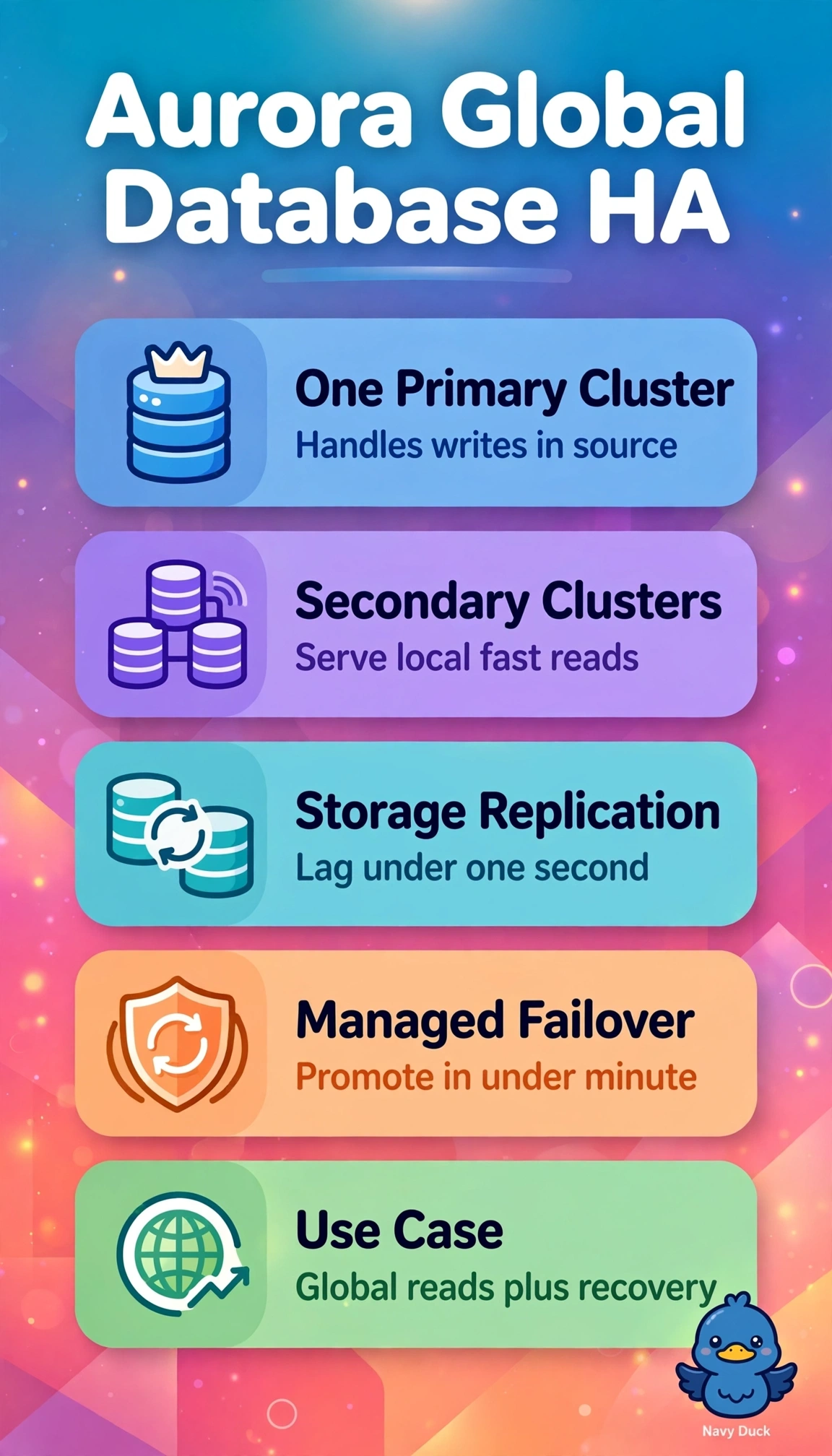
You’ve got worldwide readers and seconds matter, so global-database replication is your friend. It keeps secondaries lagging by about a second and lets you promote one quickly when trouble hits.
Full Explanation
Aurora Global Database is correct because storage-layer replication from the primary in eu-west-1 to secondary clusters in us-east-1 and ap-southeast-2 typically keeps lag to about a second, supporting the RPO target, and each secondary Region has local reader endpoints for the 50 ms read requirement. For a Regional outage you run a managed failover (FailoverGlobalCluster), which promotes a secondary cluster typically within a few minutes and can be scripted or triggered by your own automation; planned switchovers are typically under 30 seconds with no data loss. Because replication is asynchronous, an unplanned failover can lose the last unreplicated transactions, so you monitor lag and, on Aurora PostgreSQL, can set rds.global_db_rpo. Aurora PostgreSQL cross-Region read replicas fail on failover concept because they offer higher, more variable lag, are promoted by hand with endpoint updates, and give no managed global topology. A Multi-AZ cluster with readable standbys fails on scope concept because its synchronous replication and automatic failover operate only within eu-west-1 Availability Zones, giving zonal durability but no local endpoints in the other Regions and no regional disaster recovery. Migrating to DynamoDB global tables fails on engine-fit concept because the NoSQL key-value model would force rewriting PostgreSQL joins, queries and transactions instead of scaling Aurora. For the exam, do not confuse single-Region high availability with cross-Region disaster recovery. In practice verify AuroraGlobalDBRPOLag in CloudWatch, confirm secondary reader endpoints, and test a switchover and a failover drill to measure RTO and endpoint behavior.