
A healthcare SaaS stores PHI in S3 and EBS for 200 clinics and must enforce customer managed keys per tenant, with annual rotation without re-encrypting data and centralized audit of key use. Which encryption-at-rest design with automatic rotation satisfies the tenant isolation requirement?
Select an answer to reveal the explanation.
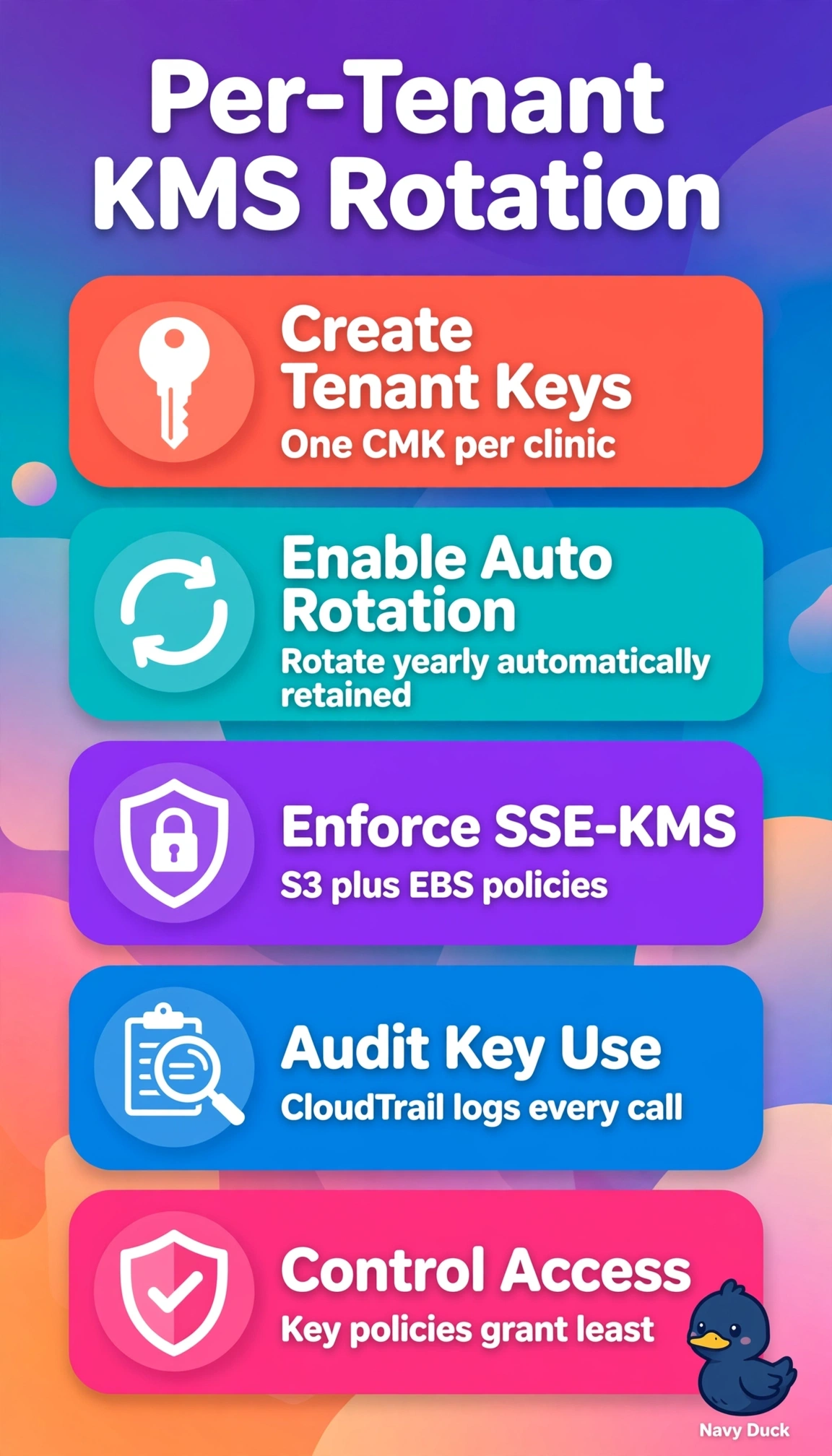
Short Explanation
You can give each clinic its own house key and let the lock change keys automatically. Per-tenant customer managed keys provide independent control and annual rotation without re-encrypting stored data.
Full Explanation
Per-tenant AWS KMS customer managed keys provide a distinct key and independent lifecycle and revocation for each clinic’s PHI. Native automatic rotation preserves prior key versions, so S3 objects and EBS volumes remain decryptable without re-encrypting data. Key policies can limit each key to its tenant; bucket policies requiring SSE-KMS and EBS encryption using the tenant’s key enforce its use, while CloudTrail records Decrypt and GenerateDataKey activity for centralized audit. An organization-wide key with tenant-specific aliases fails the isolation requirement: aliases point to the same key, so ABAC and prefixes may separate authorization, but compromise, revocation, or rotation affects all tenants rather than giving each one a distinct key. Per-tenant keys audited through CloudWatch metrics fail the audit requirement because metrics summarize volume and throttling but lack authenticated identity, request parameters, and immutable history; centralized CloudTrail records who used which key and when. Per-tenant keys with annually imported material fail the automatic-rotation requirement because externally supplied material does not support automatic rotation and requires scheduled manual re-import, increasing the burden across 200 tenants and risking expiration or outage. Exam caveat: aliases do not create distinct per-tenant keys, even when paired with ABAC. Practical check: verify each tenant maps to a unique CMK ARN with rotation enabled, confirm unencrypted S3 puts and EBS volumes are denied, and query the centralized log store for key ID and principal.