
A fitness app streams 40,000 wearable events per minute with bursts during races. Product wants SQL queries over raw and curated data, automatic schema discovery, and no cluster tuning during spikes. Which serverless pipeline best delivers this analysis?
Select an answer to reveal the explanation.
Short Explanation
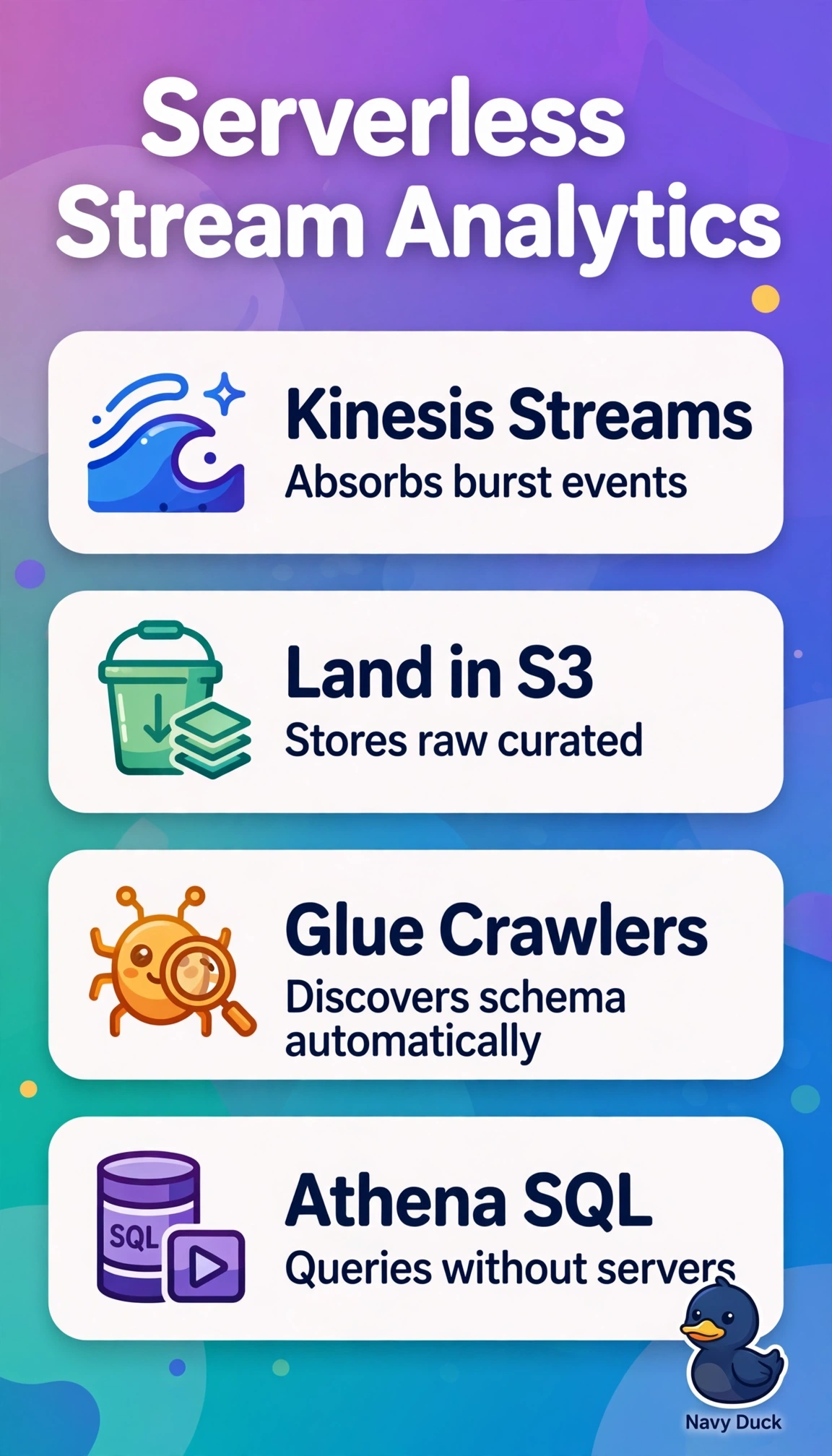
Want race-day spikes without pager duty? You get serverless SQL here: Kinesis absorbs bursts, while Glue crawlers discover schemas and Athena runs queries without cluster tuning.
Full Explanation
Kinesis Data Streams ingests tens of thousands of events per minute and absorbs race-day bursts through sharded throughput; it can also support multiple consumers writing raw and curated data to S3. Glue crawlers automatically infer evolving wearable schemas and register tables in the Data Catalog, avoiding manual schema updates. Athena then provides serverless SQL over both S3 data sets, scaling independently and charging per query, so there is no cluster to tune during spikes. Managing schemas with versioned DDL instead of crawlers misses the automatic-discovery requirement: engineers must update table definitions as devices add fields, slowing raw-data exploration. Querying in a Redshift cluster misses the no-tuning requirement because a provisioned warehouse needs capacity sizing, distribution and sort-key design, maintenance, and concurrency management as loads change. Processing with Lambda functions provides event-by-event compute and ETL, not interactive SQL queries over large S3 datasets. For exams, treat automatic schema discovery, serverless operation, and SQL over raw data as cues for crawlers plus Athena rather than manual DDL, a provisioned warehouse, or code-based processing. As a practical check, test S3 partitioning by event time, crawler schedule and classifier confidence, and Athena workgroup query limits under burst conditions before race day.