
A regional bank must prove quarterly that its payment platform meets RTO and RPO, document gaps, and provide operators with one-click recovery steps for database failover and DNS switchover during audits. Which disaster recovery assessment and recovery procedure combination satisfies testing and execution?
Select an answer to reveal the explanation.
Short Explanation
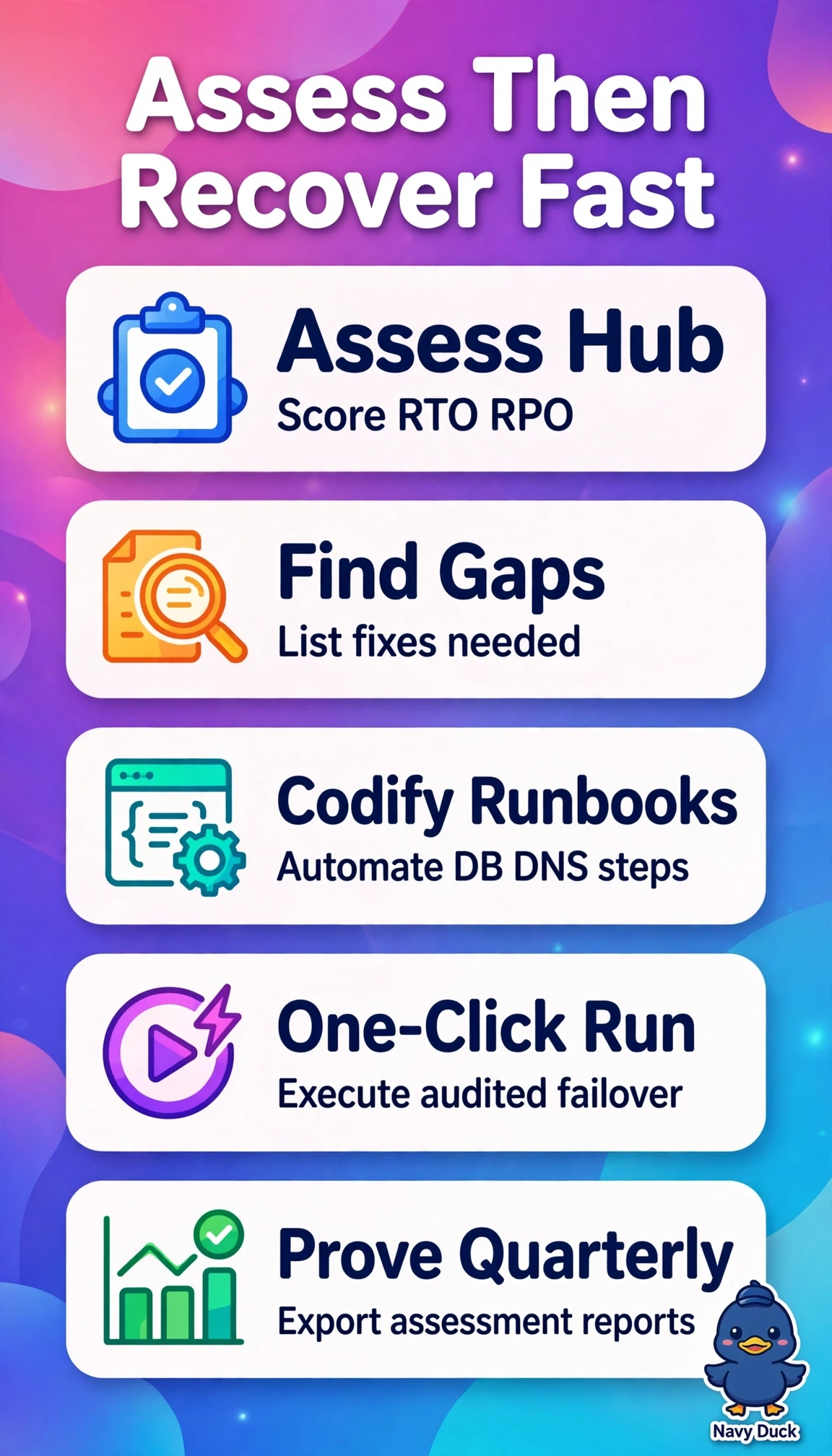
Auditors love proof plus a big red button that actually works. Resilience Hub grades your readiness, then runbooks turn recovery into repeatable clicks.
Full Explanation
The correct approach works because Resilience Hub continuously assesses workloads against RTO and RPO policies, identifies resiliency gaps, and tracks improvement, while Systems Manager runbooks codify database failover and DNS switchover into auditable one-click automations with approvals and logging. CloudWatch SLO with Beanstalk swaps fails by concept because SLO dashboards monitor availability without policy-based resiliency scoring, and Beanstalk swaps redeploy application environments rather than orchestrating data-tier failover. Fault Injection with drift detection fails by concept because fault injection tests failure modes but does not produce RTO and RPO compliance assessments, and drift detection reports template changes rather than executing recovery. Audit Manager with Inspector fails by concept because Audit Manager collects compliance evidence without resiliency scoring, and Inspector finds vulnerabilities rather than orchestrating failover workflows. Exam caveat: pair assessment services with execution automation for complete DR governance. Practical check: schedule quarterly Resilience Hub assessments and run game days executing the runbooks in an isolated recovery environment.