
An e-commerce company stores 80 TB of clickstream JSON in S3, needs SQL analytics with schema evolution, fine-grained access by marketing team, and Redshift joins without duplicating data. Query patterns are ad hoc and bursty. Which data lake design supports governed schema-evolving analytics with zero-copy warehouse joins?
Select an answer to reveal the explanation.
Short Explanation
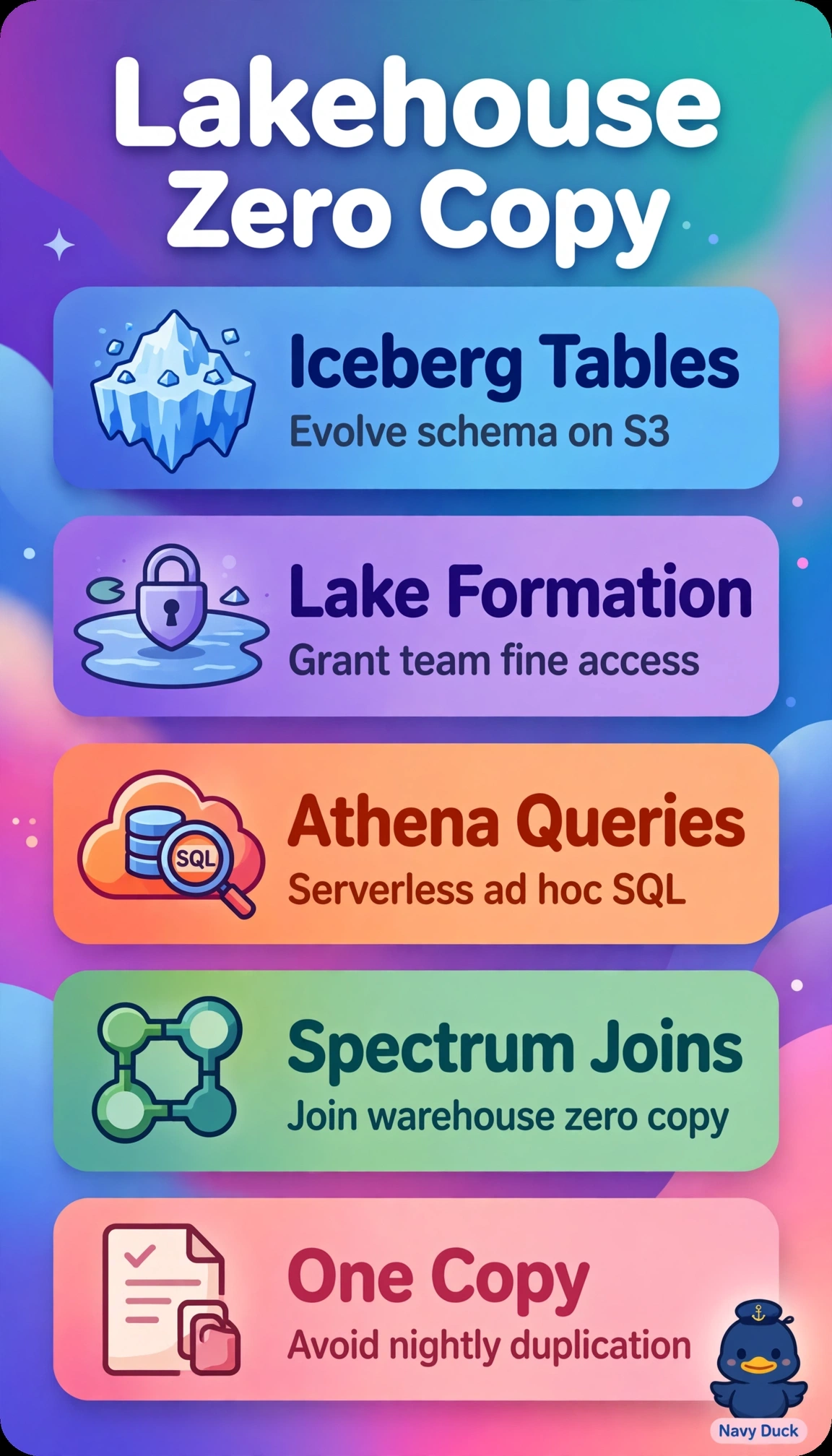
You don't need to haul 80 TB into Redshift like lugging boxes to a new house. You'll keep one evolving Iceberg table on S3 that Athena and Spectrum query in place while Lake Formation guards your marketing data.
Full Explanation
Apache Iceberg on S3 provides an open lakehouse table format with snapshot isolation, schema and partition evolution, and time travel for JSON clickstream, AWS Lake Formation provides centralized LF-Tags and column-level permissions for marketing teams, and Redshift Spectrum plus Athena query Iceberg in place enabling joins to warehouse dimensions without ingestion duplication for bursty ad hoc use. Nightly COPY into Redshift duplicates 80 TB, incurs load cost and staleness, and loses Iceberg evolution. A provisioned warehouse with S3 federation centralizes compute rather than scaling serverless for bursty queries and lacks lakehouse versioning. DynamoDB is a key-value store unsuited to 80 TB analytical scans and S3 export plus COPY reintroduces duplication and poor schema evolution. Exam caveat is Spectrum and Athena query governed Iceberg tables directly while Lake Formation enforces access, and practical check is to verify Iceberg table properties, LF permissions per team, and Spectrum IAM role access to the S3 prefix.