
A global media startup serves Bedrock-powered video summarization from us-east-1, but European users cause costly cross-Region inference traffic and latency spikes during peak hours. The models are available in eu-west-1 and data residency allows EU processing. Which routing strategy optimizes data transfer costs for AI/ML workloads while preserving performance?
Select an answer to reveal the explanation.
Short Explanation
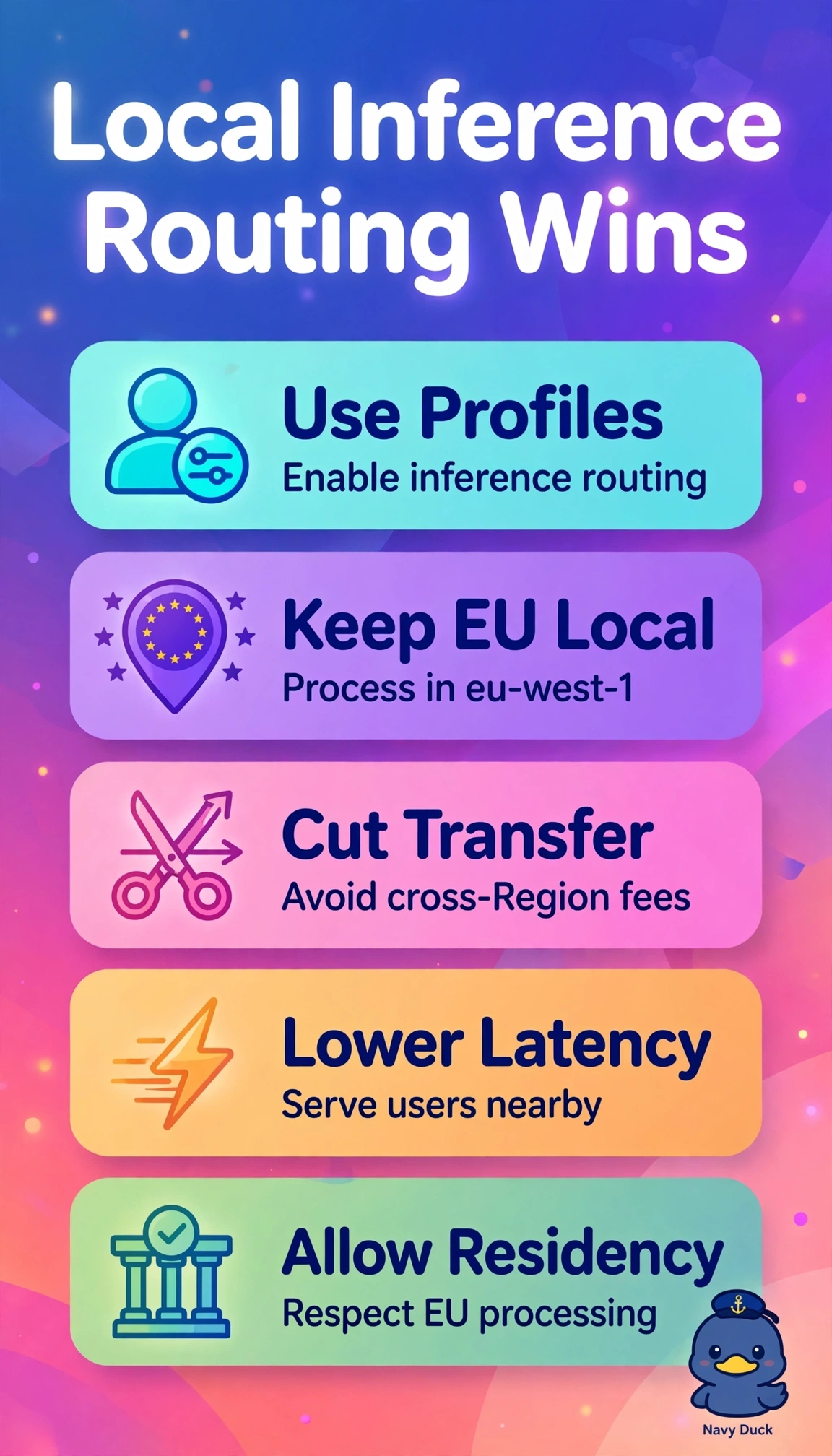
You've got EU users paying an ocean-crossing toll on every summary, when your models are already available in the EU. You'll trim transfer costs and latency by serving them from an EU Regional endpoint and an EU inference profile for bursts.
Full Explanation
The correct strategy succeeds because it moves inference next to the EU users: the application calls Bedrock in eu-west-1, so prompts and video context no longer cross the Atlantic to us-east-1, which removes the recurring inter-Region transfer and latency penalty. An EU geographic cross-Region inference profile adds managed burst capacity by routing only among EU Regions, with no routing surcharge and billing at the source Region rate, which keeps processing inside the allowed EU residency boundary without custom endpoint operations. The CloudFront edge caching approach fails on workload locality since video summarization requests are largely unique and uncacheable, so first-pass inference still incurs full transfer cost and latency. The throughput reservation approach fails on economic fit since Provisioned Throughput in eu-west-1 does localize compute and protect peak performance but imposes high fixed commitment cost for spiky media traffic, contradicting the requirement to optimize total cost. The Lambda preprocessing approach fails on inference locality since compressing payloads reduces upload size yet still sends requests to the centralized us-east-1 summarization path, leaving the costly cross-Region inference and latency unresolved. For exams, do not confuse smaller payloads or reserved capacity with moving inference into the user's geography. As a practical check, confirm the model is supported in eu-west-1 (in-Region or via the EU profile), then compare transfer cost and InvokeModel p95 latency before and after.